Why we created the Board
Accessibility decisions should be informed by the people who understand digital barriers firsthand.
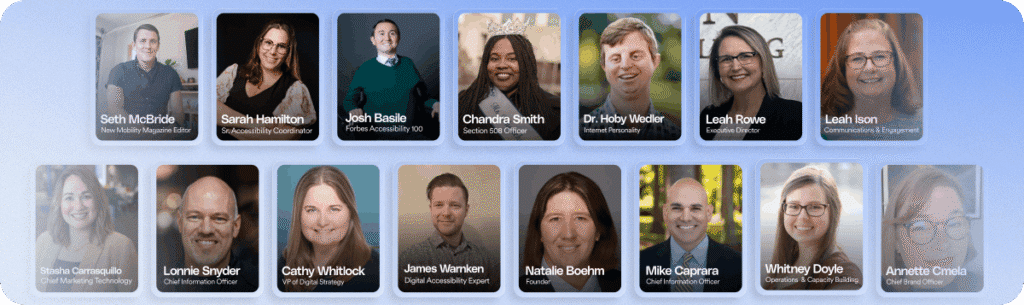
The Inclusive Product Advisory Board brings together disability advocates, assistive technology users, and accessibility professionals to review product experiences, challenge assumptions, and provide feedback while decisions are still being made.
Members meet quarterly as a group and continue working with accessiBe teams between sessions, helping inform product language, UX decisions, accessibility profiles, research, and release readiness.
The category exists because of scale. There are more than 1.5 billion websites on the internet. Manually reviewing each one for WCAG conformance is not economically viable for most organizations — and even where it is, content changes fast enough that a site audited in January may have introduced new barriers by March.
Who participates
Board members include disability community leaders, advocates, accessibility professionals, and people who use assistive technologies in their daily lives.
Members have included people connected to organizations such as The Viscardi Center, United Spinal Association, Parkinson’s Foundation, Hidden Disabilities, Blinded Veterans Association, and Turnstone.
Board sessions are moderated by Josh Basile, accessiBe’s Community Relations Manager, disability rights advocate, lawyer, and C4-5 quadriplegic.
Board members help accessiBe evaluate product and content decisions from a real-world accessibility perspective.
They test product experiences, review accessibility profile language, score flows for clarity and usefulness, flag language that may feel inaccurate or limiting, and contribute to research and storytelling initiatives.
The goal is not to treat advisory feedback as a final approval stamp. It is to bring lived experience into the product process early enough to influence what gets built, changed, or clarified.
During the Board’s first year, member feedback helped shape updates to accessWidget, especially around how accessibility settings are named, explained, and presented.
Examples include:
- Person-first and function-first language
- Clearer profile naming, such as “Low Vision” instead of “Vision Impaired”
- More useful descriptions focused on what a setting helps users do
- More accurate claims, replacing absolute language like “eliminates” with “helps mitigate”
These updates reflect a larger shift: accessibility language should be accurate, respectful, and useful to the people who rely on it.
The Inclusive Product Advisory Board is one part of accessiBe’s broader approach to product feedback and validation.
Alongside the Board, accessLabs is a testing hub where blind usability analysts test releases using real assistive technologies. Their work helps surface issues automated testing alone may not detect.
Together, the Board and accessLabs help accessiBe evaluate accessibility from multiple angles: lived experience, usability testing, product language, and release quality.