For years, compliance was what defined the industry we operate in.
That made sense; businesses needed a viable path to meet legal requirements and the market responded. For most of the industry’s early history, the question being asked was: What does the law require, and how do we get there?
That framing served a real purpose.
But it consistently took priority over a more fundamental question:
Are these efforts truly resulting in optimal experiences for all users?
That question deserved more attention — not just as a matter of principle, but as a business consideration.
An accessible website is a more usable website, for everyone. Better navigation helps keyboard users — and reduces bounce; more descriptive alt text helps screen reader users — and improves SEO; sufficient contrast helps people with low vision — and helps everyone reading in sunlight. Accessibility and usability are, in practice, the same investment.
The businesses that have started asking this question aren’t just doing the right thing. They’re building something that works better, for more people, and seeing the results.
Automation: the promise and the limits
Up until the late 2010s, web accessibility was essentially a manual, resource-intensive process — the kind that required dedicated teams and enterprise-level budgets to execute. This effectively confined it to a small segment of the market, leaving the vast majority of businesses without a realistic path to making their digital products accessible.
The introduction of automated solutions changed that.
Companies like accessiBe brought accessibility within reach for businesses that had never been part of the conversation — closing real gaps, at scale, for a market that had effectively been locked out.
For a time, automation was widely regarded as the solution — a genuine breakthrough that had finally made accessibility achievable at scale. And in many respects, it was. But as the industry matured, a clearer picture emerged: Exclusive reliance on automation wasn’t delivering the level of accessibility that end users actually needed.
The technology had expanded the market significantly, but it had its ceiling. That understanding has become an industry-wide one. When accessiBe settled with the FTC in 2025, it was in many ways a reflection of where the broader conversation had already arrived — that automation is a critical part of delivering accessibility at scale, but it works best as one component of a more complete approach.
accessiBe 2.0: combining AI with the best in human expertise and dev tools
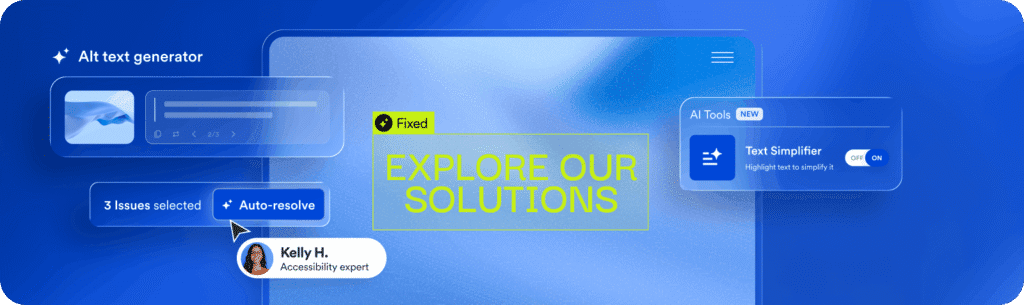
accessiBe 2.0 is built around a single objective: ensuring that every user, regardless of ability, can access and navigate the digital products companies are building. It combines our patented AI with human expertise and developer tools to make that possible, at any scale.
We can say that with confidence. The Inclusive Product Advisory Board — made up of disability-focused nonprofits — actively tests our products, surfaces what isn’t working, and drives what we build and improve next. The result is a comprehensive, end-to-end platform built to support the unique and complex accessibility needs of modern organizations; one that closes accessibility gaps at the source and provides ongoing remediation as products develop and expand.
Serving both business and user
Compliance matters. But it was always meant to serve a more fundamental goal — ensuring that people with disabilities can actually use the products companies are building. And while legal requirements exist as important frameworks, meeting them doesn’t automatically translate into the best possible experience for the people they’re designed to protect.
With our platform, our customers never have to settle for meeting the minimum – applying automation at scale, and drawing on human expertise and developer tools where the work demands it.