
In short
Agencies are splitting into two camps—going deeper on specialization or wider on service range— The split isn’t even across borders: Canada’s agency market is shifting faster and absorbing more economic pressure from AI than the US market is. Accessibility is already emerging as one way agencies are trying to differentiate from AI and DIY tools, though only 38% treat it as mandatory on every project, meaning most agencies naming it as a strength haven’t built it into a specialty yet.
Running a competitive agency today means keeping pace with forces moving faster than they were just two years ago:
92% of agencies now use AI tools in their own work, and 87% work across two or more CMS platforms in parallel, with 30.5% delivering a headless or composable build in the past 12 months alone. Agencies are also narrowing to compete: 51% report becoming more specialized in that same window.
Layered on top of all of it is a legal environment that keeps tightening — with digital accessibility lawsuits on pace to top 6,000 in 2026, a new record.
These shifts are covered in detail in this research, based on a survey of 308 web, marketing, and IT agencies across the US and Canada — so you can walk away with a clearer picture of how your agency is positioned.
This report, the first in the series, looks at what’s actually shifting in the agency market right now and what’s driving it. The rest of the series goes further, covering where legal exposure genuinely sits and where client demand for AI search visibility is outpacing what agencies currently sell.
About the research
This report is based on accessiBe’s survey of 308 web design, marketing, and IT agencies across the US and Canada, fielded August 21–27, 2026, evenly split between the two countries. Respondents span Custom Software & IT Services (40%), Advertising & Marketing (38%), and Web Design/Development (23%) firms, most with 11–50 employees. 45% are agency owners or founders, with the remainder split across creative, technical, and executive leadership roles. We fielded this research to understand how agencies are actually responding to AI, where they’re placing their bets, and where accessibility fits into those decisions.
The market agencies are actually operating in
In 2026, headless and composable architecture is increasingly treated as standard infrastructure, not a specialized option. Clients now expect their content to reach apps, personalization systems, and multiple channels—not just a single website—and that shift is driving agencies toward parallel systems instead of one platform.
87% of agencies now work across two or more CMS platforms in parallel. Only 2% build without any.
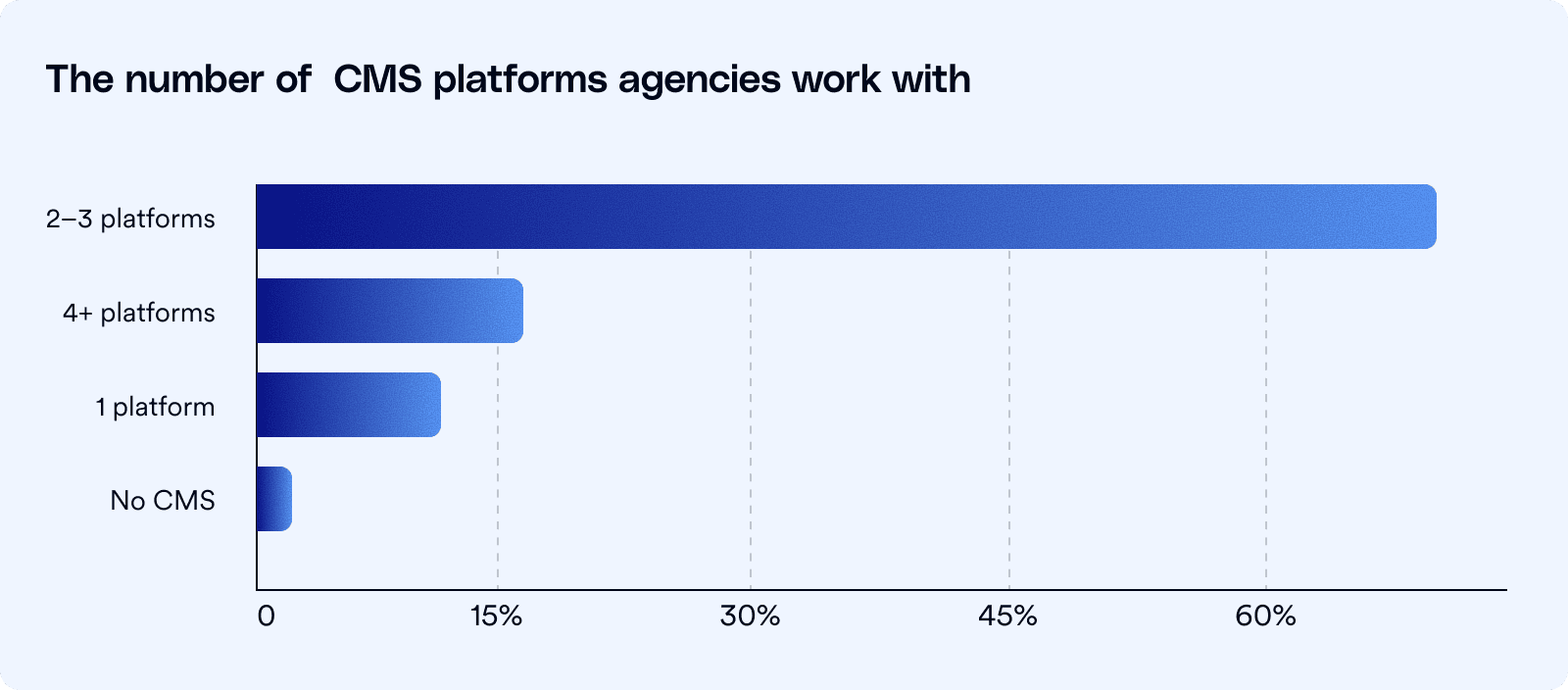
That same shift shows up in what agencies are actually building. 30.5% delivered a headless or composable build in the past 12 months. 27% delivered a no-code project in the same period.
30.5%
of agencies delivered a headless or composable build in the past 12 months, and 27% delivered a no-code project in the same period.
Source: accessiBe Wave 4 research, full sample
Specializing or spreading out: how agencies are responding
Faced with the pressures described above, agencies are responding in two opposite directions.
The overall split
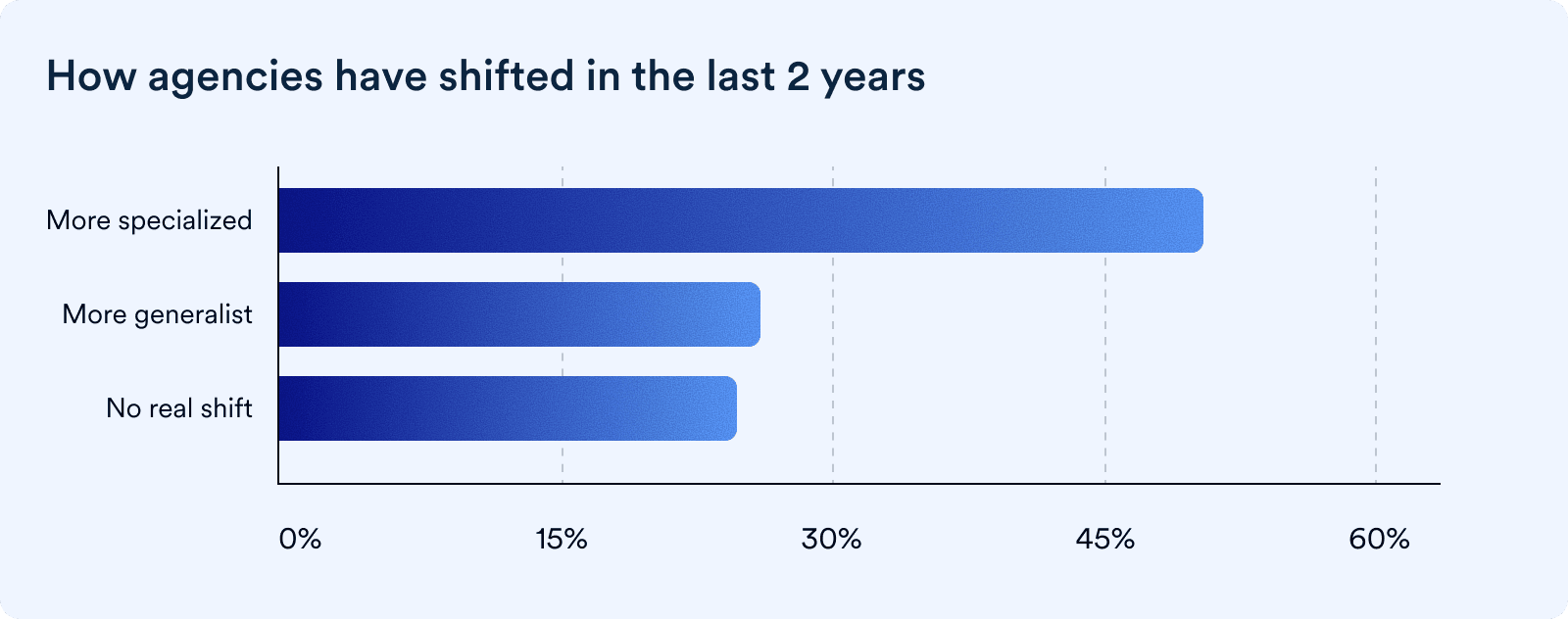
51% of agencies have become more specialized over the past two years. 24% have moved the other way, taking on a wider range of work. The remainder report no significant shift either way.
Why agencies are specializing
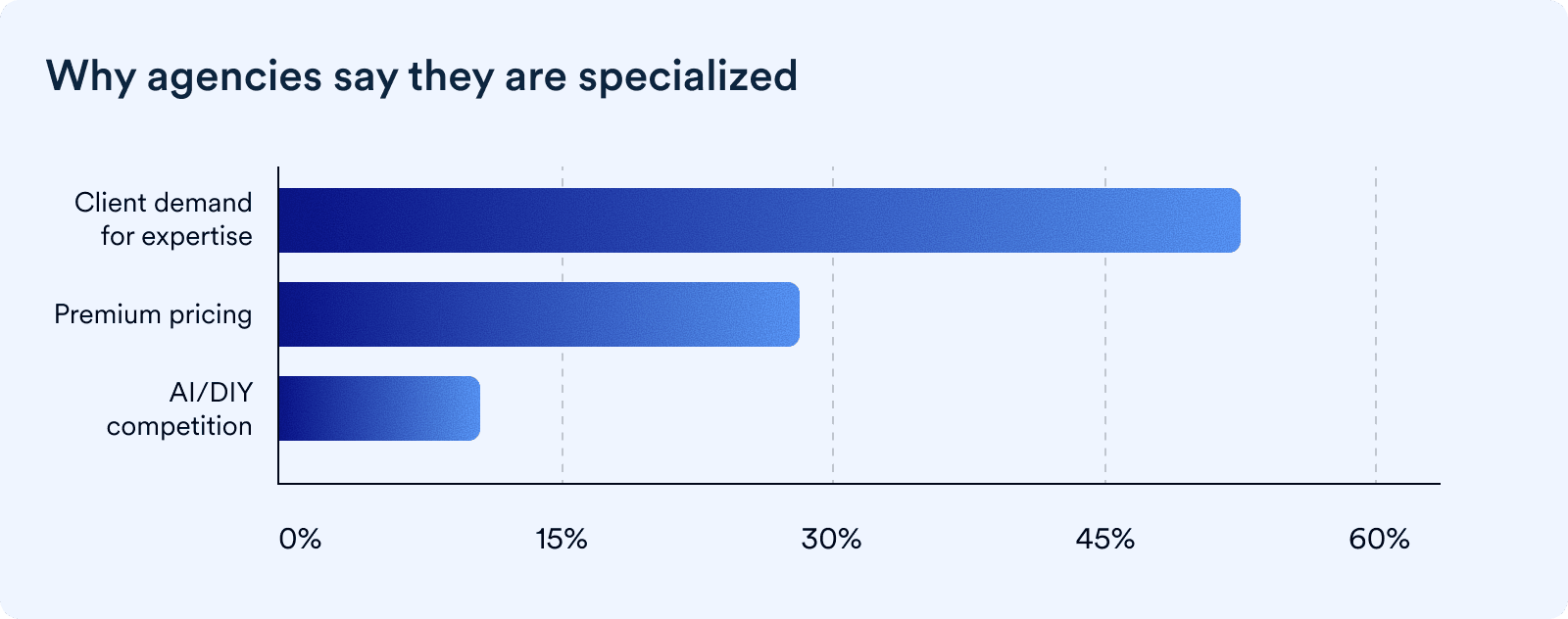
The reasons agencies give for each move suggest they’re responding to different pressures, not just reacting to the same one differently. 54% of specialists point to client demand for deeper expertise. 28% cite the ability to charge premium pricing. A smaller group, 11%, specifically cite competing with AI and DIY tools as unsustainable without a narrower focus.
Why agencies are generalizing
Agencies that broadened their range describe something closer to the opposite effect: 25% say AI lets them take on work outside their original focus — work they may not have had the capacity or expertise for otherwise.
25%
of agencies that became more generalist say AI lets them take on work outside their original focus.
Source: accessiBe Wave 4 research, agencies that generalized
Specialists aren't stepping away from AI
Some agencies say competing with AI and DIY tools is exactly why they specialized in the first place.
40.5%
of agencies that have shifted toward specialization use AI tools regularly — the heaviest use of any group in the survey.
Source: accessiBe Wave 4 research, full sample
Why this matters
The split doesn’t reduce to “AI pushed some agencies together and others apart.” AI is functioning as a rationale on both sides of a decision agencies may have already been leaning toward:
- Leaning into a niche doesn’t require walking away from AI tools.
- Broadening scope doesn’t require abandoning specialization elsewhere in the business.
Two markets, two different paces of change
The specialist/generalist split isn’t happening at the same rate in both countries. Broken down by market, the US and Canada look like two different stories.
The US market is moving too, just more slowly
31.2% of US agencies report no shift in their specialist/generalist positioning over the past two years — the largest share of any group to say things have stayed the same, though nearly 69% report moving in one direction or the other.
Canada’s market is still moving
Canadian agencies tell a different story. Only 18.8% report no real shift, and Canadian agencies are more than twice as likely as their US counterparts to have moved toward generalist work (32.5% vs. 14.9%).
Shifted toward generalist work
14.9% US
32.5% Canada
The AI pressure is landing harder in Canada, too
The same divide shows up in how AI is affecting agencies economically. Canadian agencies report reducing headcount due to AI at nearly one and a half times the US rate, and they also report client requests for reduced rates due to AI more often (28.8% vs. 20.7%).
Reduced headcount due to AI
15.9% US
24.5% Canada
Heavier AI use doesn't come with more worry — it comes with less
Adopting AI and worrying about what it might get wrong don’t move together the way you’d expect. Agencies that never use AI tools worry the most about AI creating an error that goes unnoticed, rating their concern 3.78 out of 5. Agencies that use AI regularly worry less (3.15) — and occasional users worry least of all (3.07). The same pattern shows up in how agencies rate AI’s compliance risk.
Worry does track with what’s actually happened
That doesn’t mean worry is entirely disconnected from reality. Agencies that have already reduced headcount because of AI report meaningfully higher worry — 3.42 out of 5 — than agencies that haven’t, at 2.97. The gap isn’t that experience with AI erases concern. It’s that regular use builds a kind of comfort that lower risk doesn’t match.
The economic pressure is real, and it isn’t limited to smaller agencies
20% of agencies report reducing headcount because of AI. 25% report clients requesting reduced rates because of it. Larger agencies aren’t insulated from this — in fact, the opposite is true. Agencies with 51 or more employees report client rate-cut pressure at 37.5%, compared to 21.5% among agencies with 11 to 50 employees.
Where accessibility fits into how agencies compete
Agencies were also asked what actually sets them apart from AI tools and DIY website builders — and accessibility is already part of the answer, though not the leading part.
What agencies say differentiates them from AI and DIY tools
Design quality and craftsmanship, along with custom functionality, top the list at 55% each. Compliance and accessibility expertise follows at 44%, ahead of speed enabled by AI, which only 31% of agencies cite as a differentiator.
A differentiator agencies haven’t fully built into a specialty yet
Citing accessibility as a strength isn’t the same as having built it into a defensible, monetized specialty. Only 38% of agencies treat accessibility as mandatory on every project — the rest handle it as optional, reactive, or only when a client raises it. That’s a wide gap between the number of agencies that point to accessibility as a strength and the number that have actually operationalized it.
38%
of agencies treat accessibility as mandatory on every project — the rest handle it as optional, reactive, or only when a client raises it.
Source: accessiBe Wave 4 research, full sample
Why this matters
Accessibility is already showing up on the list of things agencies believe set them apart from AI — but for most agencies, it’s closer to a stated value than an established specialty. Given everything in this report:
- A market splitting between specialists and generalists.
- Real economic pressure from AI.
- A US/Canada divide in how fast that pressure is landing.
A natural next step: accessiBe's partner program
To properly integrate accessibility into their offering, agencies should be seeking out comprehensive solutions like accessiBe — a platform combining AI-powered automation with code-level remediation and expert support, built to help businesses make their websites more accessible, mitigating legal risk under laws like the Americans with Disabilities Act (ADA) and the Accessibility for Ontarians with Disabilities Act (AODA).
accessiBe’s partner program lets agencies add that to their client offering without building the specialty from scratch.
There are a few different ways to do it, depending on how much an agency wants to own directly — from simply referring clients and earning recurring commission, to reselling accessiBe’s solutions directly under the agency’s own client relationship, to using accessiBe’s tools to build accessibility into development work the agency already does.
Help your clients advance accessibility and grow your business
Refer, resell, or build with accessiBe and get the tools, support, and earning opportunities to make accessibility a stronger part of your client offering.

Frequently asked questions about the state of web agencies in 2026
Are agencies specializing or broadening their services?
The market is split. 51% of agencies report becoming more specialized over the past two years, 24% report moving toward a wider range of work, and 25% report no significant shift. Agencies that specialized cite client demand for expertise (54%), premium pricing (28%), and competition from AI/DIY tools (11%) as their reasons. Agencies that broadened cite AI letting them take on work outside their original focus (25%).
Do the US and Canada show the same trends?
No. 31.2% of US agencies report no shift in their specialist/generalist positioning over the past two years, compared to 18.8% of Canadian agencies. Canadian agencies are more than twice as likely as US agencies to have moved toward generalist work (32.5% vs. 14.9%), and they report higher rates of AI-related headcount reduction and client rate-cut requests.
What's the current state of digital accessibility lawsuits?
Digital accessibility lawsuits are on pace to top 6,000 in 2026 — a new record.
What's the difference between the ADA and the AODA?
The ADA (Americans with Disabilities Act) is US federal law. The AODA (Accessibility for Ontarians with Disabilities Act) is a provincial law governing accessibility requirements in Ontario, Canada.
Does AI use correlate with how worried agencies are about compliance risk?
Agencies that never use AI tools report the highest concern about AI-related errors going unnoticed (3.78 out of 5). Agencies that use AI regularly report lower concern (3.15), and occasional users report the lowest (3.07). Agencies that have already reduced headcount due to AI report higher concern (3.42) than those that haven’t (2.97).
Does agency size affect AI-related economic pressure?
Agencies with 51 or more employees report client rate-cut pressure at 37.5%, compared to 21.5% among agencies with 11–50 employees. 20% of agencies overall report reducing headcount because of AI, and 25% report clients requesting reduced rates.
What options does accessiBe's partner program offer agencies?
Agencies can refer clients and earn recurring commission, resell accessiBe’s solutions under their own client relationship, or use accessiBe’s tools to build accessibility into development work they already do.