Online document accessibility: the quietest Title II risk with the biggest public impact in Higher Education
-
Written by: Naama Oren
- Last update on
-
 Review by: Nora Ginio
- Last review on August 4, 2026
In short:
- Under the ADA Title II Final Rule, public colleges and universities must ensure digital documents — including syllabi, financial aid forms, and course packets — conform to WCAG 2.1 Level AA. On April 20, 2026, the DOJ extended compliance deadlines by one year: April 26, 2027 for larger institutions, April 26, 2028 for smaller ones. The scope didn’t change. Fewer than 3.2% of PDFs currently meet basic accessibility criteria, while over 1 in 5 undergraduate students live with a disability and rely on inclusive content. The extension is time to close that gap — not permission to wait.
About the research
Our higher education readiness survey—conducted in partnership with disability community leaders—captured insights from 300 public college and university administrators. The findings explore how institutions are managing the transition toward proactive digital inclusion under the ADA Title II Final Rule. While websites often get the spotlight, this research reveals why the thousands of PDFs and documents powering course syllabi and financial aid forms represent the quietest—yet most impactful—frontier for institutional compliance.
What Title II actually requires for public higher education documents
The 2024 ADA Title II Final Rule, public colleges and universities must ensure that required digital content — including documents — meets WCAG 2.1 Level AA by April 2026.
There is no blanket exemption for PDFs or legacy materials when those documents are required for coursework, enrollment, financial aid, or other required student processes.
This includes documents used to:
- Deliver instruction and course content
- Communicate assignments, assessments, and course requirements
- Support registration, enrollment, and financial aid
- Publish institutional policies, notices, and official communications
Why this matters
Documents are not secondary in higher education. They are how instruction and core student processes are delivered.
Syllabi, readings, assignments, financial aid forms, registration instructions, and institutional policies shape daily academic and administrative processes students must navigate.
When those documents are inaccessible, students with disabilities are blocked from participating independently in required processes.
“Digital accessibility isn’t just a compliance checkbox — it’s a smart business investment. When people with disabilities can actually use your websites and online services independently, you remove friction and earn trust for life.”
– Josh Basile, Esq. – Community Relations Manager, accessiBe
The hidden operational strain
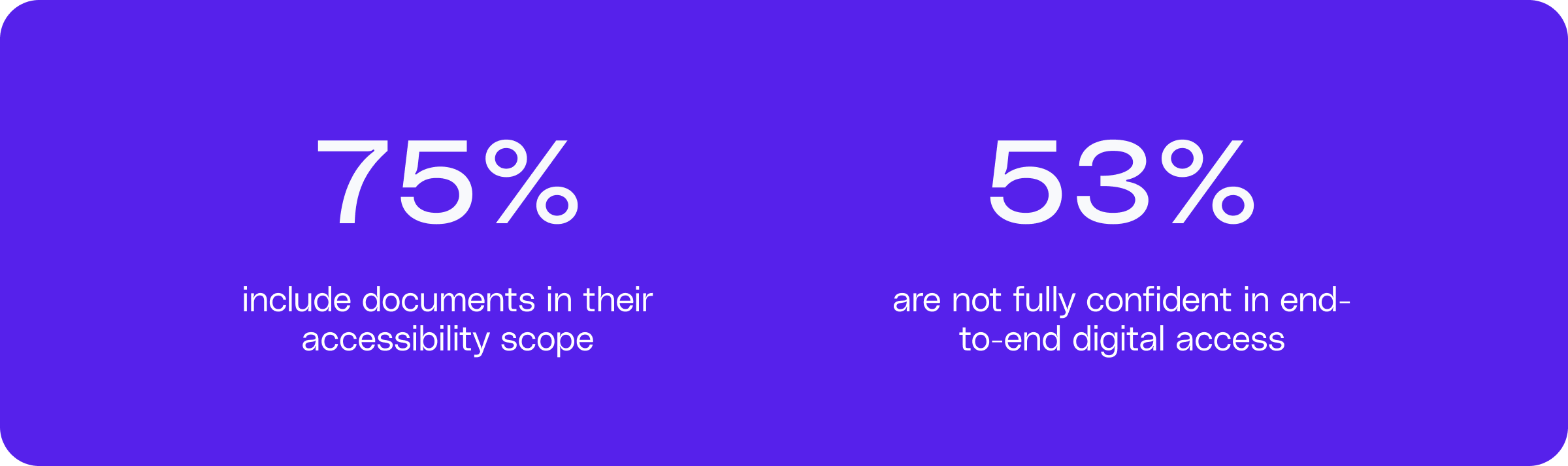
In our national survey of 300 public colleges and universities: 75% include documents in their accessibility scope. Yet 53% are not fully confident that students can complete required digital tasks end-to-end.
The issue is not awareness.
When asked what makes document accessibility difficult to manage consistently:
- 53% cited limited staff time or resources
- 41% said responsibilities are spread across teams
- 38% said documents are created across many systems
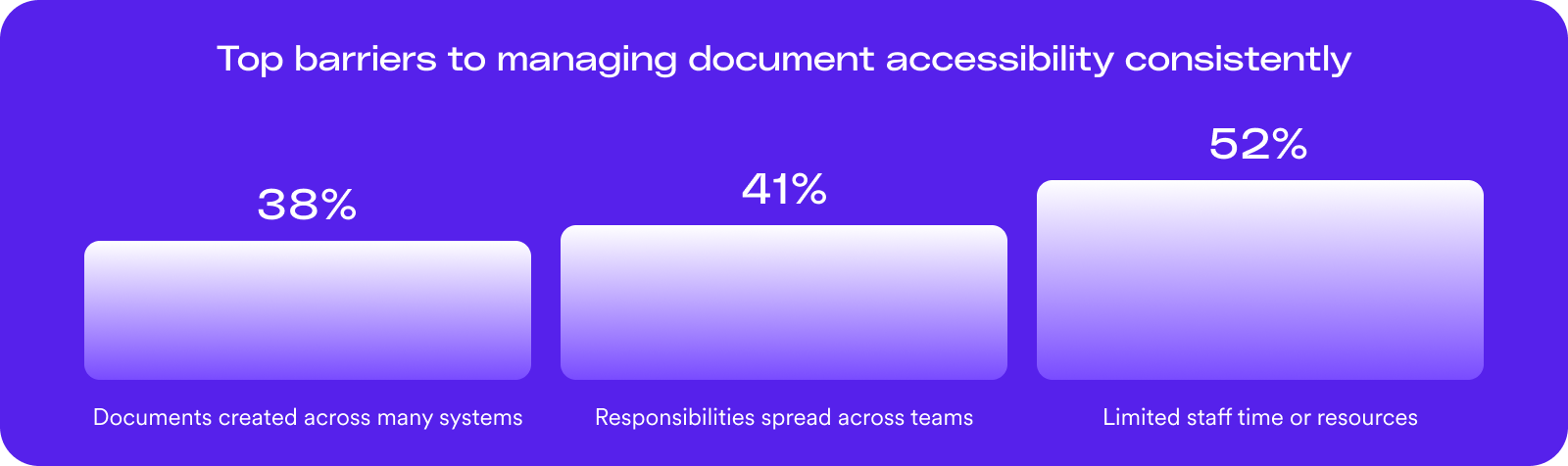
This suggests a structural challenge: document accessibility is widely recognized — but difficult to sustain at scale.
Why documents create higher accessibility risk
Most institutions recognize that document accessibility matters. The challenge is maintaining accessibility across thousands of files created by faculty and staff.
In fact, independent research analyzing more than 20,000 PDFs found that:
- Fewer than 3.2% met basic accessibility criteria
- Nearly 75% failed every accessibility check evaluated

This is not minor. It shows how deeply embedded PDF accessibility barriers remain. Unlike web content built within standardized systems, PDFs are often:
- Created outside structured workflows
- Missing tags and reading order
- Lacking labeled form fields
- Generated by multiple decentralized contributors
In higher education — where syllabi, financial aid forms, course packets, and policy documents drive required student actions — this creates disproportionate exposure.
The operational impact of inaccessible documents
Inaccessible documents affect the materials students rely on every day. More than one in five undergraduate students has a disability. Many rely on assistive technologies to access course content and required instructions.

When documents are inaccessible, the impact is immediate:
- Students cannot independently access required materials
- Instructions become unclear, leading to missed deadlines or errors
- Accessibility offices are pulled into reactive remediation
- Faculty and staff must create ad hoc workarounds
Bottom line: Inaccessible documents do not create minor friction — they disrupt learning, delay progress, and strain institutional operations.
Where institutions most often fail or underestimate scope
Even institutions that recognize the importance of document accessibility can misjudge how risk accumulates over time.
In our national survey of 300 public colleges and universities: 41% reported that documents are addressed only after problems arise or when someone requests a fix.
This reactive model is understandable, particularly in environments with limited staffing and distributed document creation.
But it creates two challenges:
- Accessibility becomes complaint-driven rather than systematic
- Barriers are often discovered only after students encounter them
Federal guidance makes clear that fixing documents after problems are reported does not replace the obligation to provide timely, accessible materials when they are required for coursework or deadlines. When document accessibility depends on reaction rather than prevention, institutions face both operational disruption and legal risk.
What a defensible document accessibility program looks like
The goal is not perfection. It is consistency, visibility, and defensible progress.
Many institutions still rely on a reactive approach to document accessibility. But under Title II, that approach is not enough. DOJ guidance makes clear that summaries or help upon request do not substitute for accessible documents when those materials are required for coursework or institutional processes.
Our data shows that only 14% of institutions describe their accessibility efforts as defensibly advancing, while the majority report operating in reactive or transitional modes. Moving from isolated fixes to structured governance is difficult — but necessary.
A defensible document accessibility program typically includes:
- Defined scope
Clear identification of which document categories are in scope — especially those tied to coursework, enrollment, financial aid, housing, and required policies. - Risk-based prioritization
High-use and high-impact documents are addressed first, rather than attempting to remediate every file simultaneously. - Accessibility built into new content
Given that 53% of institutions do not consistently build accessibility into new documents, prevention must become part of the creation process. - Documented oversight
Responsibilities are defined. Progress is tracked. Decisions are recorded — so institutions can demonstrate reasonable, good-faith efforts.
The goal is not to eliminate every barrier overnight. It is to demonstrate consistent, documented progress aligned with how students actually use institutional documents.
Defensibility comes from structure — not reaction.
What institutions should prioritize now
With the April 2026 Title II deadline approaching, institutions do not need to remediate every historical document at once. They need to prioritize the documents students depend on most.
1. Active course materials
Syllabi, required readings, assignment instructions, course packets, and LMS uploads tied to current or upcoming semesters.
2. Enrollment and financial aid workflows
Admissions forms, FAFSA-related documents, tuition billing notices, housing contracts, and registration instructions.
3. Student services documentation
Accommodation request forms, disability services paperwork, Title IX notices, academic policies, and required institutional communications.
4. Preventing new barriers
Ensure faculty and staff use accessible templates and defined document workflows so new course materials are created accessible by default.
5. Clear accountability across campus
Define responsibility across academic departments, student services, and IT. Track remediation progress and document decisions to demonstrate reasonable, good-faith compliance.
Under Title II, defensibility is not about fixing everything overnight. It is about prioritizing required materials, preventing recurring barriers, and showing structured progress aligned with how students actually participate in campus life.
Need added help? Use this checklist to keep track of where to focus.
The time is now to act on document accessibility
For many public colleges and universities, the most immediate Title II risk sits in required institutional documents used for coursework, enrollment, and financial aid that students depend on today. Ensuring these materials remain accessible across thousands of files, departments, and academic cycles can be difficult to manage consistently.
Document accessibility often requires specialized remediation, manual review, and coordination across multiple teams. And because digital content changes every semester, accessibility cannot be treated as a one-time effort.
accessiBe works alongside higher education institutions to support both immediate remediation needs and long-term accessibility oversight:
Expert document remediation
Our accessibility specialists assist institutions with reviewing and remediating high-risk PDFs and course materials so they are usable by assistive technologies and aligned with WCAG requirements.
Tools that support institutional technology teams
Developer-focused tools help teams understand accessibility status across websites, portals, and LMS environments, providing visibility into issues and guidance for ongoing improvements.
Automation that supports ongoing accessibility
AI-driven monitoring helps identify recurring accessibility issues as content changes, helping institutions maintain coverage without overwhelming internal teams.
Structured oversight and reporting
Accessibility activity is documented and tracked over time, creating a record of progress, remediation efforts, and oversight aligned with Title II expectations.
Because digital environments in higher education evolve each semester, accessibility requires sustained monitoring and coordination across systems. We work alongside institutional teams from initial assessments through ongoing remediation and oversight.
If your institution is preparing for the April 2026 Title II deadline, our accessibility specialists can help you review your current approach and identify practical next steps.
Speak with a Title II accessibility expert for a one-on-one review of your institution’s document and platform strategy.
Frequently asked questions
What does ADA Title II require for digital documents in higher education?
Under the 2024 Title II rule, public colleges and universities are required to ensure that all digital content used to deliver their programs, services, and activities—including PDFs, Word documents, and spreadsheets—is accessible to people with disabilities. To meet these requirements, institutions must ensure that their documents conform to the technical standards of Web Content Accessibility Guidelines (WCAG) 2.1 Level AA.
When is the deadline for public institutions to comply with Title II?
The compliance deadlines are based on the population size the institution serves. Large public entities (serving 50,000 or more people) must ensure their digital documents and content are conformant by April 24, 2026. Smaller entities (serving fewer than 50,000 people) and special district governments have until April 26, 2027, to meet the same standards.
Does Title II apply to documents hosted behind a student login or on a Learning Management System (LMS)?
Yes. The Title II rule applies to all digital content used to deliver services, whether it is public-facing or restricted by a password. This includes course syllabi, lecture slides, and required readings hosted on platforms like Canvas or Blackboard. Documents must be accessible from the moment they are made available to students, rather than being remediated only after a student requests an accommodation.
Are there any exceptions for legacy or archived documents?
There are limited exceptions for “archived web content,” which is defined as content that existed before the compliance deadline, is not currently used to deliver services, and is maintained solely for historical or research purposes. However, any document that is “actively in use” for the delivery of an institution’s programs or activities—such as enrollment forms or current course materials—must be fully accessible and does not qualify for this exception.
Why can’t we simply provide accessible documents “upon request” as an accommodation?
Federal guidance clarifies that a reactive “upon request” model is insufficient because it places students with disabilities at a disadvantage. When a student must wait for a document to be remediated, they lose equal access to information and timely participation in their education. Title II requires public entities to proactively ensure that digital content is accessible upfront so that all users have an equitable experience from the start.
What are the core technical elements of an accessible Higher Ed PDF?
To conform to WCAG 2.1 Level AA, a PDF must include several structural and design elements: proper tagging to define structure for screen readers, a logical reading order, descriptive alt text for meaningful images, sufficient color contrast, and searchable text (not scanned images of text).
How can accessiBe help public colleges and universities meet these requirements?
As part of its end-to-end accessibility solutions, accessiBe’s expert services help institutions address high-risk PDFs and course materials quickly and accurately. Our team of specialists review and remediate complex documents, providing an Accessibility Validation Report to confirm your files meet WCAG 2.1 Level AA standards. This layered approach supports institutions in fulfilling their Title II obligations while maintaining a high volume of accessible academic resources.
Table of Contents