This blog is part of our GAAD (Global Accessibility Awareness Day) series spotlighting members of accessiBe’s Inclusive Product Advisory Board — disability community leaders and advocates helping shape how accessibility is built in practice. Advisory board sessions are moderated by Josh Basile, accessiBe’s Community Relations Manager, C4-5 quadriplegic, and disability rights advocate.
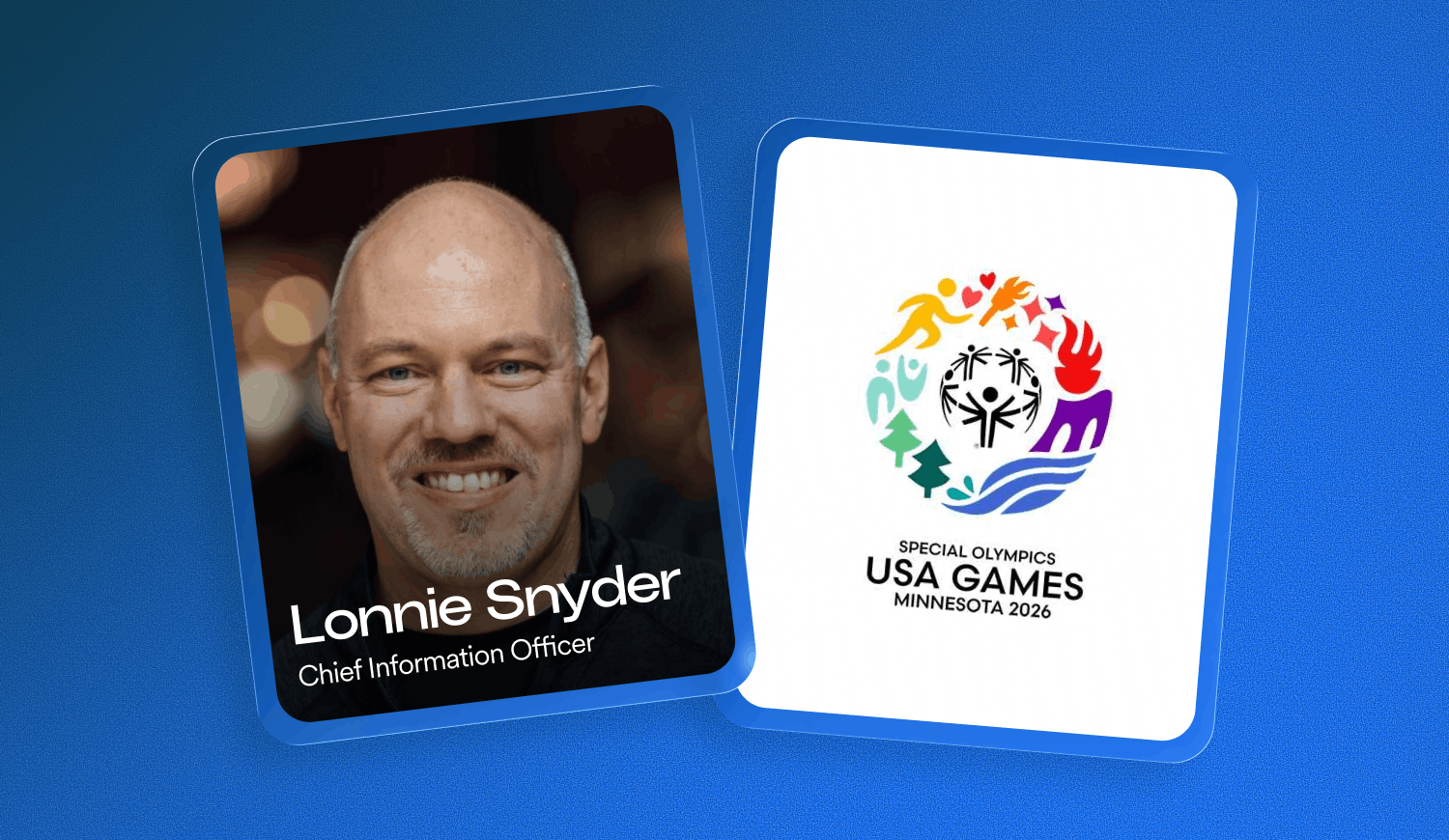
Meet Lonnie Snyder, Chief Technology and Information Officer, 2026 Special Olympics USA Games
Lonnie Snyder has spent 30 years leading technology innovation, mostly for nonprofit organizations. He served as CIO for the 2022 Special Olympics USA Games, where he built a first-ever fan engagement app delivering real-time results and athlete celebrations. He spent eight years with Special Olympics International — a global organization spanning 195 countries — where he led the Enterprise Systems and Health Technologies teams, overseeing a network of 20 technology business systems used by thousands of people worldwide.
Now he’s back for the 2026 Special Olympics USA Games in Minneapolis-St. Paul, bringing everything he learned in 2022 and more.
“My hopes and dreams for the 2026 Special Olympics USA Games are to use technology to deliver quality experiences and showcase the extraordinary abilities of Special Olympics athletes worldwide.” — Lonnie Snyder
Lonnie’s connection to the Special Olympics runs deeper than his job title. He and his wife adopted three children who they worked tirelessly to bring home from Taiwan. That personal stake in inclusion isn’t background — it’s the reason he approaches accessibility as a mission, not a mandate.
What accessibility barriers do people with intellectual disabilities face online?
People with intellectual disabilities are among the most underserved in digital accessibility conversations. Most accessibility frameworks — including WCAG — have stronger guidance for sensory and motor disabilities than for cognitive accessibility. The result is that websites designed to be “accessible” by compliance standards are often still genuinely difficult for someone with an intellectual disability to use.
Lonnie’s team operates with a clear benchmark: nothing above a 7th grade reading level. That standard requires constant discipline, because the default register of professional communication — press releases, event registration flows, sponsor pages — routinely exceeds it.
“People with intellectual disabilities — we try and target nothing above a 7th grade reading level. I’m constantly reminding my colleagues to stop using big words and just make things simple. It’s something we struggle with.” — Lonnie Snyder
That gap between compliance and genuine usability is something Lonnie encounters in his own technology work too. When he had a blind engineer test the Special Olympics app in 2022, the feedback was blunt: “It sucks, it’s worthless, I can’t do anything.” That honest assessment drove meaningful improvements — the app now fully passes screen reader testing, and a blind tester is part of the team. It’s a model for what real accessibility accountability looks like.
What Lonnie brought to the table
Lonnie’s advisory board contributions are direct, practically grounded, and delivered with the confidence of someone who has spent decades making technology work for real people in complex environments. He’s also an early and enthusiastic adopter of AI across his organization — using it for meeting transcription, communications, and building interactive tools for athletes arriving in Minneapolis.
“AI is our friend, and it’s everywhere — so if people think it’s not being used, they’re silly.” — Lonnie Snyder
On the question of how accessibility tools should be designed, he was unambiguous: clarity beats elegance every time.
For the intellectual disability community especially, a tool that requires users to hunt, hover, and interpret before they can get help has already failed. “They’re going to look at this and not know what to do. By the time they click around with it, they’re going to get lost and just say this is too hard and go.” Accessible design isn’t about looking clean. It’s about being immediately, obviously useful.
He also made a point that resonated with the whole board. When asked how much control users should have over how content is presented to them, his answer was three words: “I don’t have to think.”
That instinct — minimize friction for users already navigating a complex world — is a design philosophy worth internalizing across every product decision. The best accessibility tool isn’t necessarily the one with the most options. It’s the one that gets out of the way.
Lonnie also brought a personal dimension to the testing sessions that grounded everything. Testing a profile designed to enlarge and clarify on-screen content, he noted that he couldn’t remember the last time he’d been able to read a screen without glasses — his vision had deteriorated significantly since his forties. His reaction wasn’t clinical. It was immediate.
“I can actually read out of the top and middle where ordinarily it would be completely blurry. I could completely do it without the glasses — that’s wild.” — Lonnie Snyder
That moment — a technology leader in his own right, genuinely surprised by what an accessibility feature could do for him — is exactly the kind of feedback that moves products forward.
The takeaway
The 7th grade reading level benchmark isn’t a limitation — it’s a standard that makes content better for everyone: the Parkinson’s caregiver reading on a phone, the person with ADHD who can’t sustain attention through a dense paragraph, the first-time visitor who doesn’t know the jargon. Lonnie’s work is a reminder that designing for intellectual disability isn’t a niche accommodation. It’s just good communication.
The 2026 Special Olympics USA Games take place in Minneapolis-St. Paul in June 2026. Volunteers are needed — if you’re able to be part of it, it’s one of the most meaningful ways to spend a week this year.