Part of our GAAD series spotlighting members of accessiBe’s Inclusive Product Advisory Board — disability community leaders and advocates helping shape how accessibility is built in practice. Advisory board sessions are moderated by Josh Basile, accessiBe’s Community Relations Manager, C4-5 quadriplegic, and disability rights advocate.
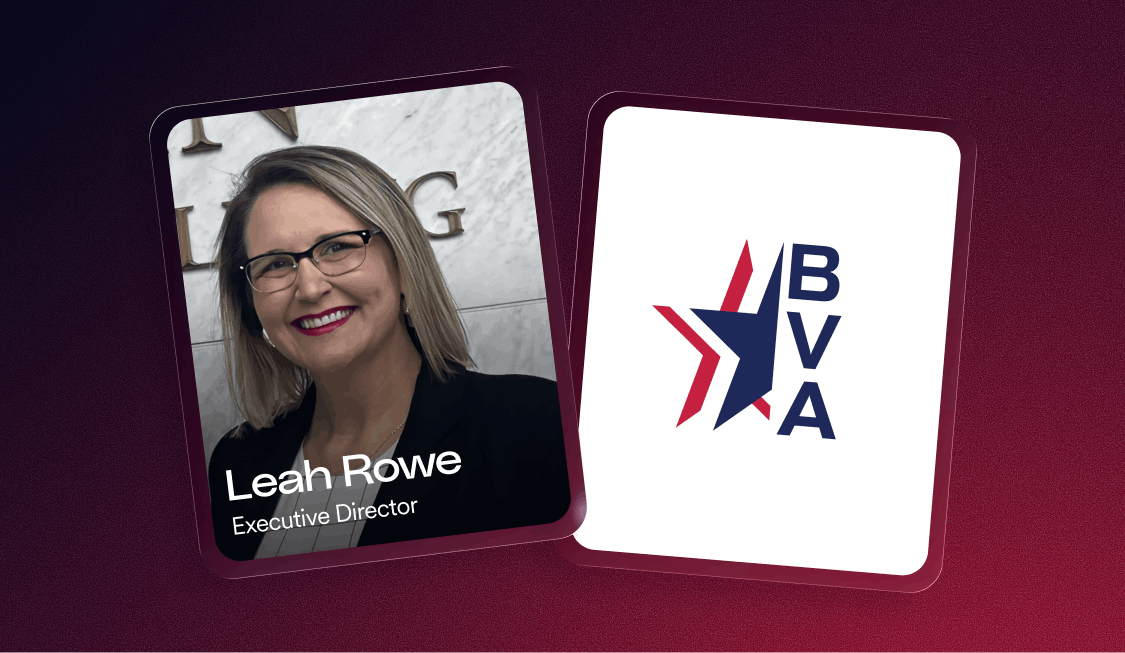
Meet Lea Rowe, National Executive Director and National Legislative Director, Blinded Veterans of America
Lea Rowe was recently appointed as the permanent National Executive Director of Blinded Veterans of America — a recognition of the leadership she has demonstrated since stepping into the interim role, and a milestone worth celebrating. BVA is the only congressionally chartered veterans service organization created for, consisting of, and led by visually impaired veterans. Its motto — Blinded Veterans Helping Blinded Veterans — captures its founding principle: that the people who best understand the experience of sight loss in service are the ones best positioned to help others navigate it.
Lea brings 21 years of nonprofit management experience to the role, including her tenure as Head of Client Services at Lighthouse for the Blind of Fort Worth and leadership roles in public health and community health organizations across Texas and Tennessee. She holds a Bachelor’s Degree in Public Health from the University of Texas Tyler and recently earned a Master of Science in Low Vision Rehabilitation from Salus University, alongside certification as a Low Vision Therapist — credentials that reflect both her professional depth and her personal commitment to the community she serves.
In 2025, she delivered one of BVA’s most significant legislative wins in recent memory.
“We were successful in getting through the House and Senate the Veterans Accessibility Advisory Committee. I’m excited about getting that up so that as new changes come through, all disabilities are at the table to make sure all accessibility needs are being addressed.” — Lea Rowe
What accessibility barriers do blind and low vision veterans face online?
Veterans who lose their sight — whether through combat, service-related conditions, or age-related causes — often encounter the digital world at its most complicated: navigating VA benefits systems, accessing healthcare information, filing claims, and connecting with support services that were not designed with screen reader users in mind.
The blind and low vision veteran community faces an unemployment rate of over 70% — a figure that reflects not a lack of capability, but a lack of access. Digital inaccessibility is one of the most direct contributors to that gap. When a job application, a benefits portal, or a healthcare system doesn’t work with assistive technology, the barrier isn’t the person’s vision. It’s the design.
Don Overton, a Desert Storm veteran who sustained a blast injury leaving him totally blind in one eye and legally blind in the other, served as BVA’s National Executive Director before Lea. In a spotlight session with accessiBe on Veterans Day 2024, he put it plainly:
“Accessibility is just ensuring the same opportunity. The blindness and low vision community — we have the technologies. It’s just a matter of ensuring that websites allow our technology to communicate with what they’re doing. And it doesn’t take much to be able to do that.” — Don Overton, former National Executive Director, BVA
BVA has spent decades fighting to close that gap — from catalyzing the creation of the first blind rehabilitation centers across the country, to securing website accessibility legislation, to the Veterans Accessibility Advisory Committee that Lea successfully moved through Congress in 2025. Each win represents years of sustained advocacy to ensure that the institutions that serve veterans actually work for all of them.
What Lea brought to the table
Lea’s presence on the advisory board connects accessiBe’s work to a community where digital access is directly tied to independence, employment, and the benefits veterans have earned. Her legislative win with the Veterans Accessibility Advisory Committee is a model for how accessibility gets enshrined in institutional structures — not just product features, but policy.
That philosophy mirrors exactly what the advisory board is built on: bringing the community to the table before decisions are made, not after.
Don said it simply in his Veterans Day conversation with accessiBe: “When they take the time to bring different communities to the table in an advisory capacity, they end up with better results and better outcomes for everyone — and making sure that people don’t fall through the cracks.”
accessiBe is proud to have BVA’s voice shaping that work. When Josh Basile and Sapir Yarden met Lea in person in Washington, D.C., it was a reflection of a partnership built on genuine relationship — not just shared logos.
Lea’s presence on the advisory board connects accessiBe’s work to a community where digital access is directly tied to independence, employment, and the benefits veterans have earned.
The takeaway
“There’s really no barriers to what our folks are capable of doing. We just do it differently.” — Don Overton
For blind and low vision veterans, digital accessibility isn’t abstract. It’s the difference between independently managing your own healthcare, benefits, and daily life — or depending on someone else to do it for you. Lea’s work at BVA, and her seat at the advisory board table, ensures that reality stays front and center in how accessiBe builds.
If you’re a veteran with a visual impairment or support one, BVA is the place to start.