This blog is part of our GAAD series spotlighting members of accessiBe’s Inclusive Product Advisory Board — disability community leaders and advocates helping shape how accessibility is built in practice. Advisory board sessions are moderated by Josh Basile, accessiBe’s Community Relations Manager, C4-5 quadriplegic, and disability rights advocate.
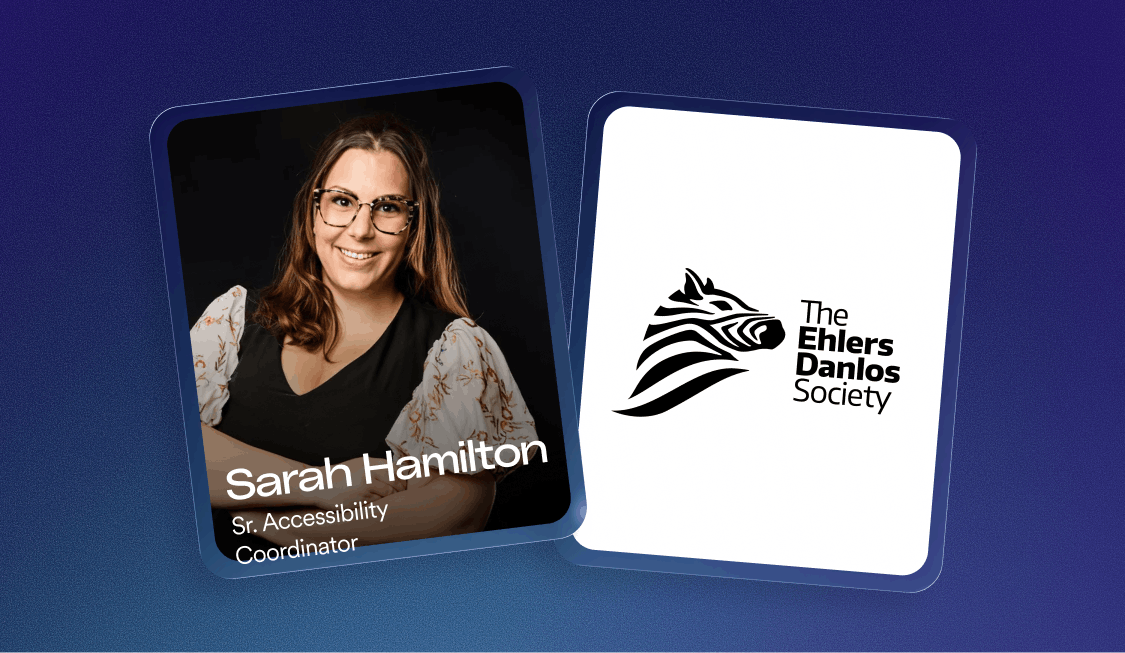
Meet Sarah Hamilton, Senior Accessibility Coordinator at the Ehlers Danlos Society
Sarah Hamilton has worked in support of the Ehlers-Danlos Syndrome (EDS) community since 2015. Ehlers-Danlos syndromes are a group of 13 heritable connective tissue disorders that affect the body across multiple systems — joints, skin, the cardiovascular system, and more.
EDS is often called an “invisible illness” because its symptoms — chronic pain, fatigue, and cognitive difficulty — can be debilitating but are not visible to others. Sarah began experiencing symptoms at a young age, but like many in her community, went years without a clear answer. She was repeatedly told her symptoms might be anxiety. It wasn’t until later that things began to connect.
In her role as Senior Accessibility Coordinator, Sarah is responsible for embedding accessibility into the Ehlers-Danlos Society’s operations, digital presence, and communications — including how the organization uses AI to support its helpline and improve the experience for the people it serves. She recently earned a promotion to that senior role, which she described as “a very nice Christmas present.”
Over the last decade, the Ehlers-Danlos Society has funded more than $40 million in research, reflecting both the complexity of these conditions and the scale of the need.
What accessibility barriers do people with Ehlers-Danlos syndromes face online?
For many people living with EDS, one of the most overlooked accessibility barriers is cognitive variability — often described as brain fog. This can mean struggling to process information, rereading the same sentence multiple times, or losing track of content mid-page. And critically, it isn’t a fixed barrier. It shifts throughout the day, for the same person. That kind of fluctuation is exactly why designing for cognitive disabilities has to account for adjustability, not just static defaults.
For the EDS community, web accessibility isn’t just about motor or visual access. It’s about how readable, clear, and adjustable a site’s content is — and whether that can be changed on a bad day without friction.
“For our community that gets a lot of brain fog, especially at different times of the day, being able to adjust the way that you’re using the site is brilliant — when you’ve had a long day, being able to simplify it so you’re not doing what a lot of us do: rereading the same sentence over and over again because it’s not taking it in.” — Sarah Hamilton
Her point captures something essential about what cognitive accessibility means in practice — not a fixed accommodation, but a flexible one.
What Sarah brought to the table
Sarah uses AI in her own work to double-check accessibility and validate user testing, and the Ehlers-Danlos Society is exploring an AI-powered chatbot for its helpline — reflecting the same instinct that runs through her advisory board contributions: technology should make it easier for people with health conditions to get the support they need, not harder.
In board sessions, her feedback consistently highlighted two things. First, that adjustability is everything for a community with fluctuating symptoms. Second, that how features are described matters as much as what they do. Sarah pushed for language that leads with function rather than diagnosis — so users don’t have to first decide whether a tool is “for them” before they can use it.
“This is just what it does — it removes the barrier of ‘can I use this, is this for me?’ and allows someone to go, oh, actually, that would be really helpful for me, regardless of diagnosis, regardless of labels. It’s a tool doing an action, and I need that action, so I’m going to use it.” — Sarah Hamilton
That insight is now shaping how accessibility features are described across the accessWidget, moving from diagnostic labels toward clear, functional descriptions of what each adjustment actually does.
The takeaway
It’s the same lesson that emerges anytime we look at accessibility from a disability perspective — needs are individual, and design has to make room for that. Invisible illness is a category that contains millions of people who have learned not to announce their access needs, because those needs are not visible and therefore often not believed. Sarah’s contribution to the advisory board is a reminder that good accessibility design meets people where they are — not where they were an hour ago, and not where a diagnostic label says they should be.
The Ehlers-Danlos Society is the global hub for EDS education, research, and community. If EDS or chronic illness is part of your life or your organization’s work, it is an invaluable resource.