This blog is part of our GAAD (Global Accessibility Awareness Day) series spotlighting members of accessiBe’s Inclusive Product Advisory Board — disability community leaders and advocates helping shape how accessibility is built in practice. Advisory board sessions are moderated by Josh Basile, accessiBe’s Community Relations Manager, C4-5 quadriplegic, and disability rights advocate.
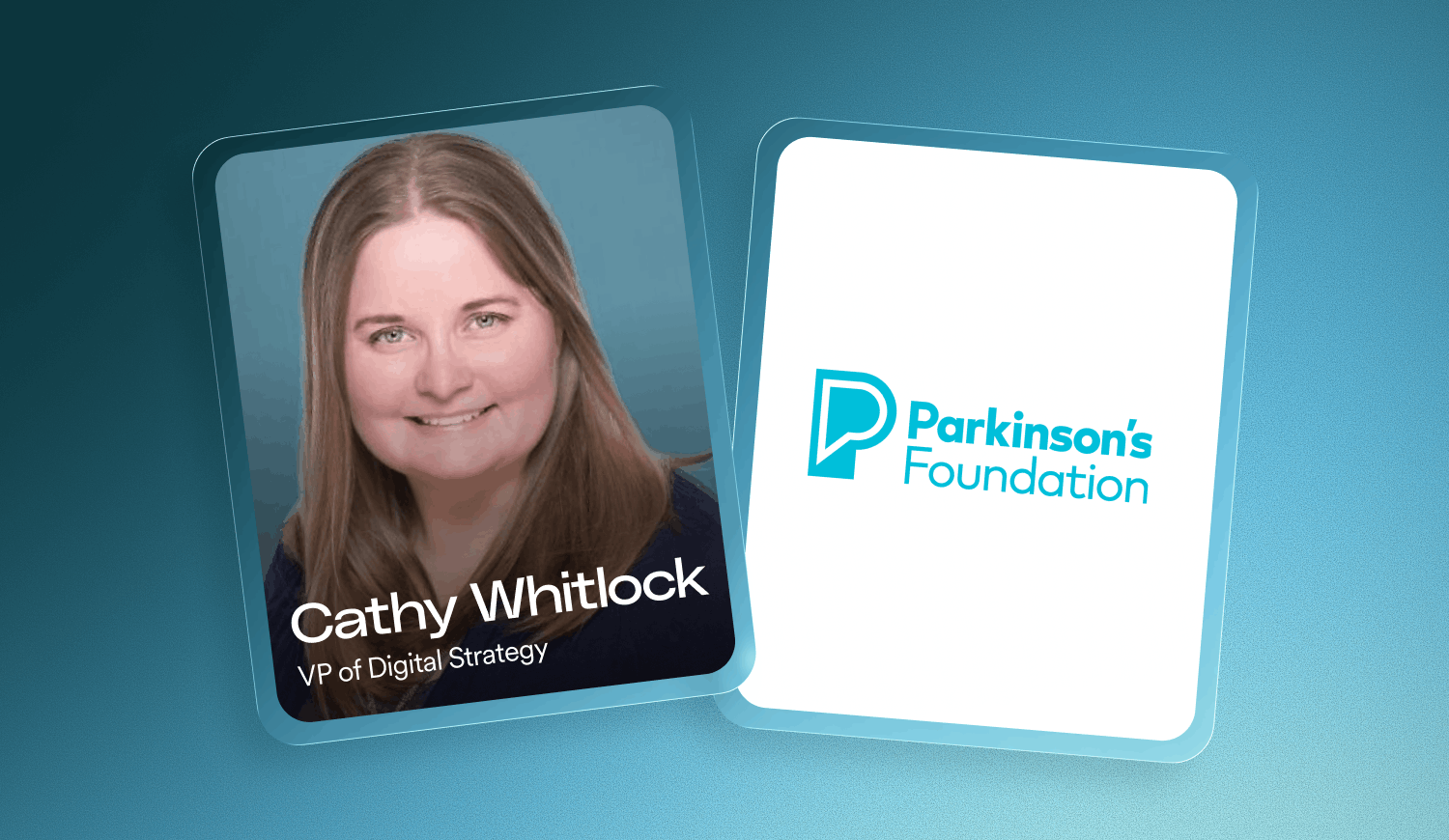
Meet Cathy Whitlock, Vice President of Digital Strategy, the Parkinson’s Foundation
Cathy Whitlock oversees digital strategy at the Parkinson’s Foundation — the leading organization advancing Parkinson’s disease research, care, and advocacy. In that role, she is responsible for how one of the most trusted health information resources in the neurology space reaches and serves the millions of people and families affected by Parkinson’s.
Cathy brings a strategist’s eye to the advisory board: she thinks in systems, in user journeys, and in the long arc of how a community’s digital needs evolve. Her background means she’s not just describing barriers — she’s thinking about how to architect solutions at scale, for a community whose needs are anything but static.
The Parkinson’s Foundation is itself actively integrating AI across its digital presence — replacing its search tool with a smart search experience, building an AI-powered chat tool to triage inquiries before referring people to its toll-free Helpline, and making structural content changes to ensure its resources are surfaced by AI tools like ChatGPT and Perplexity when people ask questions about Parkinson’s. Cathy’s participation in the advisory board is matched by her organization’s own commitment to meeting people where they are, digitally.
What accessibility barriers do people with Parkinson’s disease face online?
Parkinson’s disease is progressive. A person’s digital access needs in the early stages — when tremors are mild and processing speed is largely intact — are very different from their needs five or ten years later. Fine motor control, reading stamina, cognitive speed, and the ability to navigate complex interfaces can all be significantly affected as the condition advances.
The Parkinson’s Foundation’s own resources reflect this reality. People living with Parkinson’s may rely on adaptive computer mice, voice-activated technology, and communication aids just to manage daily tasks — and those same tools need to work seamlessly with the websites they depend on for health information, appointment scheduling, and community support. Telemedicine has become a critical access point for this community, allowing people at any stage of Parkinson’s to meet with specialists from home — but only if the digital platforms that power those appointments are accessible.
This means designing a digital experience for a moving target. The same user who can navigate a complex website today may need large text, simplified navigation, and voice control tomorrow. And increasingly, the people navigating those websites are not just people with Parkinson’s themselves — they are the care partners and family members who step in as the condition progresses, often under time pressure and looking for quick, reliable answers.
What Cathy brought to the table
Cathy’s voice consistently expanded the frame around who benefits from accessible design. Her most resonant contribution to the advisory board came when the conversation turned to who actually benefits from accessible, simplified content online.
“Care partners for people struggling with health conditions are often short on time and don’t have the time to read a long article on a website when information is needed immediately. A quicker reference for what they may need on-the-go would be a really great tool for them.” — Cathy Whitlock
It’s a perspective that connects directly to what the Parkinson’s Foundation sees every day: family members and professionals supporting someone with Parkinson’s who need fast, clear, reliable information — and who are just as locked out by inaccessible design as the person they’re caring for.
She also raised a nuance that matters deeply in health contexts: that simplification of content has limits. For complex topics like medication interactions or treatment options, there is a point at which making content simpler means losing medically important information. Her instinct was toward user control — the ability to dial in how much simplification is applied, rather than accepting a single default.
“A single default setting has its advantages – there’s the element of not having to make that decision, and it’s simpler when facing decision fatigue — but part of me wished for a slider to choose how simple I want the content to be, because I do think you reach a point eventually where oversimplification loses important nuance about some of those complex health topics specifically.” — Cathy Whitlock
That insight — simplify the presentation, not the substance — echoes a principle that ran through multiple advisory board sessions, and it carries particular weight coming from someone who works in health information every day.
The takeaway
Designing for a progressive condition means designing for change — for the person someone is today and the person they will be in three years. It also means designing for the people around them. The Parkinson’s Foundation’s work is a model for what health-focused digital accessibility looks like when it takes the full arc of a condition seriously — and Cathy’s contributions to the advisory board ensure that perspective shapes the tools accessiBe builds.