
In short
Canadian agencies face more accessibility-related legal exposure than their US counterparts, and claims there are more likely to end in a payout with no fix. That risk is sharpest in Ontario right now: 80% of agencies feel ready for the December 31, 2026 AODA deadline, but only 36.7% of that group runs accessibility as mandatory, and nearly half have already faced a claim.
Agencies put real effort into delivering a good website for their clients — strong design, smooth usability. What often gets less attention is whether that site works for everyone, including people with disabilities.
That gap is increasingly reflected in legal action.
19.5% of Canadian agencies report being sued directly over accessibility, and another 21.4% report a client being sued — not a fringe risk, but one that’s already touched a meaningful share of the market.
That exposure is about to matter more for one part of that market specifically:
The Accessibility for Ontarians with Disabilities Act (AODA) requires an Accessibility Compliance Report be submitted by December 31, 2026, for private and non-profit organizations with 20 or more employees — a mandatory, self-reported filing that becomes part of an organization’s compliance history whether or not it’s accurate.
Agencies advising Ontario clients are heading into that deadline with real exposure already in place.
This report is the third in a series drawn from a survey of 308 web, marketing, and IT agencies across the US and Canada. It looks at where Canadian agencies actually stand on legal exposure, how that exposure tends to resolve, and why the confidence many Ontario agencies have about the coming deadline doesn’t match what their own processes show.
About the research
This report is based on accessiBe’s survey of 308 web design, marketing, and IT agencies across the US and Canada. This report focuses on the 154 Canada-based respondents, with a further subset of 99 Ontario-based agencies referenced later in the report. We fielded this research to understand how agencies are responding to AI, where they’re placing their bets, and where accessibility fits into those decisions.
The exposure gap in the Canadian market
The picture breaks into three parts: who’s getting sued, what tends to happen once a claim lands, and how consistently agencies build accessibility into their process.
Who actually gets sued
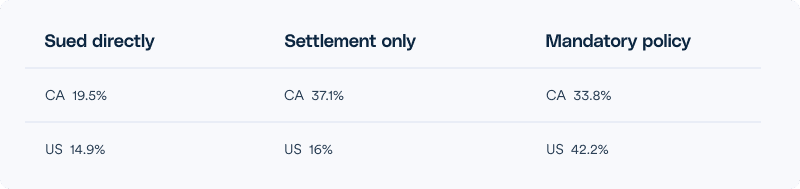
19.5% of Canadian agencies report being sued directly over accessibility. Another 21.4% report a client being sued. Together, a meaningful share of the market has already faced accessibility litigation from one direction or the other—either their own work or a client’s.
19.5% Sued directly
21.4% Client sued
What happens after a claim lands
Getting sued is one thing. What happens afterward is another, and it shapes what the exposure actually costs. Among Canadian agencies that have faced a claim, 37.1% ended in a financial settlement with no remediation attached — a payment made, with nothing else changing about the site itself.
37.1% Settled with no fix to the site
How agencies run their process
Only 33.8% of Canadian agencies make accessibility mandatory on every project. Just over half (52.3%) offer it as a service clients can opt in or out of, and the remainder only address it when a client raises it or an issue is identified — meaning for most agencies in this market, accessibility isn’t a default, it’s a choice made project by project.
How this compares to the US
Compared with American agencies, Canada is higher on every measure. US agencies self-report being sued directly at 14.9%, and a client being sued at 8.4% — both notably below the Canadian rates, despite the US market’s reputation for aggressive accessibility litigation. US claims end in a settlement with no remediation only 16% of the time, less than half the Canadian rate. And 42.2% of US agencies make accessibility mandatory on every project, well above Canada’s 33.8%.
Deadline pressure: AODA's looming date and its impact on agencies
A meaningful share of agencies and their clients have already faced legal action over accessibility. That number is likely to grow if agencies don’t complete the required work before the deadline.
The AODA deadline
The Accessibility for Ontarians with Disabilities Act, or AODA, is Ontario’s accessibility law — it sets standards for how businesses serve people with disabilities and requires organizations to periodically confirm where they stand.
Every private and non-profit organization with 20 or more employees must file an Accessibility Compliance Report by December 31, 2026.
Organizations with 50 or more employees (plus designated public-sector organizations) have to do all of that, plus:
- Maintain a written multi-year accessibility plan
- Make their public-facing websites and web content conform to WCAG 2.0 Level AA
What’s at stake in the filing
The filing itself is self-reported, not independently audited. An organization confirms and submits its own compliance status, and no one from the province reviews the site first.
Missed or unsupported filings become part of an organization’s compliance history. Penalties can reach up to $100,000 per day for corporations — though that figure is a legal ceiling, not a routine outcome.
How AODA enforcement works
AODA doesn’t give individuals a right to sue directly over a non-compliant website. That’s a meaningful difference from the US, where accessibility lawsuits are filed directly in court.
In Ontario, an accessibility-related complaint about a website more commonly goes through the Human Rights Tribunal of Ontario under the Ontario Human Rights Code — a separate, complaint-driven process.
Bottom line
If you’re a Canadian agency serving Ontario-based clients, they likely need to comply with AODA. Any client with 20 or more employees has to file an Accessibility Compliance Report by December 31, 2026. If that client also has 50 or more employees, that same report requires them to self-certify that their public-facing website meets WCAG 2.0 Level AA — which is squarely where an agency’s work comes in. As the deadline approaches, clients who haven’t started preparing will look to their agency for help figuring out where they stand and what still needs to be done.
Confident, not compliant: the Ontario readiness gap
Feeling ready
80% of Ontario agencies rate themselves prepared for the December 31 deadline. On paper, that’s a market that considers itself in good shape heading into a mandatory filing.What “ready” looks like underneath
Of that same confident group, only 36.7% actually make accessibility mandatory on every project. The rest run an optional, case-by-case approach—the exact pattern the earlier section tied to more claims and worse resolutions—while still rating their own readiness at the top of the scale.What’s already happened to this group
Nearly half of that confident group has already faced a claim, either directly or through a client. Feeling prepared and having already been sued aren’t mutually exclusive in this data — they’re happening to the same agencies at the same time.80% of Ontario agencies feel prepared for the AODA deadline
49.4% of that confident group has already faced a claim, either directly or through a client
Why this matters
A signed compliance filing is only as good as the audit behind it. Confidence, a mandatory process, and a clean legal history are three different things, and in Ontario right now, many agencies have the first without the other two. The gap closes with an actual review of where a site stands against WCAG, not an assumption that it’s probably fine.
A practical next step: helping clients close the gap
Start with where a client actually stands
Our AODA compliance checklist walks through exactly what the filing requires, what counts as evidence versus assumption, and what an agency should confirm before a client signs off on their own report. It’s built to answer the same question this report just raised: does “we’re prepared” hold up once you actually look?Know how to raise it
Bringing up a compliance gap with a client is its own challenge, separate from knowing the gap exists. If you want to better prepare yourself for that conversation, we recommend checking out how to talk to your clients about AODA compliance — it covers how to open the topic without it sounding like a warning, which questions surface where a client stands, and how to handle the objections that come up most: “we’ve never been sued,” “our developer already said it’s fine,” “can’t we just wait and see.”Bring a real offering, not just the warning
Once a client is ready to move, accessiBe’s partner program gives an agency something concrete to bring them: a platform combining the best in AI-powered automation, dev tools, and human expertise:- accessServices — comprehensive expert audits, including testing by people with disabilities, plus PDF and file remediation
- accessFlow — source-code-level accessibility work, built for dev teams to fix issues directly rather than layering a patch on top
- accessWidget — real-time, session-based remediation, along with an interface allowing visitors to adjust the site to their own accessibility needs
Help your clients prepare for the AODA compliance deadline
Talk to a partner manager about commissions, tiers, and how to get set up.

Frequently asked questions about digital accessibility legal action in Canada
How many Canadian web agencies have faced an accessibility lawsuit or claim?
19.5% of Canadian agencies surveyed report being sued directly over accessibility, and another 21.4% report a client being sued.
Is Canadian agency legal exposure higher than in the US?
Yes, on every measure reported. Canadian agencies report higher rates of being sued directly (19.5% vs. 14.9%), settlements with no remediation (37.1% vs. 16%), and lower rates of treating accessibility as mandatory on every project (33.8% vs. 42.2%).
When is the AODA compliance deadline?
Every private and non-profit organization in Ontario with 20 or more employees must file an Accessibility Compliance Report by December 31, 2026. Organizations with 50 or more employees must also maintain a written multi-year accessibility plan and make their public-facing websites conform to WCAG 2.0 Level AA.
Can someone sue directly over a non-compliant website under the AODA?
No. The AODA doesn’t give individuals a right to sue directly over a non-compliant website. In Ontario, an accessibility-related complaint typically goes through the Human Rights Tribunal of Ontario under the Ontario Human Rights Code instead.
Are Ontario agencies actually prepared for the AODA deadline?
Not consistently. 80% of Ontario agencies rate themselves prepared, but only 36.7% of that group treats accessibility as mandatory on every project, and 49.4% of that same confident group has already faced a claim.
What happens if an AODA filing is inaccurate?
The Accessibility Compliance Report is self-reported and not independently audited before submission, but providing false or misleading information in it is itself an offense under the Act, separate from any accessibility gaps the filing might be covering up. Penalties can reach up to $100,000 per day for corporations, though that figure is a legal ceiling rather than a routine outcome.
Does settling a claim mean the accessibility issue was fixed?
Not necessarily. 37.1% of Canadian claims ended in a financial settlement with no remediation attached, meaning the claim closed but the site itself didn’t change.
What can agencies offer clients to help them prepare for the AODA deadline?
Through accessiBe’s partner program, agencies can refer or resell accessServices for expert audits and file remediation, accessFlow for source-code-level fixes, and accessWidget for real-time, session-based remediation — giving agencies a way to support a client’s AODA compliance on an ongoing basis rather than as a one-time project.