
In short
A third of US agencies have already been part of an accessibility lawsuit or claim, even though they rate their own understanding of that legal exposure at 87.4% — a gap between knowing the risk exists and having a process to manage it. Most claims end with the site getting fixed, not just a settlement check, but that’s not the end of the story: nearly half of all federal cases in 2025 targeted a company that had already been sued before. Resolving one claim isn’t proof the risk is closed — treating accessibility as continuous work, not a project with an end date, is what closes the gap.
More than 5,000 web accessibility lawsuits were filed in the US in 2025 — the highest annual total on record. 2026 is on pace to beat it: based on filings through mid-June, projections put the full-year total at approximately 6,176 lawsuits.
For an agency, that’s not just a client’s problem — a third of US agencies have already been party to a claim themselves, directly or through a client.
This report is the second in a series drawn from a survey of 308 web, marketing, and IT agencies across the US and Canada. It looks at how exposed US agencies are to accessibility-related legal risk — not just their clients — and how often that exposure comes back after an agency believes it’s resolved.
About the research
This report is based on accessiBe’s survey of 308 web design, marketing, and IT agencies across the US and Canada. This report focuses on the 154 US-based respondents specifically. We fielded this research to understand how agencies are responding to AI, where they’re placing their bets, and where accessibility fits into those decisions.
Digital accessibility: know the laws
These are the laws governing accessibility in the markets agencies work in most. If a client’s website isn’t accessible, it’s likely operating under one of them — and so is the agency that built it.
ADA Title III
Covers private businesses. Courts have applied it to websites, but the law names no specific technical standard — which is part of why exposure is hard to predict.

ADA Title II
Covers state and local government sites, with a firm standard: WCAG 2.1 AA. The compliance deadline was pushed back a year in April 2026 — large entities now have until April 2027 — but the standard itself didn’t change.
AODA
EAA
Sets accessibility rules for products and services sold in the EU. The deadline passed in June 2025, and enforcement is now active — including against companies based outside Europe.
Other laws you need to know about
The exposure agencies don't expect
Many modern agencies are no strangers to digital accessibility legal action: 33% have already been part of a lawsuit or claim, either directly or through a client.
Among US agencies specifically, 14.9% report being sued directly, 8.4% report a client being sued, and 9.1% report both happening at the same time.
1 in 3
Of U.S. agencies have already been part of an accessibility lawsuit or claim, agency-direct or through a client — including 14.9% sued directly.
Source: accessiBe Wave 4 research, full sample
That exposure exists alongside real confidence. US agencies rate their own understanding of accessibility-related legal exposure at 87.4% on average — but self-rated understanding isn’t the same as having a system in place, and that gap between knowing and doing is what the rest of this report gets into.
It also isn’t evenly spread across the kind of work agencies do.
Industry tracking through year-end 2025 shows eCommerce sites accounting for 70% of digital accessibility lawsuits, and 36% of companies sued had more than $25 million in annual revenue – meaning agencies building or maintaining online stores for growing, established brands are building for exactly the profile that gets targeted most.
Why this matters
This isn’t a risk most agencies can assume applies to someone else. A meaningful share of the market has already been touched by it directly, and the type of client work most agencies actively pursue — e-commerce builds, larger accounts — sits squarely in the highest-risk category.
How US claims actually resolve
Getting sued and having a claim resolved are two separate matters.
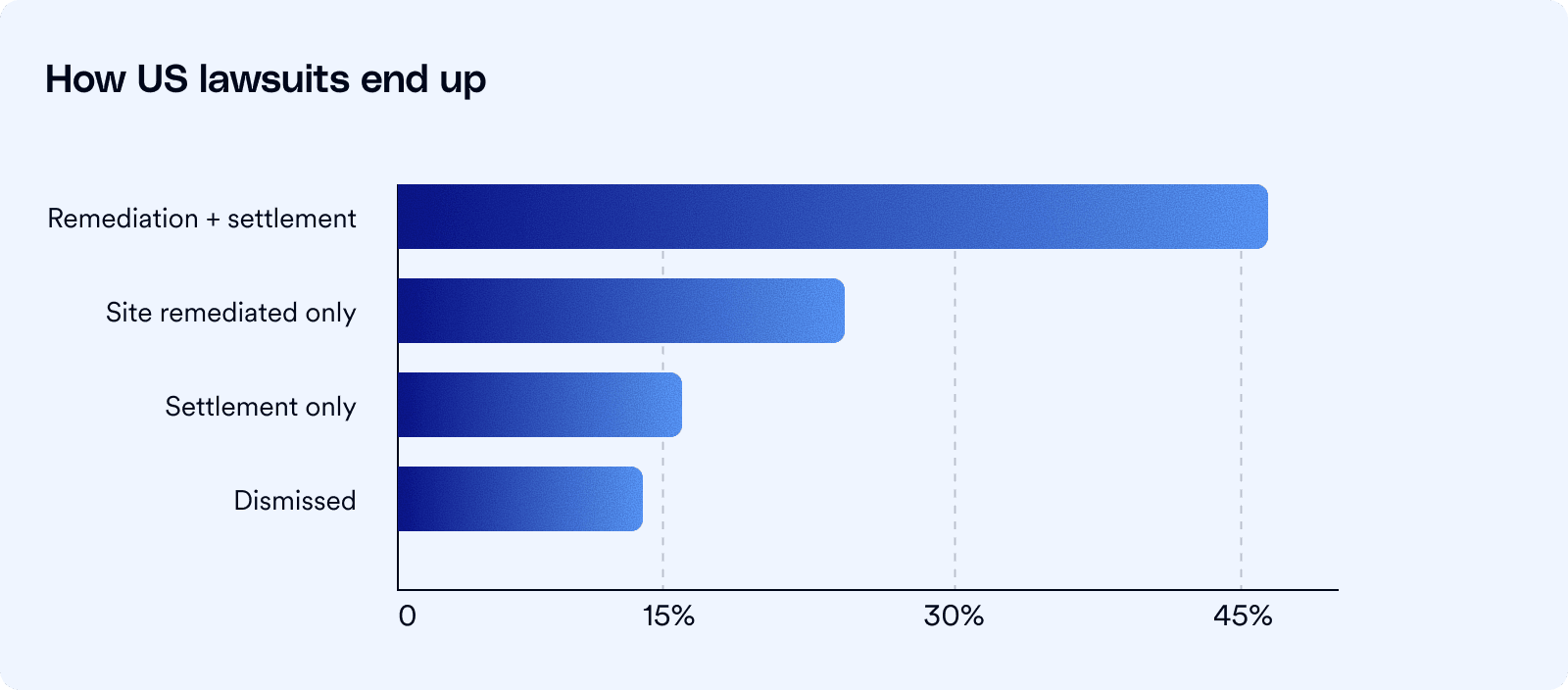
Among US agencies that have faced a lawsuit, 46% ended in remediation alongside a financial settlement.
Another 16% resulted in a settlement with no remediation attached, roughly 24% ended in site remediation without a formal settlement, and about 14% were dismissed outright. It’s worth noting that resolution with no remediation can leave the underlying exposure fully intact — the claim is closed, but the site is not meaningfully different from the one that got sued.
That pattern is worth sitting with. Industry-wide data backs up why dismissal is the exception rather than the rule: across the broader litigation landscape, the presence of an accessibility widget doesn’t stop a lawsuit from being filed, and it doesn’t make a case go away once it is — widgets only address a limited slice of what an audit catches, so a business that leans on one alone is rarely in a position to win outright.
Repeat litigation is the norm, not the exception
Getting sued once doesn’t put the risk behind an agency or its client — for a meaningful share of defendants, it’s just the first of several.
In 2025, 46% of federal accessibility cases targeted a defendant who had already been sued before — nearly half.
Of the more than 5,000 digital accessibility lawsuits filed last year, 1,427 targeted companies with a prior claim on record. Mid-year 2026 data shows no sign of that easing: filings are on pace for a new annual record, and monthly tracking through the summer continued to show a steady share of newly sued companies being repeat defendants, not first-time targets.
Why this matters
Resolving a claim isn’t proof the risk is closed. Being sued once, fixing it, and moving on doesn’t mean an agency or its client is safe from the same claim happening again — nearly half of all federal cases in 2025 involved exactly that pattern, and the volume climbing into 2026 suggests it isn’t going away. That’s why accessibility is continuous work, not a project with an end date.
Help your clients stay ahead of the curve and mitigate legal risk
Agencies are already positioned to solve the exact problem this report describes—building accessibility in from the start and keeping it in place as a site changes, rather than waiting for a claim to force the work.
Partnering with accessiBe is how that gets done in practice: the platform combines AI-powered automation with code-level remediation and litigation support, so an agency can offer real, ongoing protection instead of a one-time fix that drifts out of compliance six months later.
There’s a business case in it too, not just a client-protection one.
accessiBe’s partner program gives agencies a way to turn accessibility into recurring revenue on accounts they already manage — referring clients, reselling directly, or building it into development work already being done — rather than treating it as a cost center or a favor.
Litigation support is included on qualifying client plans at no additional cost, which agencies can point to directly as part of what makes their offering more defensible than a competitor’s.
Help your clients advance accessibility and grow your business
Refer, resell, or build with accessiBe and get the tools, support, and earning opportunities to make accessibility a stronger part of your client offering.
Frequently asked questions about digital accessibility legal action
How many US web agencies have faced an accessibility lawsuit?
A third of US agencies surveyed have already been part of an accessibility lawsuit or claim, either directly or through a client — including 14.9% sued directly, 8.4% with a client sued, and 9.1% where both happened at once.
How many web accessibility lawsuits were filed in 2025 and 2026?
More than 5,000 web accessibility lawsuits were filed in the US in 2025, the highest annual total on record. Mid-2026 filings put the full-year projection at roughly 6,176 lawsuits.
Does resolving one accessibility lawsuit protect a company from being sued again?
No. Nearly half of federal accessibility cases in 2025 (46%) targeted a defendant who had already been sued before. Resolving a claim isn’t proof the underlying exposure is closed.
How do most US accessibility lawsuits get resolved?
46% end in remediation alongside a financial settlement, 24% end in site remediation without a formal settlement, 16% end in a settlement with no remediation, and 14% are dismissed outright.
Does a settlement without remediation actually reduce legal risk?
Not necessarily. A settlement with no remediation attached closes the claim but can leave the site — and the underlying exposure — unchanged.
Which types of websites face the highest accessibility lawsuit risk?
eCommerce sites accounted for 70% of digital accessibility lawsuits tracked through year-end 2025, and 36% of companies sued had more than $25 million in annual revenue.
How can agencies help clients manage ongoing accessibility legal risk?
Through accessiBe’s partner program, agencies can turn accessibility into recurring revenue on accounts they already manage by referring clients, reselling accessiBe’s solutions directly, or building accessibility into development work already underway — with litigation support included on qualifying client plans.