

In short:
- To understand the real state of digital accessibility across healthcare, we scanned 300 websites belonging to organizations subject to Section 504 compliance requirements. Of the 235 sites that returned usable results, 84.3% showed measurable accessibility gaps — and only 15.7% met baseline accessibility benchmarks. The findings reveal that accessibility failures in healthcare are not isolated or edge-case. They are structural, widespread, and concentrated in exactly the areas that matter most for patient access: navigation, forms, and interactive content.
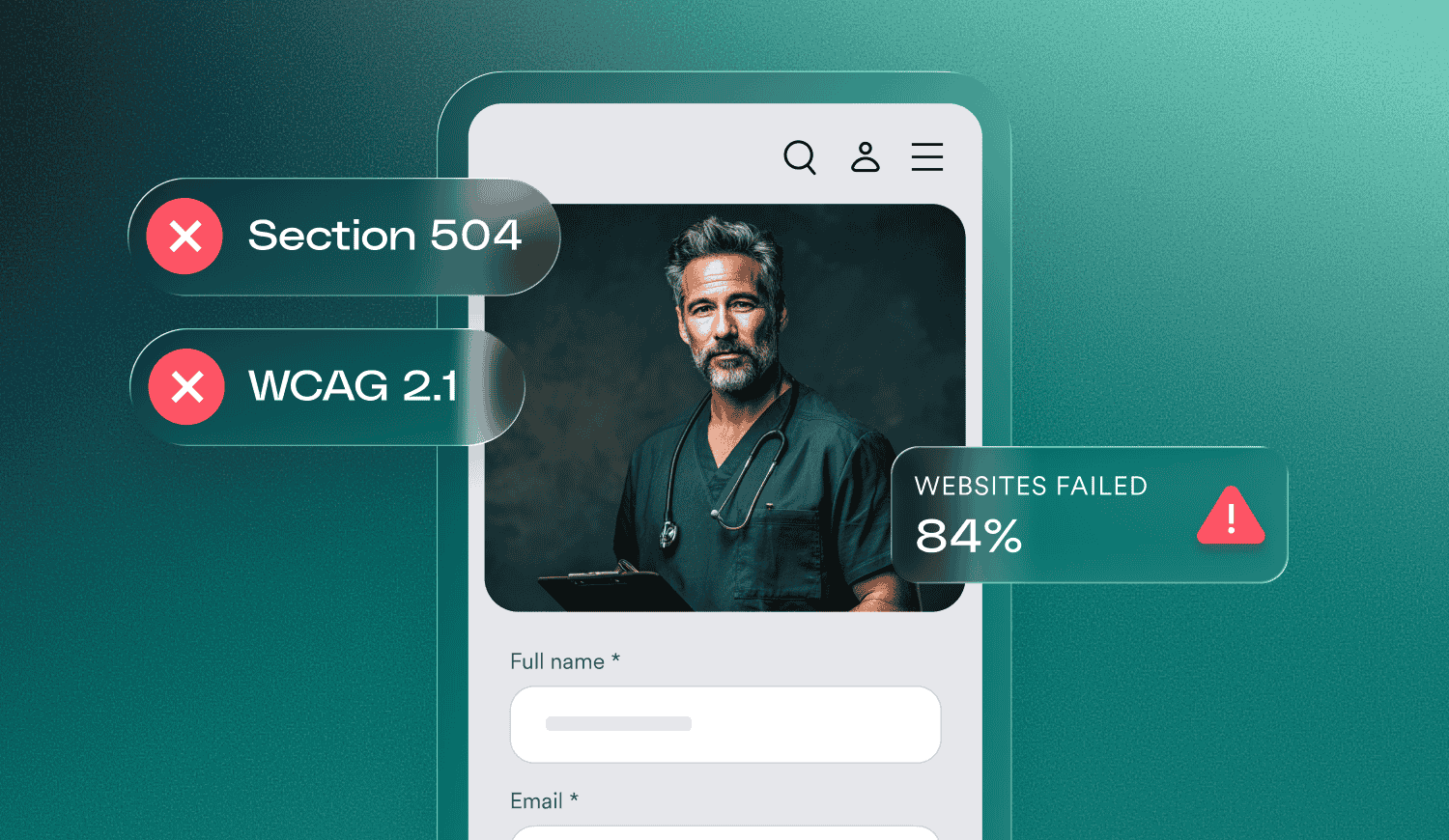
Healthcare consistently ranks among the most active sectors for digital accessibility litigation. In 2025 alone, 5,114 digital accessibility lawsuits were filed across industries — and healthcare’s share continues to grow as plaintiff attorneys gain access to an explicit technical standard under the 2024 Section 504 Final Rule.
Yet for many healthcare organizations, the actual state of their digital accessibility is unknown. Audits are expensive, internal expertise is scarce, and the daily demands of running a healthcare operation leave little bandwidth for systematic digital review.
To understand the gap between where healthcare organizations need to be — and where they actually are — we scanned 300 websites belonging to organizations subject to Section 504 requirements, evaluating them against WCAG 2.1 Level AA criteria.
What we found was consistent across the board: accessibility failures in this sector are not isolated or edge-case. They are structural, widespread, and concentrated in exactly the areas patients rely on most.
Why we conducted this scan
The 2024 HHS Section 504 Final Rule establishes WCAG 2.1 Level AA as the technical standard for digital accessibility across HHS-funded healthcare organizations. WCAG — the Web Content Accessibility Guidelines, developed by the World Wide Web Consortium (W3C) — defines measurable criteria across three conformance levels: Level A covers the most fundamental requirements, Level AA is the standard required by most accessibility regulations worldwide and what Section 504 now mandates, and Level AAA represents the highest level of conformance.
Most organizations understand the regulation in broad terms. Fewer have a clear picture of where their digital environment actually stands against it.
To provide that picture, we evaluated 300 websites belonging to healthcare organizations subject to Section 504 requirements against WCAG 2.1 Level AA criteria — examining the foundational accessibility components most directly tied to usability, workflow completion, and patient access.
What we found across 300 healthcare websites
The results point in one direction. Of the healthcare websites we scanned against WCAG 2.1 Level AA criteria:
- 84.3% showed measurable accessibility gaps
- Only 15.7% met baseline accessibility benchmarks
- 90% had no visible accessibility solution in place
That means 5 in 6 websites belonging to organizations now subject to Section 504’s digital accessibility requirements have failures that would be detectable by a patient using assistive technology — and documentable by OCR in a compliance review.
The 90% figure is worth pausing on. It means that beyond having accessibility failures, the vast majority of these organizations have no structured accessibility program visible in their digital environment at all. Not a partial solution. Not a work in progress. Nothing.
For organizations preparing to demonstrate good-faith, documented progress to OCR — which is the standard the enforcement framework is built around — that absence is itself a significant risk.
Where the gaps are concentrated
The scan evaluated six foundational accessibility areas — the components most directly tied to whether patients can navigate, interact with, and complete tasks on a healthcare website. The failures were not evenly distributed. They clustered in the structural and interactive layers that patients depend on most.
Structural navigation
Only 14% of sites properly structured their pages for assistive technologies. Page landmarks — the structural signposts that allow screen reader users to move efficiently between sections of a page — were missing or incorrectly implemented on the vast majority of sites scanned.
For a patient using a screen reader to find a contact form, a service description, or a scheduling link, the absence of proper structure means navigating the entire page linearly — a slow, disorienting experience that often ends in abandonment.
Forms and transactions
Labeling and error clarity were inconsistent across the sites scanned. For healthcare organizations, this is a high-stakes category: equipment ordering, appointment scheduling, intake forms, and bill payment all depend on forms that assistive technology users can navigate and complete independently. When form fields lack proper labels, a screen reader user may not know what information a field is asking for — or whether they’ve made an error.
ARIA and dynamic content
Only 29% of sites properly implemented ARIA attributes for modern interactive elements. ARIA — Accessible Rich Internet Applications — is the technical framework that allows dynamic web components to communicate their state and purpose to screen readers. Without it, dropdowns, modals, and tabbed interfaces may be invisible or meaningless to assistive technology users.

Tables and data presentation
0% of scanned sites passed table accessibility checks. Pricing information, service comparisons, product listings, and billing details — content patients frequently need to review before taking action — may be entirely unreadable for users relying on assistive technologies.
Tabs and interactive components
Fewer than 1% of sites handled tab functionality correctly. Tabbed navigation is common in healthcare web environments, used to organize services, resources, and patient information. When tab functionality is inaccessible, the content behind those tabs may be unreachable for keyboard-only users and screen reader users alike.
Draggable elements
100% of scanned sites failed draggable element accessibility. Users who cannot operate a mouse — including many patients with mobility impairments — may be blocked entirely from features that rely on drag-and-drop interactions.
What these failures mean for patients
The failure categories above are technical in description. Their consequences for patients are immediate and concrete:
- A patient using a screen reader on a site without proper navigation structure cannot efficiently find what they need — a scheduling link, a contact form, a service description. They are forced to navigate the entire page linearly, repeatedly, until they either find it or give up.
- When form fields are unlabeled, a patient using assistive technology may not know what information is being asked for, whether they’ve made an error, or whether their submission went through. For someone trying to order medical equipment or complete an intake process, that is a blocked transaction — not a minor inconvenience.
- When tables fail accessibility standards — and none of the sites we scanned passed table accessibility checks — pricing, billing, and service information becomes unreadable for patients relying on screen readers.
Section 504 exists because access to healthcare services is not discretionary. When the digital pathway to those services is blocked, the impact falls on the patients least able to navigate around it.
Closing the gap: how accessiBe can help
The data is conclusive: most healthcare organizations subject to Section 504 have significant accessibility work ahead of them. Closing that gap requires a layered approach — structured auditing to understand where you stand, ongoing remediation to address what’s found, and documentation to demonstrate that progress is real and continuous.
Combining the best in AI automation, human expertise, and developer tools, accessiBe’s end-to-end accessibility platform helps healthcare organizations build a compliance program that holds up:
- AI-powered remediation — automated coverage across public-facing web environments addresses common accessibility barriers at scale, delivering screen reader compatibility and keyboard-only navigation – areas in which most sites fail
- Source code accessibility — developer-level tooling identifies and tracks WCAG issues at the code level, including ARIA implementation gaps, heading structure failures, and unlabeled form fields — the structural issues our scan found most consistently across healthcare websites
- Expert audits and VPAT documentation — manual accessibility testing against WCAG 2.1 AA gives you a clear, documented picture of where your organization stands today, and produces the Accessibility Conformance Reports that form the foundation of a defensible compliance record
Frequently asked questions
How many healthcare websites showed accessibility issues in the study?
Of the 235 healthcare websites that returned usable results, 84.3% showed measurable accessibility gaps when evaluated against WCAG 2.1 Level AA criteria. Only 15.7% met the baseline accessibility benchmarks used in the study.
What types of accessibility issues were most common?
The most common issues affected the features patients rely on most, including page structure, forms, ARIA implementation, tables, interactive tabs, and draggable elements. These issues can make it difficult or impossible for people using assistive technologies to complete common healthcare tasks.
Does an inaccessible website automatically mean an organization is not compliant with Section 504?
Not necessarily. This study highlights common accessibility gaps but is not a legal determination of compliance. Section 504 compliance depends on the accessibility of an organization’s broader digital environment and its overall accessibility program, not a single website scan.
Why are forms and patient-facing interactions a high-risk area?
Healthcare websites rely heavily on forms for appointment scheduling, patient registration, bill payment, and other essential services. If these forms are inaccessible, patients using screen readers or keyboard navigation may be unable to complete critical healthcare tasks independently.
Can automated accessibility scans identify every accessibility issue?
No. Automated scans are valuable for identifying many common accessibility problems, but they cannot evaluate every WCAG 2.1 Level AA success criterion. Manual testing remains an essential part of understanding an organization’s overall accessibility posture.
Why does this research matter for healthcare organizations?
The findings show that accessibility barriers are widespread across healthcare websites, particularly in areas that directly affect patient access. Organizations can use this type of data to prioritize remediation efforts and build a documented accessibility program before accessibility issues become compliance or patient experience risks.
Does this study include patient portals and other third-party healthcare platforms?
No. The research evaluated publicly accessible healthcare websites. Organizations should also assess patient portals, scheduling systems, telehealth platforms, and other digital services that fall within the scope of Section 504.
What should healthcare organizations do if they discover accessibility gaps?
The best approach is to build a structured accessibility program that includes automated testing, manual audits, remediation, ongoing monitoring, and documentation of progress. This helps improve both patient access and long-term compliance readiness.