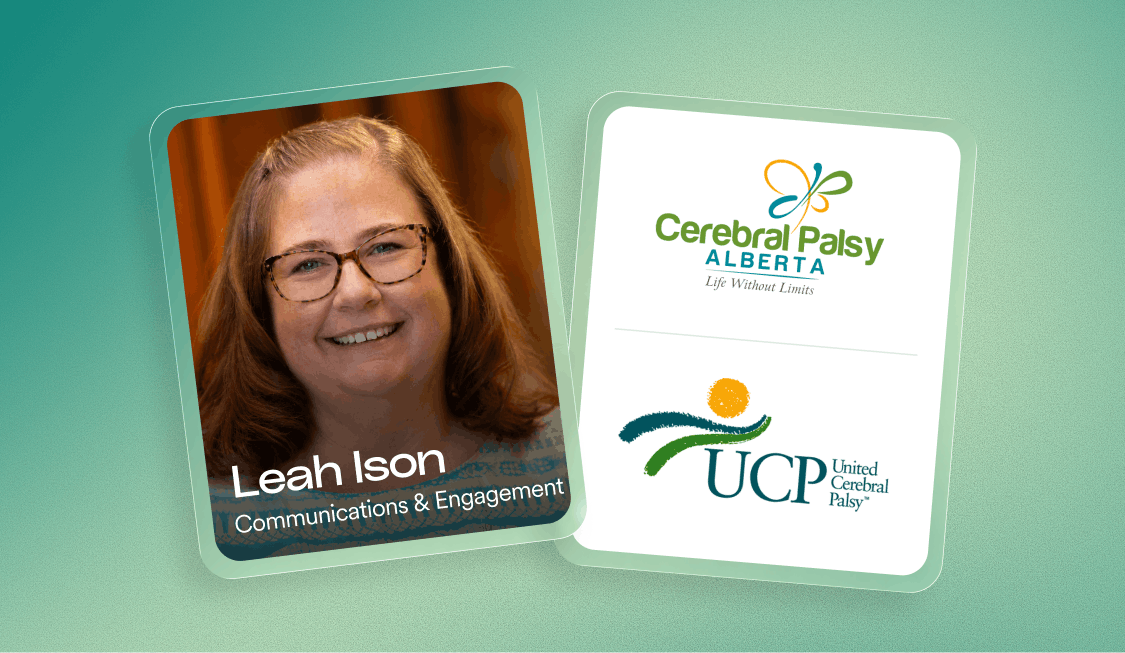
This blog is part of our GAAD (Global Accessibility Awareness Day) series spotlighting members of accessiBe’s Inclusive Product Advisory Board — disability community leaders and advocates helping shape how accessibility is built in practice. Advisory board sessions are moderated by Josh Basile, accessiBe’s Community Relations Manager, C4-5 quadriplegic, and disability rights advocate.
Meet Leah Ison, Communications and Engagement Specialist, CP Alberta
Leah Ison handles communications and engagement for CP Alberta, a Canadian nonprofit serving people with cerebral palsy and other disabilities. CP Alberta is one of 57 affiliates of United Cerebral Palsy (UCP) — an international network serving approximately 200,000 individuals with cerebral palsy and other disabilities. UCP’s mission extends well beyond a single diagnosis: it exists to empower people with disabilities and their families to live full, self-determined lives.
Leah is an active and consistent voice across the advisory board sessions — the kind of participant who asks practical questions, builds on others’ ideas, and brings genuine curiosity to every product conversation. She is also the co-host of “My Life Without Limits,” a podcast from CP Alberta hosted alongside Carlos Gonzalez, who lives with cerebral palsy. The show brings honest perspectives from the disability community — featuring success stories, conversations about disability issues and mental health, and insights from people with disabilities, caregivers, and guests from across the community. It’s a window into what it actually means to live a life without limits in a world that doesn’t always make that easy.
In her communications work, Leah has been actively integrating AI — using ChatGPT for content creation and blog posts, attending AI fundraising summits, and looking for ways to bring new technology into CP Alberta’s work.
What accessibility barriers do people with physical and developmental disabilities face online?
Cerebral palsy and the broader range of disabilities UCP serves present differently for every person — affecting motor control, coordination, communication, and sometimes cognition, in combinations that vary widely. The digital barriers this community faces reflect that variability: some users navigate with keyboards or switches, others with voice control, others with eye-tracking. Some need simplified language, others need visual adjustments, and others need content that works reliably with the assistive technology they depend on every day.
For UCP and its affiliates, the stakes are high. The organization’s website is a primary access point for thousands of individuals and families seeking resources and support. As former UCP President and CEO Armando Contreras put it when the organization undertook its accessibility-focused website rebuild:
“Our website is more than a digital presence — it’s a lifeline for the disability community, including the families and individuals served by UCP’s affiliate network. By making it accessible, we’re ensuring that everyone, regardless of ability, can find the resources and support they need.”
What Leah brought to the table
Leah brought a perspective to the advisory board that deserves more space in accessibility conversations: the caregiver or support person who navigates a website alongside someone with a disability.
“Thinking about if there is a caregiver or somebody who’s navigating the website with somebody — that maybe it helps them to be able to understand it as well, somebody that might be just a step outside of that community.” — Leah Ison
It’s an observation with significant implications. A family member, a support worker, or a care coordinator helping someone with a disability use a website needs the same accessible, intuitive experience.
Accessibility is for everyone — and the stakes double when a person with a disability and the caregiver or support person navigating alongside them both hit a wall. If neither can find the information they need, complete a form, or access a resource, the website has failed the whole relationship. Designing for the disability community means designing for everyone.
Leah’s role as a UCP affiliate representative also gives her contributions a grounding that goes beyond the advisory board. When UCP undertook a full website rebuild in 2024, the organization integrated accessFlow — accessiBe’s developer-first accessibility platform — into the build. The results were concrete: accessibility built into the development process from the start, automated scans and guided fixes that reduced remediation time, and a website launched on time with inclusion at its core.
“As a UCP Affiliate representing the national organization on accessiBe’s Inclusive Product Advisory Board, it’s meaningful to provide direct feedback that shapes accessibility solutions.” — Leah Ison
That feedback loop — between the advisory board and the products accessiBe builds — is exactly what the partnership is designed to create.
The takeaway
Accessibility for the physical and developmental disability community is not a single solution. It is a spectrum of needs that requires tools flexible enough to serve a wide range of users — and organizations willing to listen to the people who know those users best. Leah’s presence on the advisory board, and UCP’s partnership with accessiBe, are both expressions of that commitment.
Listen to “My Life Without Limits”: cpalberta.com/my-life-without-limits-podcast