This blog is part of our GAAD (Global Accessibility Awareness Day) series spotlighting members of accessiBe’s Inclusive Product Advisory Board — disability community leaders and advocates helping shape how accessibility is built in practice. Advisory board sessions are moderated by Josh Basile, accessiBe’s Community Relations Manager, C4-5 quadriplegic, and disability rights advocate.
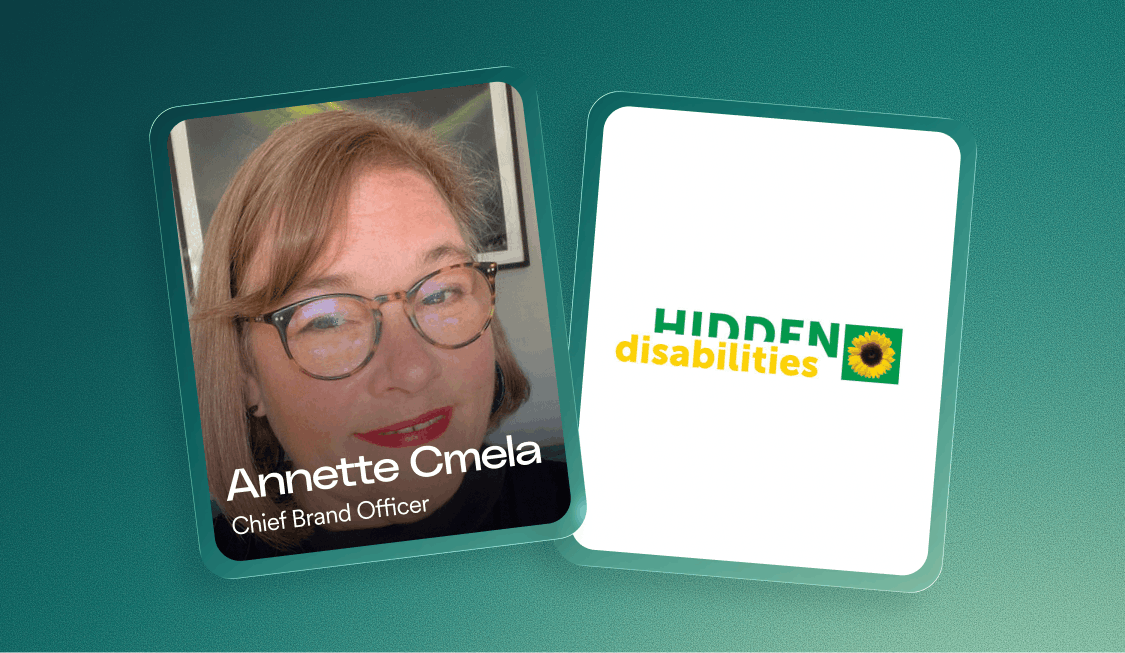
Meet Annette Cmela, Chief Brand Officer, Hidden Disabilities Sunflower
Annette Cmela leads the brand behind one of the most recognized symbols in disability advocacy: the Sunflower lanyard. As Global Chief Brand Officer at Hidden Disabilities Sunflower, she is responsible for expanding a program that began at Gatwick Airport in 2016 into a global movement now recognized by airports, retailers, healthcare systems, and employers across dozens of countries.
The premise of the Sunflower is simple and powerful: a Sunflower lanyard, badge, or other item is a voluntary, discreet signal that someone has a non-visible disability and may need a helping hand, additional time, or a little more understanding. No explanation required. No proof needed. Just a signal that asks for support without demanding disclosure.
The Sunflower symbol is internationally recognizable — a remarkable achievement in a space where awareness campaigns rarely translate into the kind of practical, behavioral change the Sunflower program has produced. Hidden Disabilities Sunflower works with businesses across retail, financial services, education, healthcare, and sport and leisure to create disability-inclusive cultures for both colleagues and customers. The program operates across countries and cultures.
What accessibility barriers do people with non-visible disabilities face online?
Non-visible disabilities are by definition not immediately apparent to others. That invisibility creates a specific kind of barrier: the burden of disclosure.
In physical spaces, the lanyard removes that burden. It gives people a way to signal what they need without having to explain why.
Online, that signal doesn’t exist. Only 5% of the internet is accessible, which means most websites were never built with the non-visible disability community in mind. Website managers don’t know who is navigating their site or what they need — and most have never tested their experience with the people who struggle most to use it. The organizations that do invest in accessibility audits and user testing with disabled people are doing something meaningful. They are also still the exception.
The burden of disclosure showed up directly in the advisory board’s feedback. Members pushed back on accessibility profiles titled after medical diagnoses — pointing out that asking someone to identify with a clinical label just to access a feature is its own form of disclosure. That feedback has shaped a shift in how accessiBe describes its profiles: leading with what each setting does rather than who it’s for, so that anyone who needs it can find it without having to claim a diagnosis first.
Critically, when someone uses the accessWidget to adjust their experience, accessiBe processes only non-personal information — the adjustments a person makes on a website are their own, and are not tied to an identifiable individual.
That’s what makes digital accessibility solutions like the accessWidget have an immediate impact for the hidden disability community. When someone can adjust their own experience — simplifying content, increasing contrast, reducing motion — they are not asking for accommodation. They are taking it on their own terms.
What Annette brought to the table
Annette brings a global, brand-driven perspective to the advisory board that is distinct from the more technical or clinically grounded voices in the room. Her work at Hidden Disabilities Sunflower is fundamentally about changing behavior at scale — getting businesses, institutions, and individuals to recognize and respond to needs that aren’t visible. That is a branding and culture challenge as much as a policy one, and it’s a lens the advisory board benefits from having.
Her presence on the board also reinforces a principle that runs through the Sunflower program’s entire existence: the population of people who benefit from inclusive design is far larger than the number of people who identify as disabled. Most people who use the Sunflower have never thought of themselves as disabled. Most people who would benefit from a more accessible website have never used an accessibility tool. Closing that gap is not just a technical problem, it’s a communication and culture problem.
That perspective will be front and center at the accessiBe GAAD webinar on May 20th, where Annette will join a conversation about what it actually takes to build an accessible brand.
The takeaway
The Sunflower symbol has become a shorthand for something profound: that disability is not always visible, that the need for accommodation is not always obvious, and that a simple, low-friction signal can change how people are treated in the world. Digital accessibility needs its own equivalent, the accessWidget is exactly that. When added to a website it does not alter the original design or impact other visitors’ experience. It enables anyone to customize their browsing session to meet their needs. Those looking for source-code accessibility, can also rely on accessiBe’s accessibility platform. accessFlow, its tool for developers – helps flag accessibility issues at the code level, tie each one to the relevant WCAG criterion, and guide teams through remediation — within your IDE and at every stage of the development cycle.
True digital inclusion isn’t about forced disclosure; it’s about providing a solution that makes the web work better for the person using it, on their own terms.
Learn more about Hidden Disabilities Sunflower here: https://hdsunflower.com/