When evaluating web accessibility solutions, it’s easy to get lost in feature lists and marketing claims. What’s harder to spin is what verified customers say — consistently, over time, across hundreds of independent reviews.
That’s what makes G2 one of the most useful tools in the evaluation process. Its ratings are built entirely from verified customer feedback, scored across consistent satisfaction categories, and updated continuously as new reviews come in. There’s no editorial bias. The scores reflect how real teams experience a product in practice.
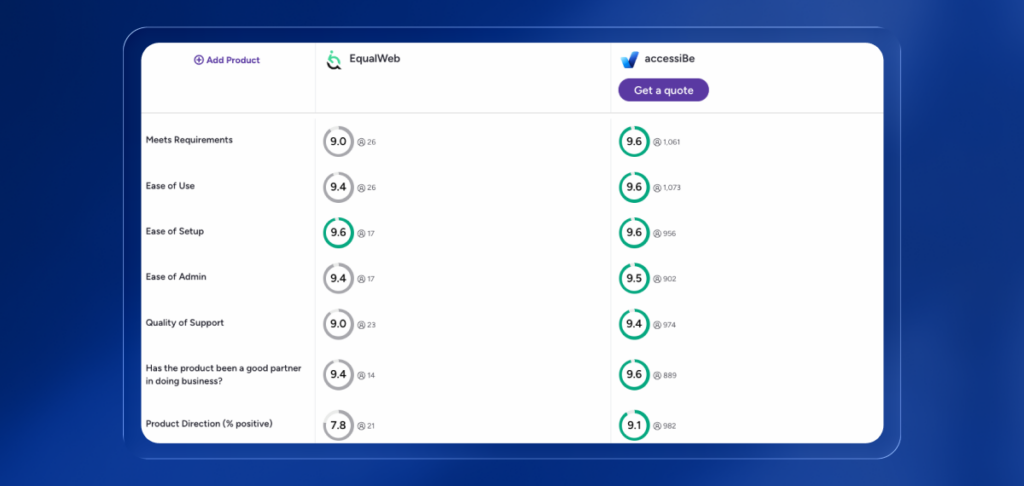
According to G2’s publicly available data, accessiBe outscores EqualWeb in six of seven core satisfaction categories. In most cases, that advantage holds across a review base that dwarfs EqualWeb’s — giving the data considerably more weight.
This guide walks through each G2 category, explains what it actually measures, and lays out what the scores mean for teams evaluating accessibility solutions and making an informed choice.
Important note: All comparisons in this article are based exclusively on G2’s publicly available ratings and review counts. Any discussion of platform structure or accessibility approach is presented separately from G2 data to maintain accuracy and transparency.
Delivering on what teams expect — advantage accessiBe
The Meets Requirements category captures something deceptively simple: does the solution actually do what customers expected when they bought it? It’s one of the clearest indicators of product fit and real-world reliability.
On G2, accessiBe holds a Meets Requirements score of 9.6, based on 1,061 verified reviews. EqualWeb scores 9.0, based on 26.
That’s not just a numerical gap — it’s a signal about confidence. A score drawn from more than 1,000 responses has been tested across a much wider range of use cases, team sizes, and industries. When that score is still 9.6, it reflects consistent product delivery at scale.
Ease of use without unnecessary complexity — advantage accessiBe
Ease of use speaks to the day-to-day experience of actually working with a platform. It captures how intuitive the interface feels, how easily administrators can find what they need, and how much friction teams encounter during ongoing use — not just setup.
accessiBe scores 9.6 here, compared to EqualWeb’s 9.4.
For organizations without a dedicated accessibility team, usability directly affects how consistently accessibility gets managed. Platforms that are easier to navigate tend to get used more reliably — which matters when accessibility is an ongoing responsibility, not a one-time project.
Getting up and running smoothly — tied
Ease of setup reflects the installation and onboarding experience: how smoothly teams can move from evaluation to a working implementation.
Both platforms score 9.6 in this category. That’s a meaningful result on its own — it suggests customers of both solutions generally find the setup process manageable. accessiBe’s score reflects input from 956 verified reviewers, compared to 17 for EqualWeb.
Simpler administration over time — advantage accessiBe
Ease of admin measures the long-term experience of managing a platform. As websites grow and content changes, accessibility can’t be a set-it-and-forget-it exercise. This category captures how easily teams can stay on top of that ongoing responsibility.
accessiBe scores 9.5 for Ease of Admin. EqualWeb scores 9.4.
The gap is narrow, but the direction is consistent: customers more frequently report that accessiBe is easier to manage over time. For teams carrying accessibility responsibilities alongside other priorities, that sustained manageability makes a real difference.
A reliable partner over time — advantage accessiBe
This category asks a straightforward question: has this vendor been a good business partner? It reflects the quality of the ongoing relationship — communication, reliability, and how easy the company is to work with as needs evolve.
accessiBe scores 9.6 here, based on 889 reviews. EqualWeb scores 9.4, based on 14.
Scores in this category are shaped by repeated interactions over time, not first impressions. A higher rating tends to reflect consistency — teams that can rely on their vendor not just during onboarding, but across the full lifecycle of their accessibility work.
Quality of support — advantage accessiBe
Quality of support captures how customers rate their direct interactions with a vendor’s support team: responsiveness, expertise, and the overall quality of help received.
accessiBe scores 9.4 in this category, based on 974 reviews. EqualWeb scores 9.0, based on 23.
Both platforms receive positive feedback on support, but the spread here is notable. A 0.4-point gap in support quality, confirmed across nearly a thousand verified responses, reflects something systematic rather than anecdotal.
Confidence in product direction — advantage accessiBe
Product Direction measures how confident customers feel about where a platform is headed. It reflects whether users believe the product is evolving in ways that match their needs — a signal of long-term trust rather than just current satisfaction.
accessiBe scores 9.1 in this category, based on 982 reviews. EqualWeb scores 7.8, based on 21.
This is the largest gap in the entire comparison. A score of 7.8 in product direction isn’t catastrophic, but it does suggest that EqualWeb customers are less consistently confident about the platform’s roadmap and future trajectory. For teams making a long-term investment in accessibility infrastructure, that confidence matters.
Going beyond G2 reviews: selecting the platform that best fits your needs
G2 scores provide an objective, customer-sourced foundation for comparison. But for most organizations, the right choice also depends on how a platform supports accessibility in practice — not just at launch, but as websites grow, regulations shift, and accessibility demands become more sophisticated.
accessiBe’s platform combines the best in AI automation, developer tools, and human expertise – designed to support accessibility as a continuous effort rather than a one-time implementation.
AI-powered accessibility automation
accessWidget uses AI-driven processes to identify and address accessibility barriers at scale. It supports compatibility with assistive technologies, including screen readers, and enables keyboard-only navigation — both foundational elements of an accessible digital experience. Visitors can also activate an accessibility interface that allows them to personalize visual and interaction settings based on their individual needs.
For more complex or highly customized websites, accessWidget can be further refined through manual review and targeted adjustments, allowing its AI to better support essential user journeys like navigation, forms, and transactional flows.
Developer-focused accessibility tools
For teams that want accessibility integrated directly into their development workflow, accessFlow provides a developer-first approach. It surfaces accessibility issues at the code level, offers clear guidance to support remediation, and includes an SDK that enables testing throughout the development lifecycle. MCP support lets developers address accessibility issues directly within their IDE — keeping accessibility part of everyday development work rather than a separate review cycle.
Expert services
accessiBe also provides access to expert-led services, including manual audits, PDF and document remediation, VPAT support, and usability testing conducted by people with disabilities. These services help organizations address accessibility challenges that extend beyond automation and support stronger long-term governance.
When accessibility-related legal action arises, having the right partner matters. accessiBe’s Litigation Support Package gives organizations dedicated guidance throughout the process, documentation that demonstrates ongoing accessibility efforts, and hands-on assistance tailored to the situation.x
Speak with one of our accessibility experts to find a plan tailored to your needs.