The DOJ has extended ADA Title II compliance deadlines by one year — to April 26, 2027 for larger entities and April 26, 2028 for smaller ones. Many agencies are treating that as breathing room. It isn’t — at least not for procurement.
The deadline moved. The vendor accountability gap didn’t.
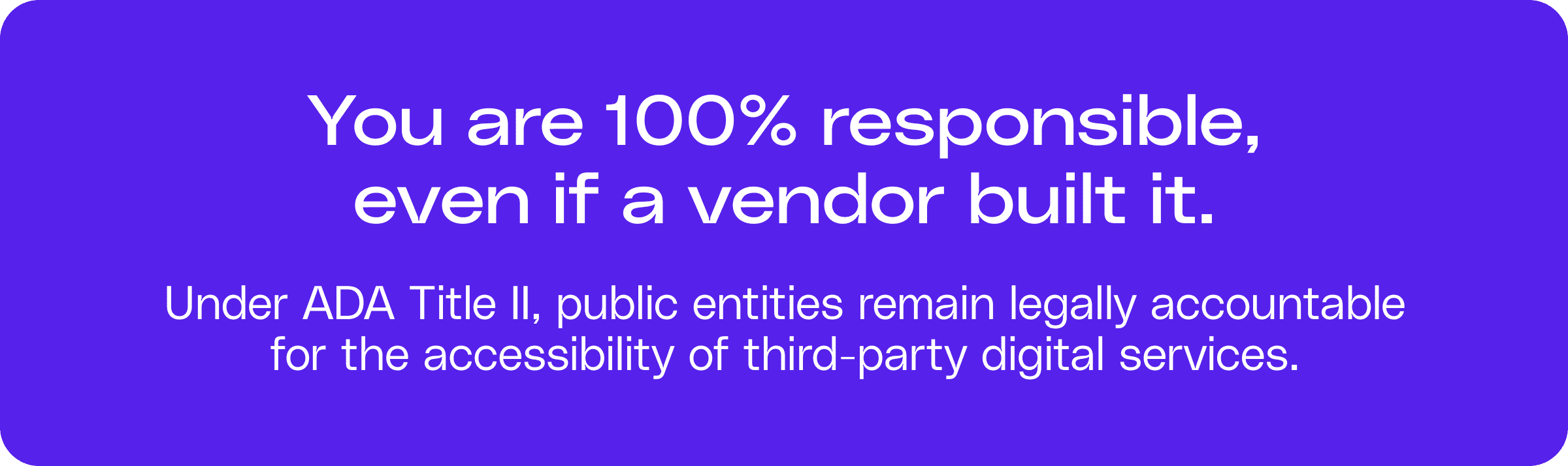
Most state and local governments don’t build their digital services from scratch — they purchase them: payment portals, website platforms, case management systems — from third-party vendors. Under Title II, outsourcing development does not outsource liability. All web content and mobile apps must conform to WCAG 2.1 Level AA, regardless of who built them. Agencies that don’t build accessibility into procurement now will inherit remediation debt they can’t compel vendors to fix later.
Building procurement accountability that holds up — regardless of the deadline
Moving from a reactive approach to a proactive, defensible strategy requires a shift in how your agency handles new partnerships. By integrating accessibility into the very beginning of your procurement process, you can mitigate legal risk and ensure that digital inclusion is a built-in feature rather than an afterthought.
Turning accountability into action requires a structured approach built around four key steps:
Step 1: Build leverage early
If you wait until a website is built to think about accessibility, you have already lost your primary source of leverage.
You must decide that accessibility is a core requirement before you even start looking for a solution.
Once you’ve done that, you should:
- Define the standard: In every Request for Proposal (RFP) and project brief, explicitly state that all deliverables must conform to WCAG 2.1 Level AA.
- Assign weight to accessibility: When scoring vendor bids, give accessibility the same importance as security or cost. If a product isn’t accessible, it isn’t functional.
- Set the expectation: Make it clear to potential partners that accessibility defects are “showstoppers” that can pause project milestones or payments.
Why this matters:
Procurement is the decisive moment where your agency either builds leverage or inherits long-term “remediation debt”. Under the DOJ’s Title II rule, you are legally responsible for the accessibility of your services, even when they are delivered through third-party platforms. If you don’t bake WCAG 2.1 Level AA requirements into the contract upfront, you lose the power to compel vendors to fix barriers later. This forces your staff to manage permanent operational burdens—like manual workarounds—while your agency carries the full legal risk.
Step 2: Share the responsibility correctly
A successful strategy relies on a clear division of labor. By defining roles upfront, you ensure that when a barrier is found, there is a clear path to a fix rather than a cycle of finger-pointing.
In practical terms, this means dividing ownership as follows:
- The vendor’s job (The Platform): The vendor is responsible for the code, navigation menus, and overall framework. They must ensure their “engine” supports your WCAG 2.1 AA obligations.
- Your job (The Content): Your team is responsible for the content you put inside that engine. This includes the text you write, the meaningful images you upload (ensuring they have alt text), and the accessibility of any PDFs or videos you post.
Designate a single internal accessibility lead to coordinate vendor oversight and documentation.
Why this matters:
Shared responsibility does not mean shared liability; under the ADA, the public entity remains solely accountable for the citizen experience. A clear division of labor prevents “structural risk,” where accessibility barriers fall into gray areas and never get fixed. By defining these roles, you ensure the vendor owns the platform-level code while your team focuses on content governance. This creates a defensible “evidence trail” showing regulators that you are exercising active oversight rather than relying on blind faith in a vendor.
Step 3: Write accountability into the contract
Don’t rely on a vendor’s verbal promise. Your contracts should include enforceable language that protects your agency and provides a safety net if a product falls short of the required standards.
To create this legal protection, your agreements should include:
- A commitment by the vendor to fix any accessibility bugs in their software at their own expense, not yours.
- A rule that future software updates must not break or remove any existing accessibility features.
- A “gatekeeper” clause that allows you to delay a launch if the product fails a final accessibility test.
Why this matters:
Contractual accountability is the only way to shift the cost of remediation back to the vendor. Without these clauses, accessibility barriers become a permanent “remediation debt” that your agency must pay for through manual workarounds or expensive third-party retrofitting. Treating accessibility as a standard product defect—with defined fix timelines and “go-live” authority—ensures that accessibility issues have a clear owner and a resolution deadline, transforming them from legal liabilities into manageable technical tasks.
Step 4: Verify vendor claims
Most vendors will provide a VPAT (Voluntary Product Accessibility Template) to show their product is accessible. Once a vendor fills out a VPAT, it becomes an ACR (Accessibility Conformance Report).
You must treat this document as a starting point, not a guarantee.
To ensure you aren’t stuck with a vendor’s mistakes, you should:
- Verify the version: Check that the report matches the exact software version you are buying. If a vendor gives you a report from an older version, ask for the current one.
- Look for “remarks”: A reliable report doesn’t just say “Supports”—it explains how the feature works for people with disabilities in the “Remarks” column. If the notes are blank, the product hasn’t been properly tested.
- Challenge “perfect” scores: No complex software is 100% accessible. If a vendor claims total support with zero known issues, ask them to provide their testing methodology or a roadmap for future fixes.
Procurement is the starting point — but defensibility depends on ongoing monitoring, documentation, and periodic re-testing as platforms evolve.
To help you maintain a defensible posture, accessiBe provides professional support for your documentation and auditing needs.
Our experts conduct manual testing to identify barriers that automated tools might miss and help you fill out a VPAT accurately. Once completed, these ACRs live on your website as a public record of your accessibility efforts and a key piece of your compliance strategy, ensuring your documentation remains current as your digital services evolve.
Why this matters:
Vetting vendor paperwork is the final check against “reactive” risk management. A VPAT is only as good as the audit that created it; empty “supports” columns or outdated version numbers are red flags that the vendor has not done the work. By verifying these claims, you ensure your agency is purchasing enforceable accountability rather than a paper shield. accessiBe can support this step by providing expert manual audits and helping you fill out an accurate VPAT, turning your ACR into a living, public record of your due diligence and proactive compliance strategy.
What a strong strategy looks like for 2027
With the April 2026 and 2027 ADA Title II deadlines approaching, a defensible procurement posture requires more than vendor documentation. It requires independent validation, accurate reporting, and ongoing oversight.
A strong strategy is not about achieving instant perfection. It is about demonstrating that your agency has an active, documented process for managing accessibility risk and holding vendors accountable as digital services evolve.
accessiBe’s accessServices provide professional support for accessibility testing, VPAT development, and documentation management — helping public entities identify barriers automated tools may miss and maintain current, publicly available Accessibility Conformance Reports (ACRs).
Accessibility in procurement is not about selecting a perfect vendor. It is about maintaining enforceable standards and a documented process that demonstrates ongoing accessibility oversight over time.
Speak with a Title II accessibility expert for a one-on-one review of your agency’s procurement strategy.
Frequently asked questions about government ADA Title II readiness
Q1. What is the ADA Title II rule for state and local government agencies?
A1. In April 2024, the Department of Justice (DOJ) issued a Final Rule clarifying that Title II of the Americans with Disabilities Act (ADA) applies to all digital services, programs, and activities. This mandate requires that all public-facing digital content—including websites, mobile apps, and documents—conforms to Web Content Accessibility Guidelines (WCAG) 2.1 Level AA.
Q2. What are the official deadlines for our agency to be ready?
A2. Compliance deadlines are determined by the population size of the public entity. Large agencies (serving 50,000 or more people) must ensure their digital content is conformant by April 24, 2026. Smaller agencies and special district governments have until April 26, 2027, to meet the same requirements.
Q3. How should our agency prioritize remediation across thousands of files?
A3. The DOJ recommends a risk-based approach centered on “public impact.” Your highest priority should be “service blockers”—digital materials that are required for a resident to complete a task, such as applying for benefits, paying a utility bill, or accessing emergency alerts.
Q4. Are we responsible for the accessibility of third-party or vendor systems?
A4. Yes. Public entities remain legally responsible for the accessibility of any digital service they provide, even if it is hosted or managed by a third-party vendor. It is essential to update your procurement rules to ensure all new vendor contracts and renewals explicitly require WCAG 2.1 Level AA conformance.
Q5. Can we provide a phone number as an “alternate access” route?
A5. No. Under the Title II rule, providing a phone number or email address is not a substitute for an accessible digital experience. Digital services must be accessible by default to ensure that people with disabilities have equal access to information and tasks on the same terms as everyone else.
Q6. What documentation is needed to show “defensible progress”?
A6. A defensible position is built on proof that your accessibility efforts are intentional and continuous. This includes maintaining a remediation log of audits and fixes, publishing a clear accessibility statement, and keeping records of how your agency prioritized high-impact public services.
Q7. How can accessiBe help our agency reach Title II readiness?
A7. As part of an end-to-end accessibility platform combining the best in AI automation, human expertise, and developer tools, accessiBe provides a layered solution for government agencies. accessWidget offers scalable AI-powered remediation for agency websites, while accessFlow allows technical teams to audit and monitor code-level accessibility in complex portals. Additionally, accessiBe’s expert services provide professional remediation for complex PDF forms and manual audits to address high-risk public assets.
Q8. The Title II deadline was just extended — does that change our procurement priorities?
A8. The DOJ extended compliance dates by one year — April 26, 2027 for larger entities, April 26, 2028 for smaller ones. But the extension applies to dates only. The substantive WCAG 2.1 Level AA requirements, vendor accountability obligations, and the agency’s legal responsibility for third-party digital services are all unchanged. Agencies that use the extension to build stronger procurement language, vendor accountability structures, and documented accessibility oversight will arrive at the new deadline in a significantly stronger position than those that wait. Procurement is where defensibility is built — not where it’s caught up on.