This blog is part of our GAAD (Global Accessibility Awareness Day) series spotlighting members of accessiBe’s Inclusive Product Advisory Board — disability community leaders and advocates helping shape how accessibility is built in practice. Advisory board sessions are moderated by Josh Basile, accessiBe’s Community Relations Manager, C4-5 quadriplegic, and disability rights advocate.
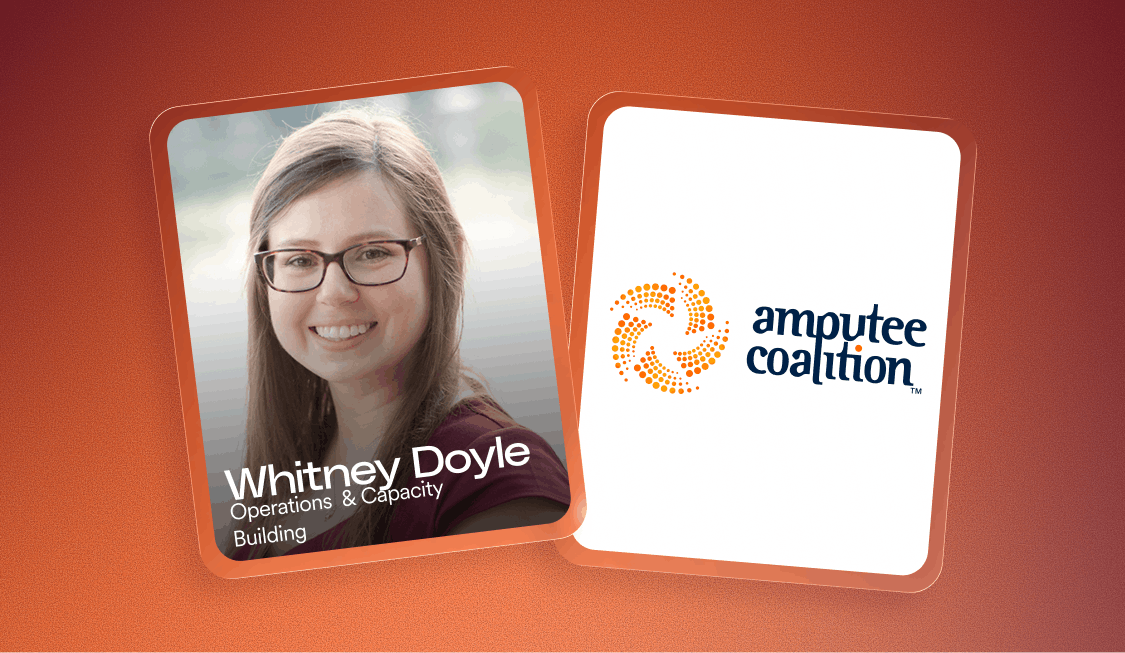
Meet Whitney Doyle, Director of Operations and Capacity Building at the Amputee Coalition
Whitney Doyle is the Director of Operations and Capacity Building at the Amputee Coalition, the leading national nonprofit organization representing people with limb loss and limb difference.
In that role, Whitney is responsible for ensuring the Coalition can scale its mission — which means making sure technology, processes, and people are aligned around serving a community with highly varied and often underrepresented needs. That includes integrating AI tools like live call transcription across the organization, so staff spend less time on administrative work and more time supporting the people who reach out for help.
She joined accessiBe’s Inclusive Product Advisory Board as one of three new members welcomed in the fall of 2025, bringing a perspective that bridges operational leadership with deep community knowledge.
What accessibility barriers do people with limb loss face online?
Approximately 5.6 million Americans live with limb loss or limb difference, according to research from the Amputee Coalition. These conditions can result from traumatic injury, vascular disease, cancer, or diabetes — which remains the leading cause of amputation in the United States.
Regardless of cause, people living with limb loss often navigate a combination of physical and emotional challenges that extend directly into digital environments. Navigation may depend on one-handed use or alternative input methods, assistive devices that require specific site configurations, or a reduced range of motion and precision. Small design decisions become significant barriers: buttons that are too small or too close together, interactions that require precise cursor control, drag-and-drop functionality that can’t be completed, or forms that time out before a task is finished.
Whitney emphasizes that interaction is only part of the challenge. Clarity is the other. Even well-intentioned accessibility features can become obstacles if their purpose isn’t immediately apparent — leaving people to guess whether a tool is meant for them, or how to use it effectively.
What Whitney brought to the table
Whitney’s presence on the board is a signal that accessibility for motor and physical disabilities goes well beyond keyboard navigation. The Amputee Coalition’s community adapts to the world every single day — and the web should be the easiest part of that adaptation, not an additional obstacle.
Whitney’s product testing contributions reflect both her operational mindset and her instinct for how real users actually navigate digital experiences.
She also flagged something that matters deeply for the communities both the Amputee Coalition and accessiBe serve: that accessibility for older adults isn’t just about bigger text or higher contrast. It’s about reducing complexity and making it easier to get from point A to point B.
“Older adults almost want things more simplified and less things to click on. The feedback we get about our website is that it’s overly complicated and they can’t find things.” — Whitney Doyle
The takeaway
The Amputee Coalition’s community adapts to the world every single day — and the web should be the easiest part of that adaptation, not an additional obstacle. Designing for that reality means questioning every small interaction: is this button reachable with one hand, is this form forgiving enough, is this label clear enough for someone to know it’s meant for them?
The Amputee Coalition’s work on peer support, advocacy, and education for people with limb loss is worth exploring for anyone whose life has been touched by amputation or limb difference — whether personally or through someone they care about.
Donate to the Amputee Coalition: https://amputee-coalition.org/