For many organizations, the journey toward digital accessibility begins with establishing a baseline of compliance. However, as digital experiences grow more complex and interactive, maintaining true accessibility across every user journey requires a broader, more integrated approach.
The ultimate level of accessibility is reached when digital products are tested and validated by real people with lived experience of disabilities.
While a manual audit can confirm that your code aligns with the Web Content Accessibility Guidelines (WCAG), only real-user feedback can bridge the gap between technical conformance and true usability.
In this blog, we’ll dive into how real-user feedback transforms digital environments from technically conformant to truly inclusive.
By incorporating the lived experiences of people with disabilities, businesses can uncover nuanced barriers that scans may miss, ensuring every user journey is seamless and equitable.
Validating digital inclusion: how people with disabilities test your site
To provide a complete picture of digital inclusion, the testing process incorporates a wide spectrum of users who rely on different input methods and technologies. Each group brings a unique perspective that is vital for creating a truly robust digital presence.
The process typically breaks down into these distinct perspectives to ensure every barrier is identified and addressed:
Ensuring a logical experience for screen reader users
People who are blind or have low vision rely on screen readers like JAWS, NVDA, or VoiceOver to navigate the web. These tools translate digital content into synthesized speech or Braille output, but they require a clear underlying code structure to function properly.
Testers from this group will inspect whether code elements, like ARIA attributes and landmarks, accurately describe the purpose of interactive components.
For example, a screen reader user will determine if a dropdown menu correctly announces its state—whether it is currently open or collapsed—which is a critical detail for successful navigation.
They also verify that the “reading order” of the site is logical rather than scattered, ensuring that content is announced in a way that makes sense.
Furthermore, these testers uncover barriers like “ambiguous link text,” identifying where descriptions must be more informative to help a user understand their destination.
Confirming clarity for users with hearing impairments
In this process, people with hearing impairments focus on the accessibility of time-based media, ensuring that video tours, podcasts, and audio clips feature accurate and synchronized captions and transcripts.
During the evaluation, testers validate that captions not only reflect spoken dialogue but also include descriptions of meaningful non-speech sounds, such as a phone ringing or music that sets a specific tone – ensuring full context is conveyed to the user.
Additionally, these testers evaluate auditory alerts that might otherwise exclude them. They ensure that any critical information traditionally delivered via sound—such as a notification ping or an error buzzer—is also provided through a visual cue or text notification.
This ensures that every message is received, regardless of a user’s ability to hear the audio.
Testing functional operability for those with motor disabilities
Users with motor impairments often utilize alternative input devices, such as switch controls, joysticks, trackballs, or mouth wands.
Testing for this group focuses on whether the entire site can be operated without a computer mouse.
A primary concern is the identification of “keyboard traps,” where a user might tab into a component, like a calendar widget or a pop-up modal, but find themselves unable to navigate back out.
They also verify that focus indicators are clearly visible, as these visual highlights show which element is currently selected. Without a strong, high-contrast focus indicator, a keyboard user is essentially navigating without a visual guide.
Finally, they inspect the interface to ensure it does not require complex multi-finger gestures, such as pinching to zoom or dragging in a specific path, which can be physically impossible for many users.
The need for user testing
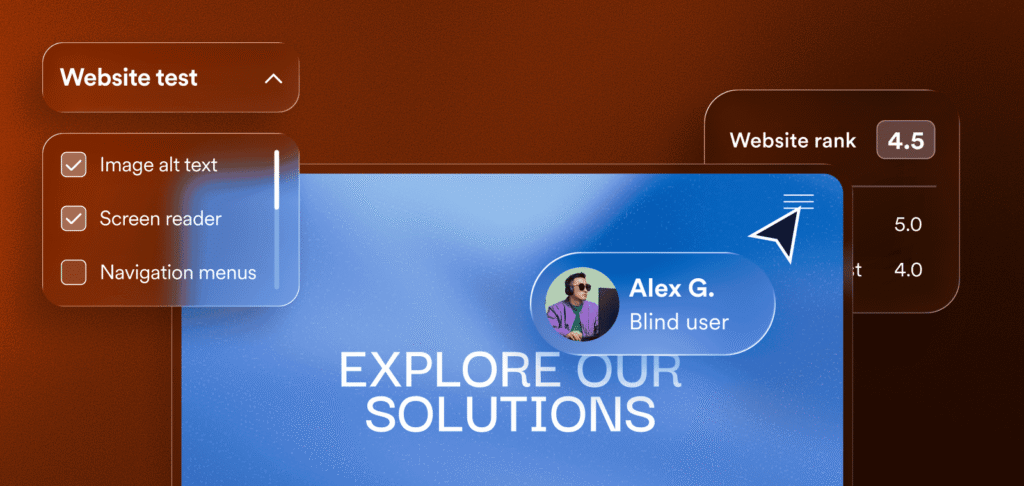
While a website can technically meet WCAG checkpoints on a code level, it may still be difficult for a person with a disability to operate in a fluid, meaningful way.
Manual code-based audits are highly efficient at detecting syntax errors or missing attributes, but they cannot fully evaluate the subjective quality of an experience or the logical flow of a complex interaction.
User testing, on the other hand, uncovers “invisible” barriers that standard reviews often overlook, such as non-intuitive navigation, confusing form logic, or interaction patterns that behave unpredictably when paired with specific assistive technologies.
Incorporating real-user feedback allows businesses to move beyond a “checkbox” approach to compliance.
By documenting these testing efforts, organizations can demonstrate a substantive, good-faith commitment to inclusivity, which is essential for mitigating legal risk under the Americans with Disabilities Act (ADA), the European Accessibility Act (EAA), and other regulations.
Furthermore, an accessible experience ensures that the global disability community—which commands trillions in annual disposable income—can successfully browse and purchase your offerings.
| “Usability testing determines whether accessibility succeeds or fails in practice. A site can technically meet guidelines, but without testing by people who rely on assistive technology, critical barriers often go unnoticed and real users are excluded.”- Ty Littlefield, co-Director of accessLabs |
Partnering with accessiBe for the ultimate level of inclusion
Achieving a truly inclusive digital presence requires more than just meeting technical requirements; it requires a deep understanding of the human experience.
accessiBe’s expert services bridge the gap between technical conformance and real-world usability by placing people with various disabilities at the center of the evaluation process.
To meet with an accessibility expert and learn more about the user testing process, press here.