

Question answered in this report: Where is AI being used in ecommerce — and to what extent?
Generative AI is now core infrastructure — 78% of brands generate at least a quarter of their customer-facing content with AI, across product descriptions, images, alt text, adaptive layouts, and chat. The speed and scale of adoption have created new opportunities for ecommerce teams, but accessibility practices haven’t evolved at the same pace. As AI-generated content volumes grow, many brands are finding it increasingly difficult to maintain consistent accessibility oversight. And 35.9% of brands have already faced legal action over digital accessibility — among those, AI-generated content was the most cited factor.
The collision no one planned for
Generative AI didn’t arrive in ecommerce gradually. It arrived everywhere at once — in product descriptions, images, chatbots, and the layouts customers navigate to find and buy things. Brands generating product copy by hand in 2023 are now doing it at catalog scale. The speed is real, the efficiency gains are real, and the competitive pressure to keep pace is real.
What wasn’t planned for is what happens when that speed meets the most-sued digital sector in the United States. Ecommerce already carried the highest digital accessibility litigation load of any industry — in 2025, more than 5,100 lawsuits were filed, a 33% increase from the prior year, and 70% targeted ecommerce. AI didn’t create that exposure. What it changed was scale. Content that once took teams weeks or months to create can now be generated in minutes. When accessibility gaps occur, they don’t remain isolated. They can be replicated across thousands of pages at machine speed, often with no practical way for human review processes to keep pace.
The gap this research surfaces isn’t awareness. Most ecommerce leaders understand accessibility and express high confidence in their processes. It’s the distance between that confidence and the operational reality underneath it — and that’s where the risk lives.
About the research
This report is part of accessiBe’s AI, eCommerce & the Accessibility Gap series, based on a June 2026 survey of 304 US ecommerce, retail, and direct-to-consumer decision-makers — from mid-market brands to enterprise retailers — all actively involved in how AI is being adopted across their digital experience. This first report establishes the usage baseline: where AI is deployed, at what volume, with what tools, and what the risk profile looks like by content type. The five companion reports go deeper on each dimension, from oversight and litigation exposure to the business case for accessible AI commerce.
AI is core infrastructure now, not a side project
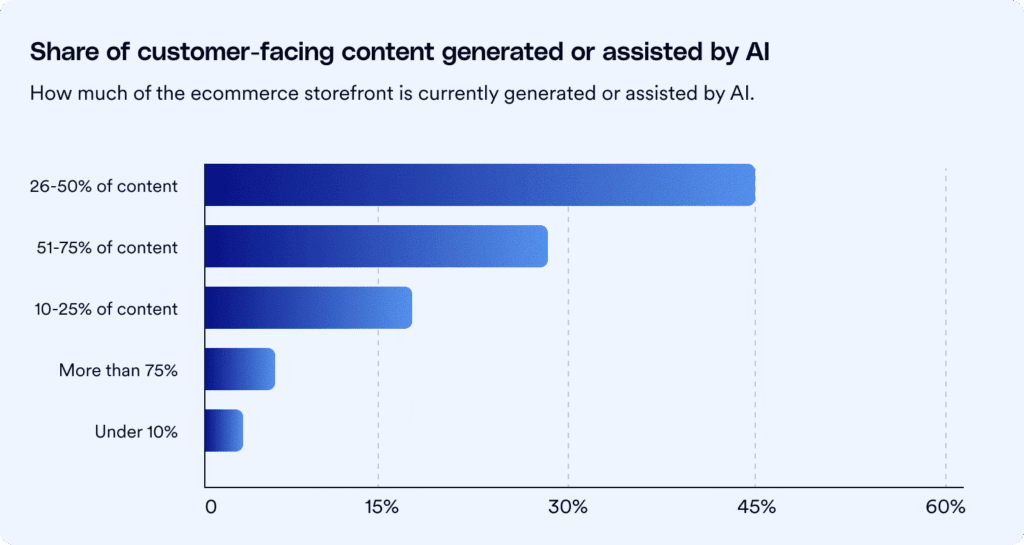
Generative AI now touches the majority of what shoppers see. Nearly half of all ecommerce brands generate between a quarter and half of their customer-facing content with AI — and 28% have crossed the point where AI produces most of it.
Altogether, 78% of brands are generating at least a quarter of their storefront with AI.
This isn’t experimentation. It’s infrastructure.
The category exists because of scale. There are more than 1.5 billion websites on the internet. Manually reviewing each one for WCAG conformance is not economically viable for most organizations — and even where it is, content changes fast enough that a site audited in January may have introduced new barriers by March.
The volume matters because accessibility risk scales with it.
A single AI-generated product description with a missing or inadequate image description is a minor gap. The same error replicated across ten thousand SKUs is a systemic one — and it’s the kind of systemic gap that shows up in litigation. Among the brands in this survey that have already faced legal action over digital accessibility, nearly two-thirds report that AI-generated content was directly involved.
-
78% of ecommerce brands generate at least a quarter of their customer-facing content with AI Source: CDC Disability and Health Data, 2023
The brands still treating AI as a side project — the 3% generating under 10% of content with AI — are the exception. For everyone else, the question is no longer whether AI is part of the content operation. It’s whether the oversight infrastructure has kept pace with the volume.
Where AI shows up across the storefront
Not all AI deployments carry the same risk. The content types where adoption is highest are also, in several cases, the ones where accessibility failures are most direct and most consequential.
Product descriptions and embedded chat assistants top the list — each used by 69.4% of brands.
Both are high-volume, fast-moving content types where human review is difficult to maintain at scale.
Below them, the numbers tell a more pointed story: 60.1% of brands are using AI to generate alt text across their product catalogs.
Alt text is not decorative metadata. It is the primary way shoppers using screen readers understand what an image contains. When it’s wrong, missing, or generic, those shoppers can’t access the product information everyone else sees.
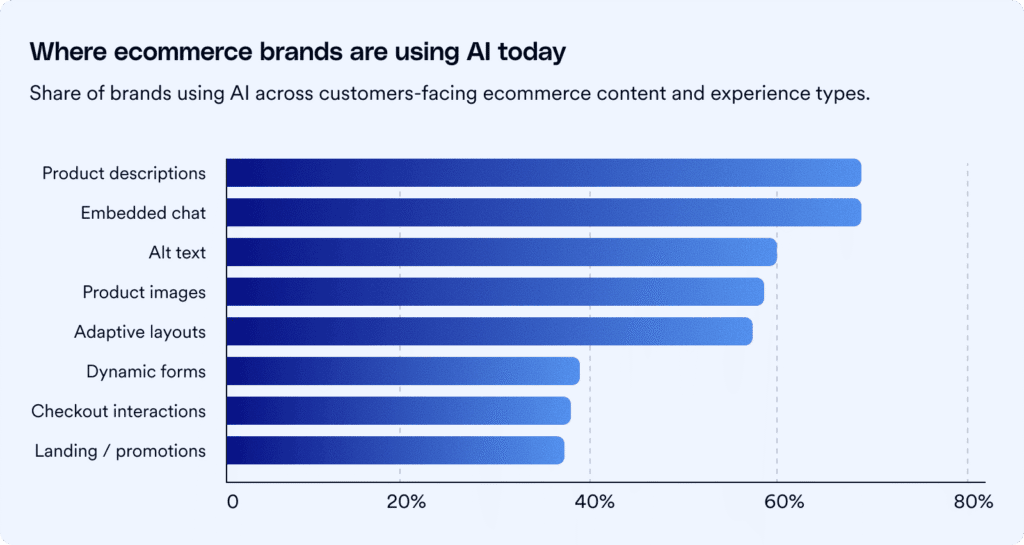
Adaptive layouts — used by 58.5% of brands — present a different kind of risk.
Layouts that shift dynamically based on user behavior or personalization signals can break the predictable navigation structure that assistive technology depends on.
A screen reader user who has learned where key elements sit on a page may find them gone or repositioned on the next visit.
Rounding out the list, dynamic forms, checkout interactions, and landing pages each sit between 38% and 39%.
Checkout in particular is worth flagging — it’s the highest-stakes moment in the customer journey, and also one of the most frequently cited areas in accessibility litigation.
-
60.1% of brands are using AI to generate alt text — accessibility-critical content — at scale Source: CDC Disability and Health Data, 2023
The common thread across these content types is volume and velocity. AI generates them fast, at scale, and often without the review infrastructure that would catch accessibility failures before they reach customers.
The tool stack driving it
Understanding where AI is deployed is one part of the picture. Understanding what’s actually generating the content is the other — because the tool determines how much control, customization, and oversight a brand typically has.
AI chatbots and search tools lead the stack, used by 78.2% of brands.
This category includes consumer-facing tools like ChatGPT, Claude, Gemini, and Perplexity being deployed in commerce contexts — most brands are working with tools that weren’t designed with accessibility as a core output requirement.
Platform-native tools come next at 66.3%: Shopify Magic, Amazon Rufus, Salesforce Einstein. These are deeply embedded in the workflows most mid-market brands already run, which makes them easy to adopt and harder to scrutinize.
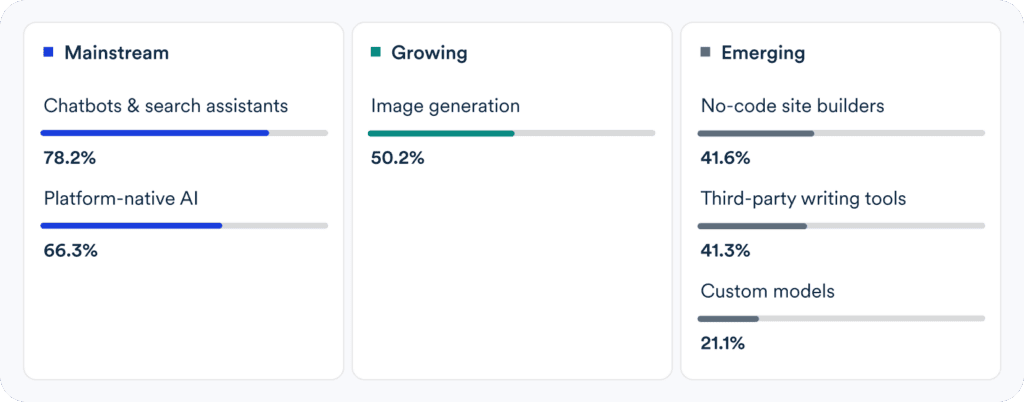
AI image generation tools — Midjourney, Adobe Firefly, DALL-E — are in use at half of all brands surveyed.
These tools produce the visual content that alt text is supposed to describe. When both the image and its description are AI-generated, with no human reviewing either, the accessibility of the result depends entirely on how well the tools were prompted and configured.
At the other end of the control spectrum, only 21.1% of brands run custom or in-house models.
These deployments typically involve more deliberate configuration, clearer ownership, and tighter integration with existing QA processes. They’re also the minority.
The pattern that emerges is one of convenience-first adoption.
The most widely used tools are the ones already embedded in existing platforms or the easiest to plug in. That’s a rational business decision. It also means most brands are working with tools that weren’t designed with accessibility as a core output requirement — and haven’t necessarily been configured to compensate for that.
-
66.3% of brands are using AI to generate alt text — accessibility-critical content — at scale Source: CDC Disability and Health Data, 2023
The risk rating by use case
Knowing where AI is deployed is the foundation. Knowing which deployments carry the most accessibility risk is what makes the map actionable.
The risk ratings below are based on three factors:
- How accessibility-critical the content type is, how much volume and velocity AI typically generates it at
- How much human review typically sits between the AI output and the customer.
High-volume, accessibility-critical content types with thin oversight land at High. Lower-stakes content types with more natural review checkpoints land at Medium.
| Content type | Adoption | Risk tier | Why |
|---|---|---|---|
| Alt text | 60.1% | 🔴 High | Primary access point for screen reader users. AI-generated alt text is frequently generic, inaccurate, or missing entirely. Generated at catalog scale with minimal review. |
| Adaptive layout | 58.5% | 🔴 High | Dynamic layout shifts break predictable navigation for assistive technology users. Hard to audit at scale. |
| Embedded chat / AI assistants | 69.4% | 🔴 High | Real-time, unreviewed responses. Failures are invisible until a user encounters them. |
| Checkout interactions | 38.9% | 🔴 High | Highest-stakes moment in the journey. Accessibility failures here directly block purchases and are frequently cited in litigation. |
| Product descriptions | 69.4% | 🟠 Medium-High | Critical for potential shoppers to understand what goods they are considering purchasing. |
| Product images | 59.1% | 🟠 Medium-High | Risk is indirect — tied to whether alt text accurately describes the image. |
| Dynamic forms | 39.2% | 🟡 Medium | Form labeling and structure can create barriers, but failures are typically more contained than layout or navigation issues. |
| Landing / promotional pages | 38.5% | 🟡 Medium | Lower update frequency creates more natural review windows than catalog-scale content. |
Two patterns stand out:
- First, the highest-risk content types are not the least adopted — alt text, adaptive layouts, and embedded chat are all above 58% adoption. Brands are deploying AI heavily in exactly the places where accessibility failures are most consequential.
- Second, the content types with the most natural human review checkpoints — landing pages, promotional content — carry lower risk not because they’re less important, but because the production cadence allows for oversight that catalog-scale content doesn’t.
-
Four of the eight most common AI content types carry a High accessibility risk rating — and all four are above 58% adoption. Source: CDC Disability and Health Data, 2023
The oversight gap hiding inside the numbers
The usage map shows where AI is deployed. What it doesn’t show is how little oversight typically sits between that deployment and the customer.
70.9% of brands report high or full trust in AI to handle accessibility-related tasks. 84.2% describe themselves as highly confident in their review processes. Yet a majority of brands let a significant portion of AI-generated content go live without any human review — and 35.9% have already faced legal action over digital accessibility, with AI-generated content the most cited factor among those cases.
The data is consistent with a straightforward inference: AI content volume is scaling faster than the oversight infrastructure meant to manage it.
At the same time, it is important to stress that the findings in this report should not be interpreted as a reason to slow AI adoption.
The benefits of AI-driven commerce are clear and substantial. The opportunity for ecommerce leaders is ensuring accessibility evolves alongside innovation so that every customer can benefit from those advances.
How that gap formed, what it looks like in practice, and what leading brands are doing to close it is the subject of Companion 3 — The AI oversight and human review playbook.
-
35.9% of brands have already faced legal action over digital accessibility — and among those, AI-generated content was the most cited factor Source: CDC Disability and Health Data, 2023
Building accessibility infrastructure that keeps pace
The usage map this report establishes points to a consistent pattern: AI is being deployed at scale across accessibility-critical content types, with oversight infrastructure that hasn’t kept pace.
The companion reports that follow examine each dimension of that gap in detail — where content breaks, where legal exposure concentrates, and where governance fails.
Across all of it, the underlying need is the same: accessibility infrastructure that operates at the speed and scale of AI-driven commerce.
accessiBe’s end-to-end accessibility platform combines the best in AI automation, developer tools, and human expertise to help eCommerce brands build that infrastructure:
AI automation
accessWidget applies accessiBe’s patented AI technology to make websites more accessible and inclusive on a session basis — addressing gaps across the storefront in real time, including WCAG-adherent alt text generation for screen reader users.
Developer tools
accessFlow gives development teams the ability to build accessibility in at the source code level — with automated auditing, monitoring, and an AI alt text generator that produces WCAG-conformant descriptions at catalog scale, with human review built into the workflow.
Human expertise
accessiBe’s expert accessibility services provide professional audits, remediation guidance, and litigation support — giving ecommerce brands the human expertise to identify real gaps, respond to legal exposure, and build a defensible, documented compliance posture.
Frequently asked questions
How much of ecommerce content is actually AI-generated today?
Nearly half of all ecommerce brands generate between a quarter and half of their customer-facing content with AI, and 28% have crossed the point where AI produces most of it. Altogether, 78% of brands are generating at least a quarter of their storefront with AI, which the report frames not as experimentation but as core infrastructure.
Which parts of the ecommerce experience use AI the most?
Product descriptions and embedded chat assistants top the list, each used by 69.4% of brands, with 60.1% of brands using AI to generate alt text across their product catalogs and adaptive layouts used by 58.5% of brands. Checkout interactions, dynamic forms, and landing pages round out the list at lower but still significant adoption rates.
What AI tools are ecommerce brands actually using?
AI chatbots and search tools lead the stack at 78.2% of brands, followed by platform-native tools at 66.3% (Shopify Magic, Amazon Rufus, Salesforce Einstein), AI image generation tools at 50%, and custom or in-house models at only 21.1%. The pattern favors convenience over control — most brands are using tools that weren’t built with accessibility as a core requirement.
Is there a connection between AI adoption and accessibility lawsuits?
More than 5,100 digital accessibility lawsuits were filed in 2025, a 33% increase from the prior year, with 70% targeting ecommerce. Among the brands surveyed, 35.9% have already faced legal action over digital accessibility, and among those, AI-generated content was the most cited factor.
Why do brands feel confident about accessibility even as risk grows?
70.9% of brands report high or full trust in AI to handle accessibility-related tasks, and 84.2% describe themselves as highly confident in their review processes — yet that confidence sits alongside a majority letting AI-generated content go live without human review. The report frames this as a gap between confidence and operational reality, not a lack of awareness.
How can ecommerce brands close the gap between AI content volume and accessibility oversight?
Closing this gap means building accessibility infrastructure that can keep pace with AI’s speed and scale. accessiBe’s platform combines AI automation, developer tools, and human expertise to support that effort: accessWidget applies accessiBe’s AI technology to help make websites more accessible on a session basis, including WCAG-adherent alt text generation; accessFlow gives development teams audit, monitoring, and remediation tools — including an AI alt text generator with human review built into the workflow — at the source code level; and accessiBe’s expert accessibility services provide professional audits, remediation guidance, and litigation support.
Supporting you every step of the way
Schedule a one-on-one demo with an accessibility expert, to find a plan tailored to your company’s needs
