

Question answered in this report: Who is responsible for AI-generated accessibility risk inside ecommerce organizations — and what happens when the answer isn't clear?
Only 12.5% of mid-market to enterprise ecommerce brands have a dedicated accessibility team or lead. For most, accountability defaults to engineering — not by design, but by proximity. 84.2% are highly confident in their review processes. 66.4% have a formal documented plan. Yet a majority let significant volumes of AI-generated content go live without human review, and 35.8% are under significant or extreme pressure to publish quickly. The gap between what organizations have on paper and what happens in practice is where AI-generated accessibility risk accumulates — and where it eventually surfaces as a strategic problem.
Only 12.5% of mid-market to enterprise ecommerce brands have a dedicated accessibility team or lead. For organizations with engineering teams, legal departments, and documented processes already in place, that’s a notable gap — and one the data suggests has real consequences.
When AI-generated content creates an accessibility problem in these organizations, responsibility tends to default to whoever is closest to it rather than to a designated owner. The result is that review processes exist in varying forms, confidence in those processes is high, and yet a significant portion of AI content still goes live without human review.
This report examines how AI-generated accessibility risk is governed inside ecommerce organizations — where ownership sits, where it doesn’t, and what the data shows about the distance between documented plans and day-to-day practice.
About the research
This report is part of accessiBe’s AI, eCommerce & the Accessibility Gap series, based on a June 2026 survey of 304 US ecommerce, retail, and direct-to-consumer decision-makers — from mid-market brands to enterprise retailers — all actively involved in how AI is being adopted across their digital experience. This report focuses on governance: how organizations assign ownership of AI-generated accessibility risk, what review processes look like in practice, and where the gaps between policy and behavior tend to appear.
Who owns AI accessibility outcomes — and who doesn't
When AI-generated content creates an accessibility problem, 51% of brands report that responsibility defaults to the IT or engineering team. 15.1% point to marketing or ecommerce. 12.8% to legal or compliance. 12.5% have a dedicated accessibility team or lead. 8.6% have no single owner at all.
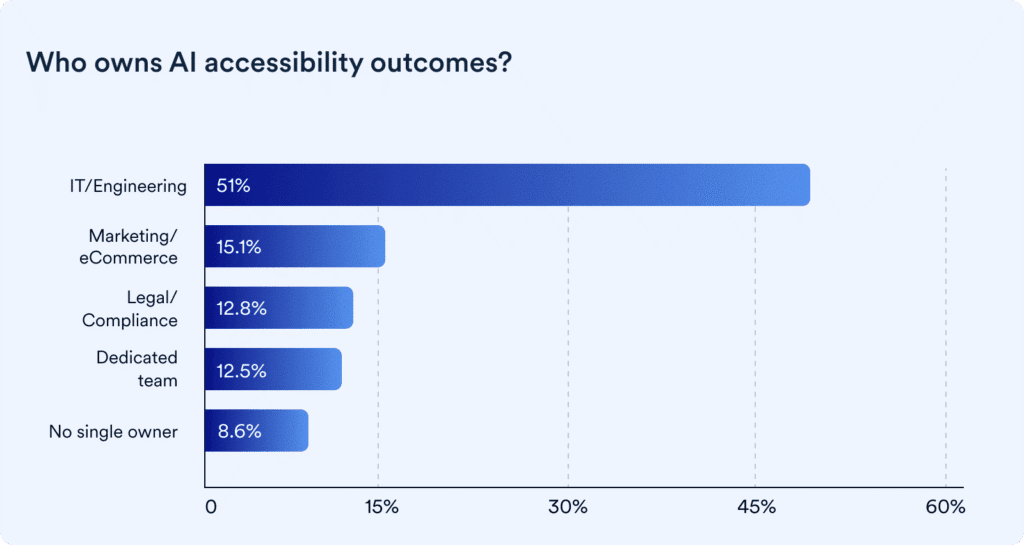
The word that matters in that first figure is “defaults.”
Engineering isn’t being assigned ownership of AI accessibility outcomes through a deliberate organizational decision. It’s absorbing responsibility because the content touches code, and code is engineering’s domain.
That’s a meaningful distinction — it suggests that for the majority of brands, AI accessibility accountability isn’t owned so much as inherited.
-
51% of brands say responsibility for AI accessibility outcomes defaults to engineering Source: CDC Disability and Health Data, 2023
Why confidence runs high even when ownership is unclear
84.2% of brands describe themselves as highly confident in their ability to catch accessibility issues in AI-generated content before it goes live. Yet given that in most organizations this responsibility falls to engineering by default rather than by design, that confidence gap is somewhat difficult to explain.
The ownership distribution may offer part of the answer.
Each team tends to measure confidence against its own scope — engineering against technical failures, marketing against content accuracy, legal against regulatory exposure. Measured within those boundaries, the confidence is probably well-founded. What it doesn’t account for is the space between those boundaries — where accessibility failures that don’t belong cleanly to any one team tend to go unexamined.
-
82.4% of brands are highly confident in their ability to catch accessibility issues in AI-generated content Source: CDC Disability and Health Data, 2023
What formal plans look like when publishing pressure sets in
Most brands have made some move toward formalizing how they handle AI-generated accessibility risk. 66.4% have a documented plan in place; a further 9.6% are actively developing one. 22.3% rely on informal guidelines. On the surface, that’s a sector that has recognized the need to govern this area and is, in the majority of cases, doing something about it.
Yet having a plan and operating one are different things.
A majority of brands let a significant portion of AI-generated content go live without human review, with 35.8% reporting significant or extreme pressure to publish AI content quickly.
When publishing speed is the dominant operational pressure, review processes — however well-documented — tend to compress.
Content moves faster than the plan anticipated. Steps get skipped. The gap between what the plan says and what actually happens widens quietly, without anyone making a deliberate decision to abandon the process.
The review frequency data reflects this.
36.8% evaluate AI-generated content for accessibility every time before publishing. 42.1% do so frequently, but not for all content.
That second figure describes a consistent, structural gap in coverage — not an occasional oversight.
-
66.4% of brands have a formal documented plan for AI accessibility — yet a majority let significant volumes of AI content go live without human review Source: CDC Disability and Health Data, 2023
From governance gap to strategic priority
When accountability for AI-generated accessibility risk isn’t clearly assigned, the work doesn’t disappear — it accumulates. And at some point, it becomes significant enough to land on the strategic agenda.
62.3% of brands name ensuring AI-generated content meets accessibility standards as a top priority for the next 12 months. 50.7% name managing legal risk from AI-generated content.
These sit at the top of the list — ahead of new AI features, agentic commerce, and voice-first experiences. For a sector that has spent the past two years racing to adopt generative AI, that reordering of priorities is telling.
-
62.3% of brands name ensuring AI content meets accessibility standards as a top priority for the next 12 months Source: CDC Disability and Health Data, 2023
Building accessibility infrastructure that keeps pace
The governance gaps this report describes — diffuse ownership, review processes that compress under publishing pressure, and formal plans that don’t translate into consistent practice — don’t resolve on their own. They require infrastructure that makes accessibility governance operational, not just documented.
accessiBe’s end-to-end accessibility platform combines the best in AI automation, developer tools, and human expertise to help ecommerce organizations close that gap.
AI automation
accessWidget applies accessiBe’s patented AI technology to make websites more accessible and inclusive on a session basis — providing a consistent accessibility layer across the storefront that doesn’t depend on every team getting every review right every time.
Developer tools
accessFlow gives development teams the ability to build accessibility in at the source code level — with automated auditing, monitoring, and remediation workflows that create clear ownership and accountability at the point where content is created.
Human expertise
accessiBe’s expert accessibility services provide professional audits that identify real gaps in AI-generated content, remediation guidance, and litigation support — giving organizations the external expertise to validate what internal processes may be missing, and to build a compliance posture that holds up under scrutiny.
Frequently asked questions
Who ends up responsible when AI-generated content creates an accessibility problem?
Usually, whoever is closest to the content — not whoever was assigned to own it. Our research found 51% of ecommerce brands say responsibility defaults to IT or engineering, simply because the content touches code. Only 12.5% have a dedicated accessibility team or lead, and 8.6% have no clear owner at all.
If brands feel confident in their review process, why does unreviewed content keep going live?
Because confidence tends to be measured within a single team’s lane. Engineering checks for technical failures, marketing checks for content accuracy, legal watches for regulatory exposure — and none of those views covers the full picture. That’s how 84.2% of brands can report high confidence while a majority still let AI-generated content publish without human review.
Can accessWidget mitigate my legal risk?
Implementing accessWidget on your website helps mitigate your legal risk and align with the accepted accessibility standards. You’ll even get a built-in accessibility statement detailing your website’s remediation and emphasizing your commitment to inclusion.
What does "being prepared" actually look like in this context?
It generally comes down to documentation: a record of how AI-generated content is reviewed before it goes live, clear ownership over who signs off on that content, and an audit trail showing accessibility was considered rather than assumed. Without that paper trail, confidence alone doesn’t carry much weight if a claim arises.
Can accessiBe help me with my lawsuit or demand letter?
Yes, depending on your plan, accessiBe offers a Litigation Support Package to paying customers to aid in the case of a demand letter or lawsuit. We also offer a $15k+ pledge (terms & conditions) with certain plans. Contact us for more information.
Does AI-generated content have to meet the same accessibility standards as content written by a person?
Yes. Accessibility expectations apply to what a website’s content and experience actually deliver to visitors, not to who or what produced it. Product descriptions, alt text, and page layouts generated by AI carry the same conformance expectations under WCAG and the same ADA compliance obligations as anything written manually.
Why are ecommerce leaders suddenly prioritizing AI accessibility risk?
Because ownership gaps don’t stay quiet forever — they surface as a business problem. 62.3% of brands now name AI accessibility as a top priority for the next 12 months, and 50.7% name managing legal risk tied to AI-generated content, both ahead of newer initiatives like agentic commerce.
How can a business close this accountability gap?
Start by naming an actual owner instead of letting responsibility default by proximity. From there, accessiBe’s platform combines AI automation, developer tools, and human expertise to help close the gap: accessWidget helps make the storefront more accessible on a session basis, accessFlow gives development teams auditing, monitoring, and remediation workflows at the source-code level, and accessiBe’s expert services provide professional audits and litigation support to catch what internal review misses.
Supporting you every step of the way
Schedule a one-on-one demo with an accessibility expert, to find a plan tailored to your company’s needs
