Most of us know the frantic feeling of a banking app timing out just as we’re about to hit “confirm.” For millions of people with disabilities, this isn’t just a minor rush—it is a frequent and absolute barrier to care.
When digital healthcare platforms prioritize security at the expense of accessibility, they create a “transactional wall.” Whether paying a bill or refilling a prescription, the tools designed for convenience are often the ones locking patients out.
In this blog, we’ll explore how aggressive timeouts and fragmented form design turn essential tasks into impossible hurdles, and the design shifts needed to ensure “security” no longer means “exclusion.”
The problem: the “transactional wall” and form failure
In the healthcare sector, security is paramount—but it often creates unintended obstacles. The biggest barrier occurs when a patient attempts to complete a high-stakes task, such as paying a bill or authorizing a prescription, only to be defeated by the system’s own safeguards.
This friction typically materializes in the following ways:
1. The “speed tax”:
Security policies—implemented to meet HIPAA’s requirement for ‘reasonable and appropriate safeguards’—often use short session timeouts (e.g., 2-5 minutes). For screen reader or switch control users, this creates a ‘speed tax,’ as form navigation takes significantly longer.
2. The MFA loop:
Multi-factor authentication (MFA) requires users to jump between their healthcare portal and a text or email app. For patients with motor or cognitive disabilities, this “context switching” is slow. By the time they retrieve the verification code and return to the portal, the session has frequently expired.
3. Unreadable financial data:
Completing a transaction is impossible if you don’t know what you are paying for. Explanations of Benefits (EOBs) and medical bills are frequently delivered as static PDFs or unlabelled tables. Without proper tagging, a screen reader sees these as a meaningless jumble of numbers, leaving the patient unable to verify charges.
The solution: accessible authentication and persistent design
To tear down the transactional wall, healthcare providers must move beyond “compliant” design and embrace “functional” accessibility. This involves rethinking the logic of how a user interacts with a form from start to finish.
Providers can implement these improvements through the following methods:
1. Adjustable timeouts:
Implementing The Web Content Accessibility Guidelines (WCAG) 2.1 Success Criterion 2.2.1 allows users to turn off, adjust, or extend the time limit. Providing a simple warning that says, “Your session is about to expire. Do you need more time?” can be the difference between a completed refill and a missed dose.
2. Accessible authentication:
Design MFA processes that don’t require rapid-fire context switching. Support for biometrics (like FaceID or fingerprint) or “Magic Links” can bypass the need for manual code entry, making the “vault” accessible to everyone.
3. Tagged documentation:
Ensure every PDF bill and digital statement is fully tagged for screen readers. By using proper HTML table headers, providers ensure that when a user clicks a “pay now” button, they are doing so with clarity and confidence.
Many orgnizations rely on expert service providers – like accessServices – when dealing with high-volumes of online documents that require remediation. Better-equipped to deal with complex remediation projects, these service providers help organizations meet necessary standards within a timely, and more cost effective manner.
Why you need to take action now: understanding the legal landscape
Digital accessibility in healthcare is a mandatory legal obligation. Failure to provide an accessible platform can lead to lawsuits, federal investigations, and the loss of funding.
The primary laws governing this space include:
The Americans with Disabilities Act (ADA)
The ADA prohibits discrimination against people with disabilities. For most private healthcare providers, this falls under ADA Title III, which covers “public accommodations” like hospitals and doctor’s offices. For state and local government-run healthcare facilities, ADA Title II applies.
Both titles require your digital platforms to be accessible.
To meet ADA requirements, platforms should align with the Web Content Accessibility Guidelines (WCAG) 2.1 Level AA.
HHS section 504 (the new 2024 update)
Section 504 of the Rehabilitation Act applies to any organization that receives federal financial assistance, such as Medicare or Medicaid. A major update finalized in May 2024 now explicitly requires these organizations to meet WCAG 2.1 Level AA standards for all digital content, mobile apps, and kiosks.
This update introduces strict compliance deadlines that are now rapidly approaching:
- May 11, 2027: Deadline for organizations with 15 or more employees.
- May 10, 2028: Deadline for organizations with fewer than 15 employees.
The high cost of non-compliance
Failing to meet these standards carries severe consequences beyond poor user experience:
- Loss of funding: The HHS can terminate federal financial assistance, including Medicare and Medicaid reimbursements, for organizations that fail to provide “meaningful access.”
- Legal penalties: Civil penalties for ADA violations can reach tens of thousands of dollars, excluding private legal fees and potential compensatory damages.
- Mandatory remediation: Courts often force non-compliant providers into expensive, supervised overhauls of their entire digital infrastructure under strict settlement terms.
Building accessible digital healthcare environments with accessFlow

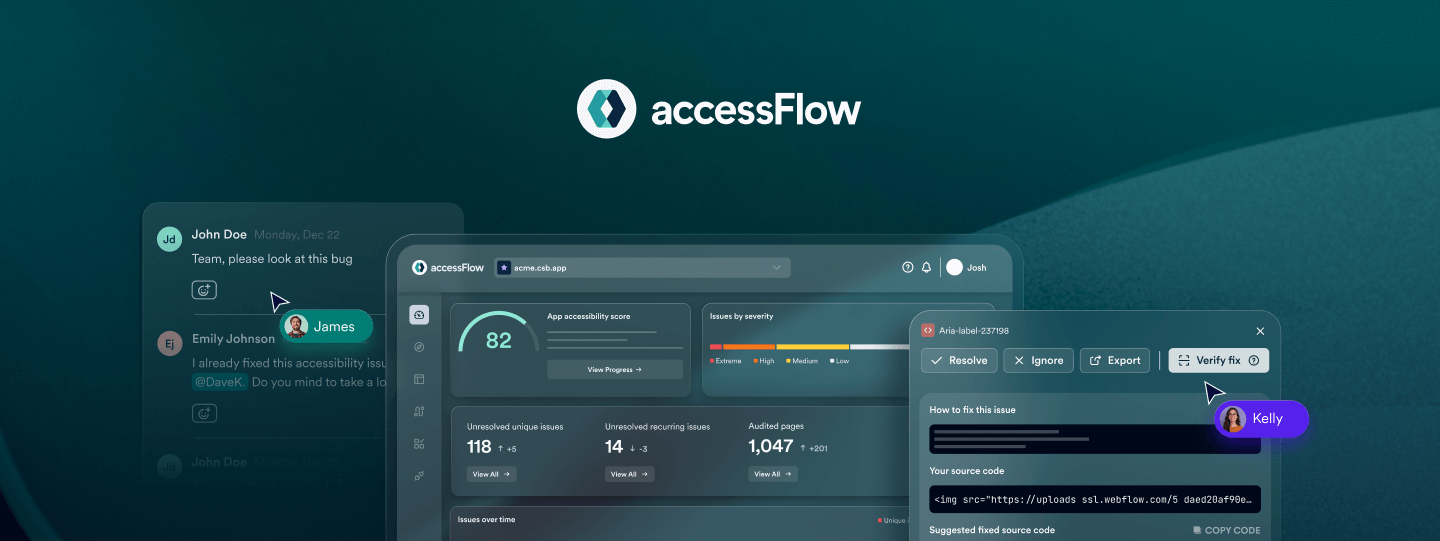
Solving the transactional wall requires more than a one-time fix; it requires a systemic shift in how healthcare software is built and maintained. accessFlow, accessiBe’s accessibility operations hub provides the automated testing and remediation tools necessary to catch “form fragility” before it reaches the patient.
The platform supports healthcare organizations in the following ways:
CI/CD integration for proactive testing
accessFlow integrates directly into development pipelines (such as GitHub, GitLab, or Jenkins) to audit code during the build process. This materializes in the following ways: it finds form fields lacking an accessible name and ensures important dynamic updates are announced to assistive technology. This prevents users from missing vital info—like an error message or a price change—that would stop them from finishing a task.
Time limit and session management
The platform audits for compliance with WCAG 2.1 Success Criterion 2.2.1 (Timing Adjustable). It identifies hard-coded session limits within the application’s logic and flags instances where the system fails to provide a programmatic way for assistive technologies to request a time extension.
Advanced remediation for complex data structures
To address unreadable financial data, accessFlow’s scanning engine identifies complex data tables and verifies the presence of proper structure, such as correct use of <table>, <tr>, <th>, and <td> elements. This ensures that screen readers can correctly associate pricing data with the appropriate medical service descriptions.
Integrating accessibility into the developer workflow
To further streamline these fixes, accessFlow provides a comprehensive SDK that allows teams to trigger accessibility tests at every stage of the development cycle, from initial local builds to final production deployments.
Additionally, its Model Context Protocol (MCP) allows developers to access remediation guidance and solve these accessibility issues directly within their IDEs, shifting the correction process to the very start of the coding journey.
The future of inclusive healthcare starts now
Prioritizing accessibility is a strategic necessity for any modern healthcare provider. By dismantling the “transactional wall,” you aren’t just checking a box for regulatory compliance; you are building a platform that honors patient dignity and ensures that the one in four adults with a disability can manage their health with the same independence as anyone else.
Designing with inclusion at the core helps you mitigate significant legal risks while building deep, lasting trust with your patient base. As the digital landscape of medicine continues to evolve, the organizations that lead in accessibility will be the ones that truly ensure healthcare is a right that is accessible to all.
Press here to learn more about how accessFlow can support your accessibility needs.