

Question answered in this report: What does AI-generated content exposure actually look like in court — and how are these cases resolving?
More than one in three ecommerce brands have already faced accessibility legal action — and among those, AI-generated content was the single most cited factor, named by nearly two-thirds. These cases rarely resolve cleanly: 96% ended in site fixes, a financial settlement, or both. 70% of brands describe themselves as very or extremely prepared for a future AI-related lawsuit. The data suggests otherwise.
The legal risk attached to AI-generated content in ecommerce isn’t hypothetical.
35.9% of brands in this survey have already faced accessibility legal action — and among those, AI-generated content was the most cited contributing factor.
That figure sits inside a broader trend already in motion before generative AI became standard infrastructure.
In 2025, more than 5,100 digital accessibility lawsuits were filed in the US — a 33% increase from the prior year — with 70% targeting ecommerce. Our October 2025 research pointed in the same direction. AI didn’t create that litigation environment. But it is expanding the surface area of exposure faster than most legal and compliance teams have accounted for.
This report maps where that exposure is concentrating — and what legal and compliance teams need to understand about AI-generated content in the context of accessibility litigation.
About the research
This report is part of accessiBe’s AI, eCommerce & the Accessibility Gap series, based on a June 2026 survey of 304 US ecommerce, retail, and direct-to-consumer decision-makers — from mid-market brands to enterprise retailers — all actively involved in how AI is being adopted across their digital experience. This report focuses on the legal dimension of that adoption: where AI-generated content is creating litigation exposure, which use cases are drawing the most legal activity, and what the data shows about how brands are — and aren’t — preparing for it.
Why ecommerce is the highest-risk sector for accessibility litigation
Digital accessibility lawsuits don’t distribute evenly across industries. Ecommerce absorbs a disproportionate share — and has for years. The reasons are structural: Ecommerce sites are transactional by nature, meaning accessibility barriers don’t just create inconvenience — they directly block purchases. Courts and plaintiffs’ attorneys have consistently treated that distinction as meaningful.
In 2025, more than 5,100 digital accessibility lawsuits were filed in the US. 70% targeted eCommerce.
That concentration has held across multiple years of rising filing volumes, and our October 2025 research found brands already reporting significant legal exposure before the current wave of AI-generated content had fully arrived.
What AI has changed is not the legal framework — the ADA, WCAG standards, and the established case law around digital accessibility haven’t shifted. What’s changed is the volume and consistency of accessibility failures that a single tool decision can now produce across an entire storefront.
A brand that deploys a general-purpose AI tool to generate chat interfaces, adaptive layouts, and dynamic content at scale is making one decision that touches thousands of customer-facing touchpoints simultaneously.
When that tool produces inaccessible output — and the data in this series suggests it frequently does — the exposure isn’t isolated to one page or one content type. It’s systemic. And systemic failures are exactly what plaintiffs’ attorneys look for.
AI-generated content as a legal liability
More than one in three ecommerce brands have already faced accessibility legal action. Among those, 65.4% report that AI-generated content was directly involved — ahead of checkout flows, product images, and chat tools. It is the single most cited factor in these cases.
-
73% of brands that audited their AI-generated content found accessibility issues Source: CDC Disability and Health Data, 2023
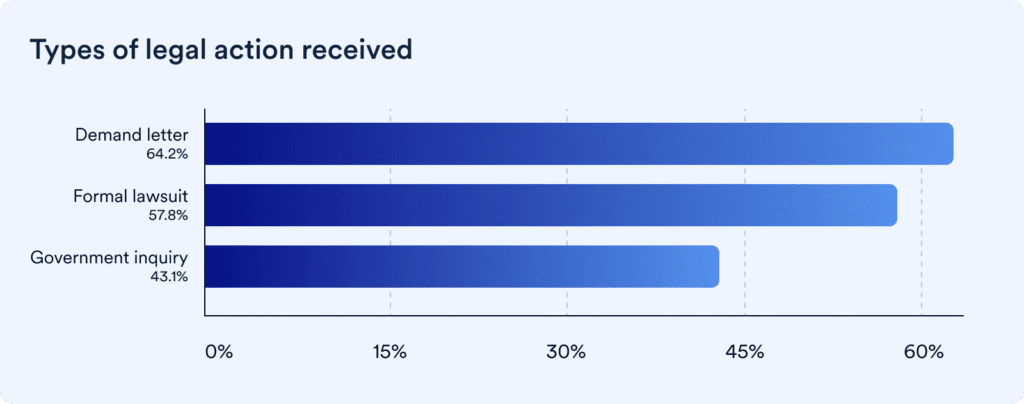
- The legal actions these brands faced weren’t limited to one type — and many faced more than one simultaneously:
64.2% received a demand letter or legal threat
57.8% faced a formal lawsuit or legal complaint
43.1% received a government inquiry or regulatory notice
Against that backdrop, 70% of brands describe themselves as very or extremely prepared for a future AI-related accessibility lawsuit. 24.1% say they have full documentation in place.
-
70% of brands feel very or extremely prepared for an AI-related accessibility lawsuit — yet only 12% of accessibility legal actions are dismissed Source: CDC Disability and Health Data, 2023
The gap between perceived preparedness and legal reality deserves scrutiny.
Feeling prepared for a lawsuit and being prepared are different things — and the resolution data suggests most brands overestimate their position.
A brand with no formal documentation of its AI review processes, no audit trail showing accessibility was considered before content went live, and no clear ownership of AI-generated content decisions is not well-prepared for litigation, regardless of how confident it feels. Preparedness in a legal context isn’t a state of mind. It’s a paper trail.
How these cases resolve
1. Only 12% saw their case dismissed
2. 96% ended with site fixes, a financial settlement, or both
3. 80% involved a financial settlement.
The data is clear: most accessibility legal actions end in a financial settlement, site fixes, or both. For brands generating significant volumes of AI content across accessibility-critical touchpoints, that resolution pattern is the clearest argument for getting ahead of the problem rather than responding to it.
What the data looked like eight months ago
-
79% of ecommerce leaders were not confident they met accessibility requirements Source: CDC Disability and Health Data, 2023
In October 2025, accessiBe conducted research across 300 US ecommerce decision-makers examining digital accessibility readiness and legal exposure.
At that point, 43% of brands had already been hit by a lawsuit or demand letter, 71% said they were concerned about legal risk, and 79% were not confident they met accessibility requirements.
The June 2026 findings show that pressure hasn’t eased.
Two independent surveys, eight months apart, point to the same conclusion: legal exposure was already widespread before AI-generated content became standard infrastructure, and it hasn’t let up.
Since then, AI content volumes have grown significantly, oversight infrastructure hasn’t kept pace, and AI-generated content has emerged as the leading factor in accessibility legal actions.
The data is consistent with a straightforward inference: the legal risk that existed eight months ago has not diminished. It has more surface area.
Building accessibility infrastructure that keeps pace
The data in this report points to a sector where legal exposure is widespread, cases rarely resolve quietly, and AI-generated content is the leading factor in claims. For ecommerce brands, having the right support in place before a claim arrives — and when one does — is no longer optional.
accessiBe works with ecommerce brands at every stage of that challenge.
When accessibility-related claims arise, accessiBe’s Litigation Support Package provides end-to-end assistance — expert analysis of alleged violations, focused accessibility audits, structured documentation reflecting ongoing remediation efforts, and ADA attorney consultation for eligible plans.
It’s designed to give legal teams and internal stakeholders the technical insight and documentation they need to respond clearly, quickly, and with confidence.
Frequently asked questions
Is AI-generated content actually a legal risk for ecommerce sites, or is this overstated?
The data says it’s real. Among ecommerce brands that have already faced accessibility legal action, 65.4% report that AI-generated content was directly involved — more than checkout flows, product images, or chat tools. AI didn’t invent accessibility litigation, but it’s expanding how many touchpoints a single content decision can affect at once.
Why does ecommerce get targeted more than other industries?
eCommerce sites are transactional by nature. When a page isn’t accessible, it doesn’t just create friction — it can block someone from completing a purchase entirely. Courts and plaintiffs’ attorneys have consistently treated that distinction as meaningful, which is part of why 70% of the 5,100+ digital accessibility lawsuits filed in the US in 2025 targeted ecommerce.
If my AI tools are already in place, doesn't that mean I'm covered?
Not necessarily. In this survey, 70% of brands said they felt very or extremely prepared for a future AI-related lawsuit, but only 12% of accessibility legal actions actually end in dismissal. Feeling prepared and having a documented, defensible process are two different things — and the second one is what tends to matter in a legal dispute.
What does "being prepared" actually look like in this context?
It generally comes down to documentation: a record of how AI-generated content is reviewed before it goes live, clear ownership over who signs off on that content, and an audit trail showing accessibility was considered rather than assumed. Without that paper trail, confidence alone doesn’t carry much weight if a claim arises.
How do most accessibility legal actions end up resolving?
Rarely quietly. Of the brands in this survey who detailed how their case concluded, only 12% saw it dismissed. The remaining 96% ended in site fixes, a financial settlement, or both, with 80% involving a settlement. That pattern is consistent with what accessiBe’s earlier September–October 2025 research also found.
What kind of support does accessiBe offer if a brand is already facing a claim?
accessiBe’s Litigation Support Package is built for exactly that moment. It includes expert analysis of the alleged violations, a focused accessibility audit, structured documentation of remediation efforts, and ADA attorney consultation for eligible plans — giving legal and compliance teams the technical backup they need to respond with clarity rather than starting from scratch.
Supporting you every step of the way
Schedule a one-on-one demo with an accessibility expert, to find a plan tailored to your company’s needs
