When comparing accessibility solutions, the hardest part is cutting through opinion and marketing language to understand how platforms actually perform in real-world use. That’s why independent, third-party sources play such an important role in the evaluation process.
G2 is one of the most widely used platforms for that kind of comparison. Its ratings are based on verified customer reviews and scored across consistent categories, making it easier to evaluate usability, setup, administration, and ongoing experience side by side.
Based on G2’s publicly available data, accessiBe consistently scores higher than AudioEye across the key satisfaction categories G2 measures.
Both platforms are well rated overall, but the data shows a clear and consistent difference in how customers rate their experience.
In this guide, we’ll walk through the most important categories one by one, explain what each score actually reflects, and show how to interpret the data in a clear, straightforward way — without hype or unnecessary complexity.
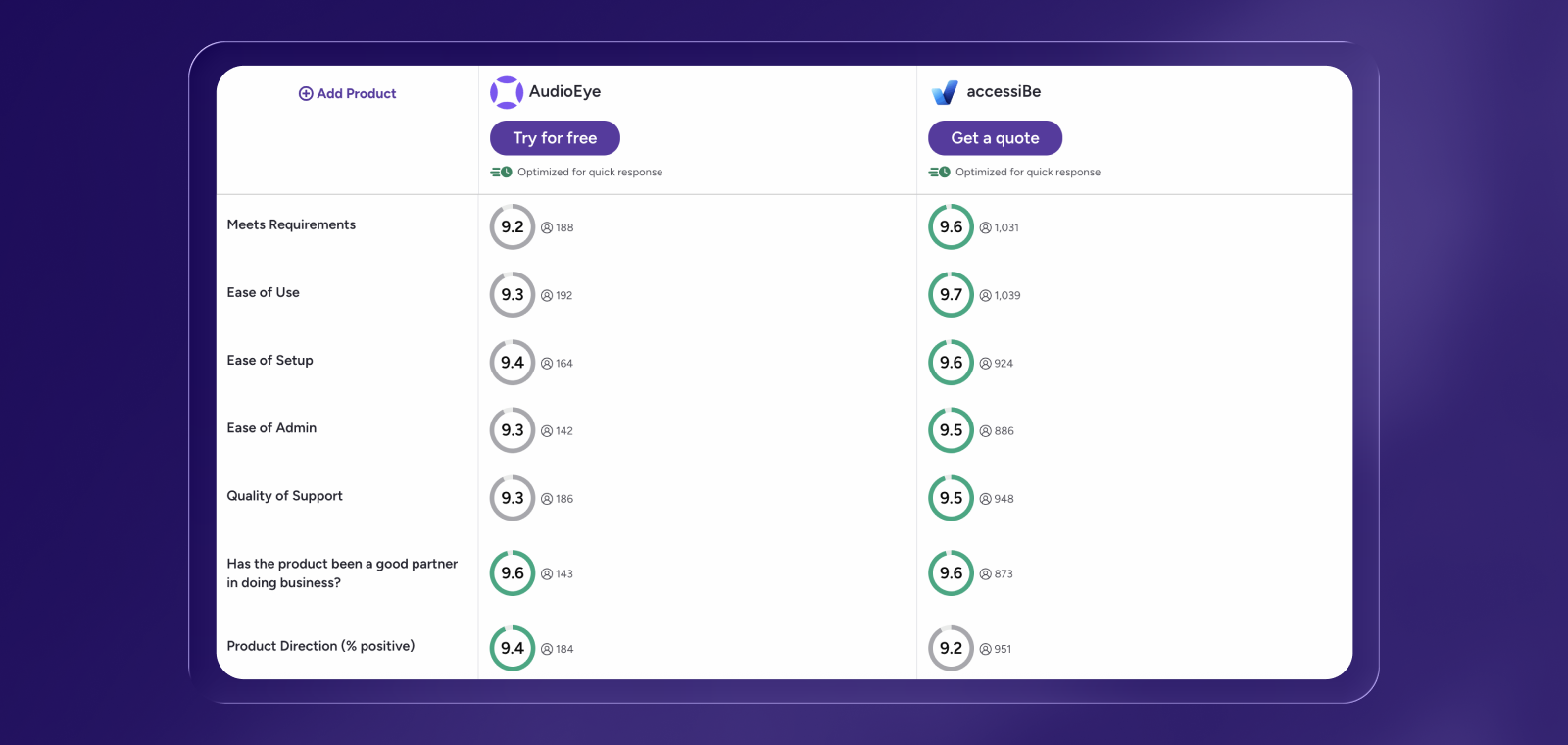
Important note: every comparison in this article is based exclusively on G2’s publicly available ratings and review counts. Any discussion of platform structure or accessibility approach is presented separately from G2 data to keep the analysis accurate and transparent.
Delivering on what teams expect – advantage accessiBe
Ease of use reflects how intuitive a platform feels once teams start working with it day to day. This includes how easily administrators can navigate the system, understand its controls, and make adjustments without needing constant technical support.
On G2, accessiBe scores higher than AudioEye in this category, with an Ease of Use rating of 9.7 compared to AudioEye’s 9.3.
This indicates that customers more often find accessiBe straightforward to use and easier to work with over time. Higher scores here typically signal that teams are able to manage accessibility tasks efficiently, without unnecessary friction or a steep learning curve.
This category is especially important for organizations that don’t have dedicated accessibility specialists on staff.
When a solution is easier to use, teams can spend less time figuring out the tool itself and more time focusing on maintaining accessible experiences across their websites.
Strong performance in ease of use often translates into faster adoption, fewer internal bottlenecks, and a smoother experience for everyone responsible for accessibility management.
Ease of setup that doesn’t slow teams down – advantage accessiBe
Ease of setup reflects how smoothly teams are able to get a platform up and running. This includes installation, onboarding, and the initial configuration required before a solution can be used effectively.
On G2, accessiBe scores higher than AudioEye in this category, with an Ease of Setup rating of 9.6 compared to AudioEye’s 9.4. While both scores are strong, the difference suggests customers more consistently experience a straightforward setup process with accessiBe.
For many organizations, setup is where momentum is either built or lost. A smoother onboarding experience allows teams to begin addressing accessibility needs sooner, without extended configuration cycles or heavy reliance on technical resources.
Strong performance here often signals that teams can move from evaluation to implementation quickly, keeping accessibility initiatives on track from the start.
Easier administration over time – advantage accessiBe
Ease of admin focuses on what happens after setup. It reflects how manageable a platform is on an ongoing basis, including how easily teams can maintain accessibility, monitor progress, and handle routine tasks without added complexity.
On G2, accessiBe scores higher than AudioEye in this category, with an Ease of Admin rating of 9.5 compared to AudioEye’s 9.3.
This indicates that customers more often find accessiBe simpler to manage as part of their day-to-day operations.
As accessibility becomes an ongoing responsibility rather than a one-time project, administrative overhead matters. Platforms that are easier to manage over time help reduce long-term strain on internal teams and make sustained accessibility more realistic.
Higher scores here often reflect fewer day-to-day blockers and a more predictable experience for teams responsible for maintaining accessibility as websites evolve.
A reliable partner in doing business – advantage accessiBe
This category reflects how customers evaluate the overall working relationship with a vendor. It includes factors such as communication, reliability, and how easy the company is to collaborate with over time.
On G2, accessiBe scores higher than AudioEye in this category, with a rating of 9.6 compared to AudioEye’s 9.5.
While both platforms are rated positively, the data suggests accessiBe customers more consistently view the company as a dependable partner in day-to-day business interactions.
This score is shaped by long-term experience rather than one-off touchpoints. Strong performance here often reflects consistency in communication, responsiveness, and how well a provider supports teams as accessibility needs evolve beyond initial implementation.
Quality of support when it matters – advantage Audioeye
Quality of support reflects how customers rate their interactions with a vendor’s support team, including responsiveness, clarity, and overall helpfulness.
In this category, AudioEye scores slightly higher than accessiBe on G2, with a rating of 9.5 compared to accessiBe’s 9.3. Both scores are strong, indicating that customers of both platforms generally report positive support experiences.
Support can play an important role when teams encounter complex issues or need guidance. While the difference here is modest, it highlights that some customers place particular value on their support interactions when evaluating a solution.
As with other categories, this score reflects customer perception rather than the scope or structure of support offerings themselves.
Going beyond G2 reviews: Why choose accessiBe
While the comparisons in this article rely exclusively on G2’s publicly available ratings and review counts, many teams look beyond review scores when making a final decision. Once you understand how customers rate their experience, the next step is evaluating how an accessibility platform is designed to support your organization over time.
This is where platform structure and operational fit come into focus.
accessiBe is built as an end-to-end accessibility solution that brings together automation, developer tools, and expert services.
These components work together to help organizations support accessibility and their compliance efforts as websites, content, and requirements evolve.
An end-to-end solution designed to support accessibility over time
AI-powered accessibility automation
Quick and simple to install, accessWidget audits websites for accessibility issues, fixing them in as little as 48 hours. Through the power of AI, it helps make sites compatible with assistive technology like screen readers, and allows for keyboard only navigation – core accessibility tenets. Website visitors are also presented with an interface through which they adjust UI elements to better-fits their abilities.
For unique, highly customized sites, accessWidget can be enhanced through manual inspection and targeted customization, allowing its AI to better support critical user journeys such as navigation, forms, and transactional flows.
Developer-focused accessibility tools
With accessFlow, accessiBe’s accessibility management platform for developers, teams can address accessibility directly within their development workflows. accessFlow surfaces code-level accessibility issues and provides structured, actionable guidance for remediation. Its SDK enables accessibility testing at every stage of the development lifecycle, helping teams catch issues early, while MCP support allows developers to identify and resolve accessibility issues directly within their IDE, where code is written. Combined with continuous monitoring and task workflows that align with existing development processes, accessFlow enables engineering teams to treat accessibility as part of everyday development — without requiring any prior accessibility expertise.
Expert accessibility services
accessiBe offers expert-led accessibility services through accessServices, including manual audits, PDF and file remediation, VPAT support, and user testing conducted by people with disabilities. These services help organizations address accessibility needs that extend beyond automation and support deeper remediation and long-term accessibility governance.
Litigation support when it matters most
When an organization faces accessibility-related legal action, accessiBe provides a dedicated Litigation Support Package. This support is designed to help teams respond once a claim is filed and includes guidance through the legal process, documentation that demonstrates ongoing accessibility efforts, and hands-on support tailored to the situation. The package is backed by a $15k+ pledge, helping customers navigate these scenarios swiftly and confidently.
If you’re looking for accessibility support that fits into your workflows, works alongside your existing design, and provides added support when it matters most, accessiBe is uniquely designed to support that end to end.