When evaluating accessibility solutions, it can be difficult to separate real customer experience from product positioning and marketing claims. That’s why independent review platforms play an important role in the decision-making process.
G2 is one of the most widely referenced sources for this type of comparison.
Its ratings are based on verified customer reviews and scored across consistent satisfaction categories, offering a clearer view into how platforms perform in real-world use.
And, according to G2’s publicly available data, accessiBe scores higher than UserWay across the core satisfaction categories G2 measures.
While both platforms receive positive feedback overall, the data reflects a consistent difference in how customers evaluate their experience.
In this guide, we’ll walk through the most relevant G2 categories, explain what each one represents, and outline what the scores can tell you — clearly and directly, without hype or unnecessary complexity.
Important note: All comparisons in this article are based exclusively on G2’s publicly available ratings and review counts. Any discussion of platform structure or accessibility approach is presented separately from G2 data to maintain accuracy and transparency.
Delivering on what teams expect – advantage accessiBe
One of the clearest indicators of customer satisfaction on G2 is whether a solution delivers on what teams expected when they chose it. This category reflects overall product fit and reliability once a platform is in place.
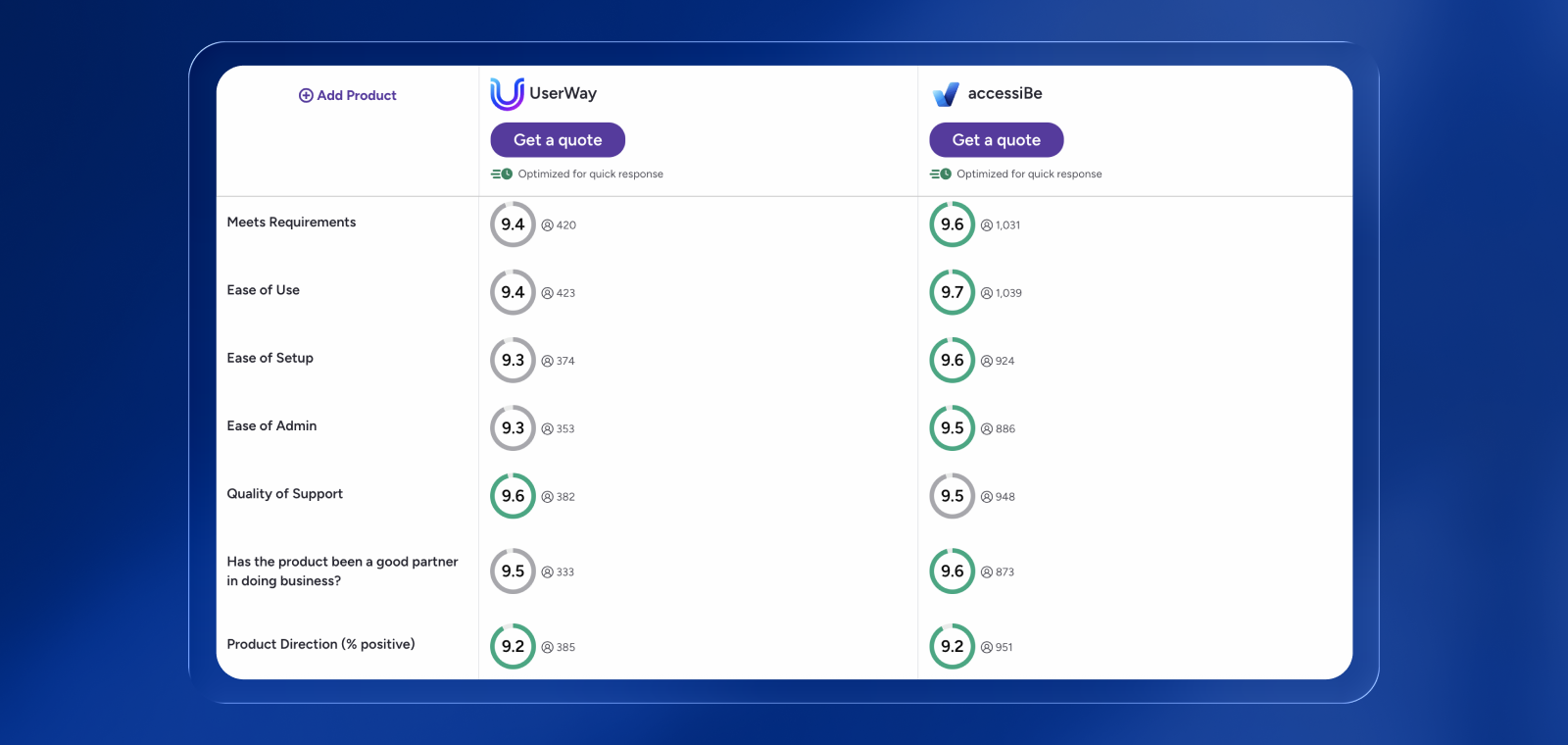
On G2, accessiBe holds a higher Meets Requirements rating than UserWay, scoring 9.6 compared to UserWay’s 9.4.
This score reflects how consistently teams feel the solution delivers on its intended purpose, without introducing friction or falling short of expectations.
Ease of use without unnecessary complexity – advantage accessiBe
Ease of use reflects how intuitive a platform feels once teams begin managing accessibility day to day. This includes how easily administrators can navigate the platform, understand available controls, and make updates without relying heavily on technical support.
On G2, accessiBe scores higher than UserWay in this category, with an Ease of Use rating of 9.7 compared to UserWay’s 8.4. This gap suggests that customers more consistently find accessiBe easier to work with over time.
For organizations without dedicated accessibility specialists, usability can have a direct impact on adoption and consistency. Higher scores here often indicate that teams can manage accessibility tasks more efficiently, with fewer internal blockers and less operational friction.
Getting up and running smoothly – advantage accessiBe
Ease of setup captures customer experience during installation, onboarding, and initial configuration. It reflects how smoothly teams can move from evaluation to implementation.
According to G2, accessiBe earns an Ease of Setup score of 9.6, compared to UserWay’s 9.3.
While both platforms are rated positively, the difference suggests accessiBe users more often experience a straightforward onboarding process.
A smoother setup phase helps teams maintain momentum and begin addressing accessibility needs sooner, without extended configuration cycles that can slow progress early on.
Simpler administration over time – advantage accessiBe
Ease of admin focuses on long-term manageability — how easily teams can maintain accessibility, monitor progress, and handle ongoing responsibilities as websites evolve.
On G2, accessiBe scores 9.5 for Ease of Admin, compared to UserWay’s 9.3.
This indicates that customers more frequently find accessiBe easier to manage as part of their ongoing operations.
As accessibility becomes an ongoing responsibility rather than a one-time project, administrative simplicity plays a meaningful role in sustainability. Platforms that are easier to manage help reduce long-term strain on internal teams and make consistent accessibility efforts more achievable.
A reliable partner over time – advantage accessiBe
This category reflects how customers feel about the overall business relationship with a vendor, including communication, reliability, and how easy the company is to work with over time.
According to G2, accessiBe scores higher than UserWay here, with a rating of 9.6 compared to UserWay’s 9.5.
While both platforms are rated positively, the data suggests accessiBe customers more consistently view the company as a dependable long-term partner.
Scores in this category are shaped by ongoing interactions rather than one-time experiences. A higher rating often reflects consistency in day-to-day collaboration and how well a provider supports teams as their accessibility needs evolve.
Confidence in product direction – advantage accessiBe
Product direction reflects how confident customers feel about where a platform is headed. It captures whether users believe the product is continuing to evolve in ways that align with their needs and expectations.
On G2, accessiBe scores higher than UserWay in this category, with a Product Direction rating of 9.2 compared to UserWay’s 9.1 – indicating stronger customer confidence in accessiBe’s ongoing development and future trajectory.
For teams thinking beyond immediate implementation, product direction can be an important signal. Accessibility is an ongoing effort, and confidence in how a platform will continue to grow often plays a role in long-term decision-making.
Quality of support – advantage UserWay
Quality of support reflects how customers rate their interactions with a vendor’s support team, including responsiveness, clarity, and overall helpfulness.
On G2, UserWay scores higher in this category, with a Quality of Support rating of 9.6 compared to accessiBe’s 9.5. Both platforms receive strong feedback overall, but UserWay holds the lead based on customer-reported support experiences.
This category reflects customer perception of support interactions rather than product capabilities, and the close scores indicate that users of both solutions generally report positive outcomes when engaging with support teams.
Going beyond G2 reviews: how to select the platform that best fits your needs

G2 reviews offer an objective way to understand how customers rate their experience with an accessibility solution. But for most organizations, review scores are only one part of the decision.
Once the data is clear, the next step is evaluating how a platform supports accessibility in practice — not just at launch, but as websites grow, content changes, and requirements evolve. That’s where overall platform design and long-term operational fit become critical.
accessiBe is built as a comprehensive accessibility solution that combines automation, developer tooling, and expert services within a single ecosystem. This approach is designed to support accessibility as an ongoing effort, rather than a one-time implementation.
Supporting accessibility from day one — and over time
AI-powered accessibility automation
accessWidget uses AI-driven processes to identify and address accessibility issues at scale. It supports compatibility with assistive technologies such as screen readers and enables keyboard-only navigation, both foundational elements of accessible digital experiences. Visitors can also activate an accessibility interface that allows them to personalize visual and interaction settings based on their individual needs.
For more complex or highly customized websites, accessWidget can be further refined through manual review and targeted adjustments, allowing its AI to better support essential user journeys like navigation, forms, and transactional flows.
Developer-focused accessibility tools
For teams that want accessibility embedded directly into their development process, accessFlow provides a developer-first approach. The platform highlights accessibility issues at the code level and offers clear, actionable guidance to support remediation. Its SDK enables testing throughout the development lifecycle, while MCP support allows developers to address accessibility issues directly within their IDE — making accessibility part of everyday development work.
Expert services
accessiBe also provides access to expert-led services, including manual audits, PDF and online document remediation, VPAT support, and usability testing conducted by people with disabilities. These services help organizations tackle accessibility challenges that extend beyond automation and establish stronger long-term governance.
Support when legal action arises
When accessibility-related legal action occurs, accessiBe offers a dedicated Litigation Support Package designed to help organizations respond with structure and clarity. This includes guidance throughout the legal process, documentation that demonstrates ongoing accessibility efforts, and hands-on assistance tailored to the situation.
If you’re looking for an accessibility solution that fits into existing workflows, works alongside your current design, and supports your team when challenges arise, accessiBe is designed to support accessibility end to end.