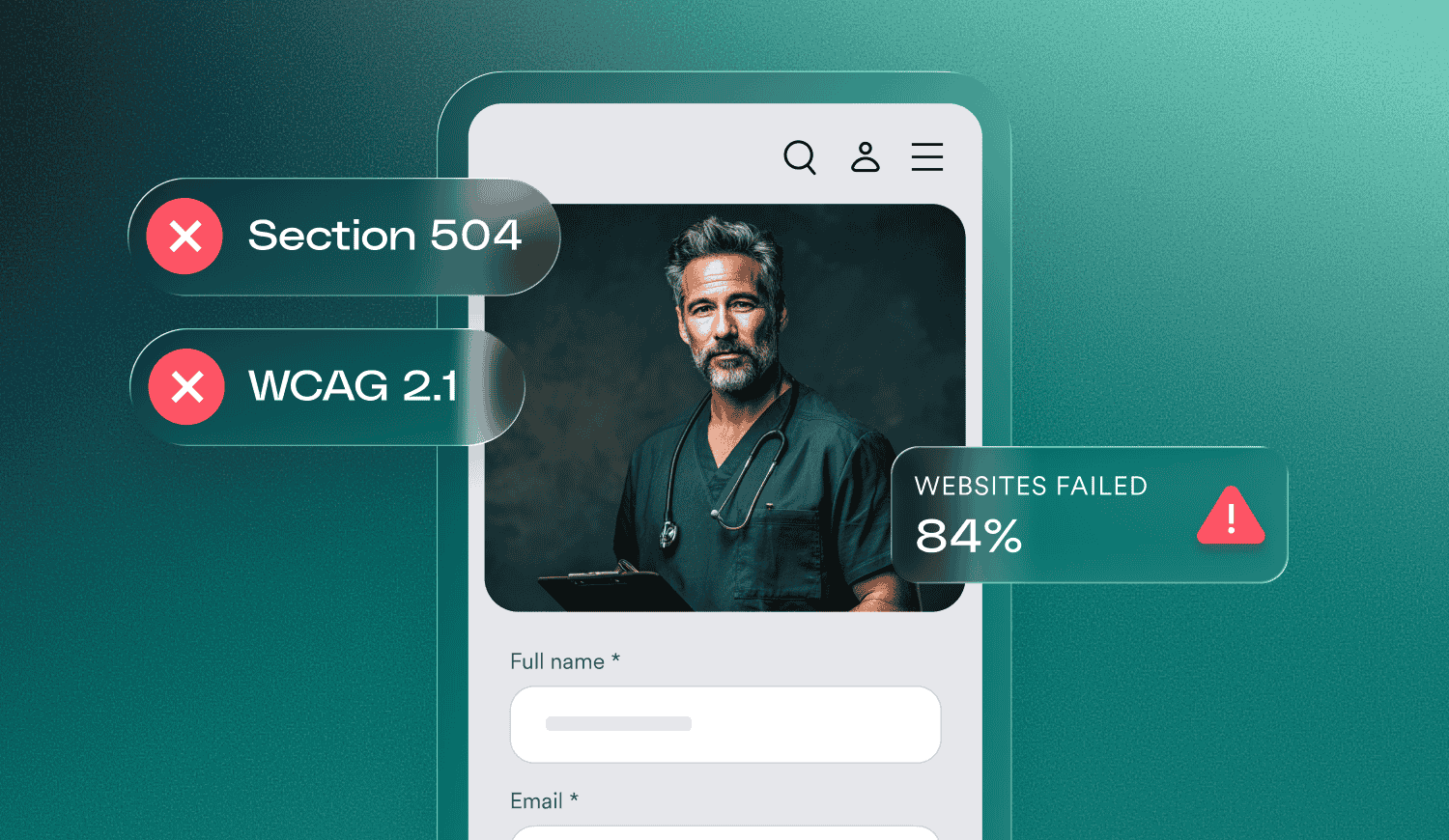
Section 504 of the Rehabilitation Act of 1973 is a federal civil rights law that prohibits discrimination against individuals with disabilities in any program or activity that receives federal financial assistance. It predates the ADA by nearly two decades and was the first federal law to establish that disability discrimination — including the failure to provide accessible communication and technology — is a civil rights violation, not just a matter of accommodation.
Section 504 applies broadly: public school districts, colleges and universities that accept federal funding, hospitals and healthcare providers that participate in Medicare or Medicaid, and any state or local agency receiving federal dollars all fall under its scope. In the digital context, this means websites, patient portals, learning management systems, and electronic communications operated by these entities must be accessible to people with disabilities.
Who Section 504 applies to
Section 504’s reach is tied to the recipient of federal funds, not the size or type of organization. Covered entities typically include:
- K-12 school districts that receive federal education funding
- Colleges and universities participating in federal financial aid programs
- Hospitals, clinics, and healthcare systems that accept Medicare or Medicaid reimbursement
- State vocational rehabilitation agencies
- Any other recipient of federal grants, contracts, or financial assistance
This is a broader net than Section 508, which applies specifically to federal agencies and their contractors. A private hospital that never contracts directly with the federal government can still be covered by Section 504 simply because it accepts Medicaid payments.
Section 504 and web accessibility
Section 504 itself doesn’t name a specific technical standard the way some newer regulations do. That changed with the Department of Health and Human Services’ 2024 update to Section 504, which adopted WCAG 2.1 Level AA as the technical standard for web content and mobile apps operated by covered healthcare entities.
The compliance deadline extension
The rule originally set a compliance deadline of May 11, 2026, for recipients with 15 or more employees, and May 10, 2027, for smaller recipients. On May 7, 2026 — four days before that first deadline — HHS announced that the deadline was pushed back by a year, citing implementation obstacles like PDF remediation backlogs and third-party vendor dependencies. The revised deadlines are now May 11, 2027, for organizations with 15 or more employees and May 10, 2028, for those with fewer.
The extension moved the compliance dates, not the underlying obligation — Section 504’s non-discrimination requirement has applied since 2024, and the technical standard itself is unchanged. HHS also aligned the timing with the Department of Justice’s own one-year extension of the ADA Title II web accessibility rule, issued in April 2026 — relevant for organizations covered by both laws at once, like public hospitals and public universities.
Section 504 vs. the ADA
Section 504 and the ADA are closely related but not identical:
- Scope: Section 504 applies only to recipients of federal funding. The ADA — specifically Title II and Title III — applies much more broadly, covering state and local governments and private businesses open to the public regardless of federal funding.
- Enforcement: Section 504 complaints are typically handled by the federal agency that provided the funding (for example, HHS for healthcare, the Department of Education for schools). ADA claims are more commonly litigated in federal court.
- Technical standard: Section 504 now explicitly references WCAG 2.1 Level AA for healthcare entities. The ADA does not explicitly mandate WCAG, though U.S. courts and the Department of Justice frequently reference it as the standard for compliance in ADA-related cases.
In practice, many organizations — hospital systems especially — are subject to both laws simultaneously, since a hospital can be both a recipient of federal funds (triggering Section 504) and a place of public accommodation (triggering ADA Title III).
Section 504 compliance for healthcare organizations
Healthcare has become the sharpest focus of Section 504 enforcement, driven by the growth of patient portals, telehealth platforms, and digital intake systems. The extended deadlines give covered organizations more runway, but not a reason to delay — remediation at scale, particularly of PDFs and third-party vendor tools, typically takes longer than expected. For a healthcare organization, Section 504 compliance typically involves:
- Ensuring patient-facing websites and portals conform to WCAG 2.1 Level AA
- Making mobile apps used for scheduling, billing, or care management accessible
- Providing accessible electronic health records interfaces where patients interact with them directly
- Auditing vendor-supplied digital tools, since a covered entity can be held responsible for accessibility gaps in third-party software it uses
Meeting these requirements generally calls for a combination of automated remediation, developer-level testing, and expert manual evaluation, since no single method reliably catches the full range of WCAG success criteria. accessWidget helps address the most commonly failed criteria — screen reader and keyboard navigation barriers — on a session-by-session basis, while accessFlow gives development teams a way to catch WCAG issues in code before they reach production. For healthcare organizations facing enforcement deadlines, accessServices’ VPAT and expert audit offerings provide the documentation and manual evaluation that automated tools alone can’t cover.
What happens when a covered entity is non-compliant
Because Section 504 enforcement typically runs through the federal funding agency, non-compliance can put an organization’s federal funding itself at risk, in addition to exposing it to civil litigation. The Office for Civil Rights at HHS, for example, can investigate complaints, require corrective action plans, and in serious cases move to terminate federal funding — a more severe practical consequence than what most ADA Title III cases carry, where remedies are typically limited to injunctive relief and attorney’s fees.
How accessiBe’s platform supports Section 504 compliance
Meeting Section 504’s requirements across a complex healthcare environment calls for a platform combining the best in AI automation, developer tools, and human expertise — not any single solution on its own. accessWidget — accessiBe’s AI-powered accessibility interface — helps address the most commonly failed criteria, including screen reader and keyboard navigation barriers, on a session-by-session basis across a healthcare organization’s public-facing web properties. accessFlow gives development teams a way to catch WCAG issues in code before they reach production, building the documented remediation history that supports a defensible compliance program. And for healthcare organizations facing enforcement deadlines, accessServices’ VPAT and expert audit offerings provide the documentation and manual evaluation that automated tools alone can’t cover.