Why digital accessibility still lags behind awareness
Fifteen years ago, Global Accessibility Awareness Day (GAAD) started with a simple idea: get more people thinking about digital access and the more than one billion people with disabilities navigating the web every day.
That part worked. But the environment has changed. Digital experiences are being built and shipped faster than ever, and accessibility has not kept pace. Generative AI has made it easier than ever to spin up a website, generate content, and deploy new features quickly. That’s genuinely useful — and it’s also producing more digital surface area, faster, than any previous moment in history. Most of that content isn’t being built with accessibility in mind.
The result: is a web that is growing faster than it is becoming more inclusive.
At the same time, new regulations are raising the stakes. The European Accessibility Act (EAA) which went into effect in June 2025, now requires businesses operating in the EU to meet accessibility standards across digital products and services. In the U.S., ADA-related digital accessibility lawsuits continue to rise, and Section 504 compliance remains a critical requirement in healthcare. These regulations make the connection between user experience, legal exposure, and brand perception harder to ignore.
That gap is where we’ve been focused.
What changed when we started listening differently
When I joined accessiBe, I spent my first months listening closely to customers, partners, developers, members of the disability community, and our own team. Not in a single setting, but across conversations that looked very different from each other.
Some of those conversations required more than listening. They required showing up in a different way.
One of the most important steps was launching our Product Advisory Board during last year’s GAAD. I approached it with a simple mindset: if we were serious about improving accessibility outcomes, we needed ongoing input from people working closest to the real-world challenges — and we needed to actually listen to it.
I spent time with Adrien Levinger, CEO of FAV Solution, a long-time agency partner that works closely with eCommerce brands, to understand how accessibility shows up in real client delivery and where it creates friction in practice.
And in collaboration with the team at VGM Forbin, I was invited to co-present at Medtrade on how accessibility is tied directly to compliance requirements, including Section 504 for healthcare organizations, and to how accessibility solutions perform in real environments.
Across those conversations, three things came up consistently.
Accessibility is not a static problem. Websites evolve constantly, and every update introduces new risks. What meets expectations today can fall short tomorrow. That challenge is accelerating as generative AI and rapid development workflows make it easier than ever to build and ship digital experiences, often without accessibility being built in from the start.
Automation is necessary, but not complete on its own. It provides scale and consistency, but modern websites are too dynamic, with evolving user flows and integrations, for any single approach to fully address accessibility.
And teams are not looking for additional tools to manage. They are looking for a way to make accessibility sustainable without adding operational overhead.
Those inputs shaped how we approached the next phase of the company.
accessiBe 2.0: An integrated accessibility and compliance platform
For many, accessiBe is still synonymous with accessWidget, our AI-powered automation. I understand why — and that foundation remains a part of what we do. For the enormous number of sites being built quickly today, including those generated with AI tools, accessWidget continues to be one of the most efficient ways to work toward WCAG 2.2 conformance at scale.
But here is what I’ve come to believe over the past year: the experiences we need to make accessible are constantly evolving.
The accessibility community has long argued that automation isn’t enough. We agree – especially in this era of generative AI content, where new pages, components, and interactions are deployed daily.
Over the past year, we’ve built an end-to-end accessibility platform. Not a set of disconnected tools, but a platform designed to support accessibility across the full lifecycle of websites, apps, and digital products:
AI-powered automation provides continuous coverage, applying fixes at scale and adapting as websites change.
Expert accessibility services introduce the human layer, including manual audits, remediation, VPATs, and litigation support for more complex or high-stakes compliance scenarios.
Developer tools bring accessibility into the development workflow. With accessFlow’s MCP (Model Context Protocol) integration, developers get accessibility guidance directly inside tools like Cursor and GitHub Copilot, while ticketing system integrations help move issues from discovery to remediation without losing momentum.
Each layer addresses a different part of web accessibility, from automated scanning and remediation to expert review and developer workflow integration — all from one platform.
Who is shaping accessiBe’s platform
The most meaningful shift isn’t just in how the platform is structured. It’s in who is involved in building it.
Our Product Advisory Board, launched during last year’s GAAD, brings together accessibility advocates and compliance experts whose input directly informs product decisions.
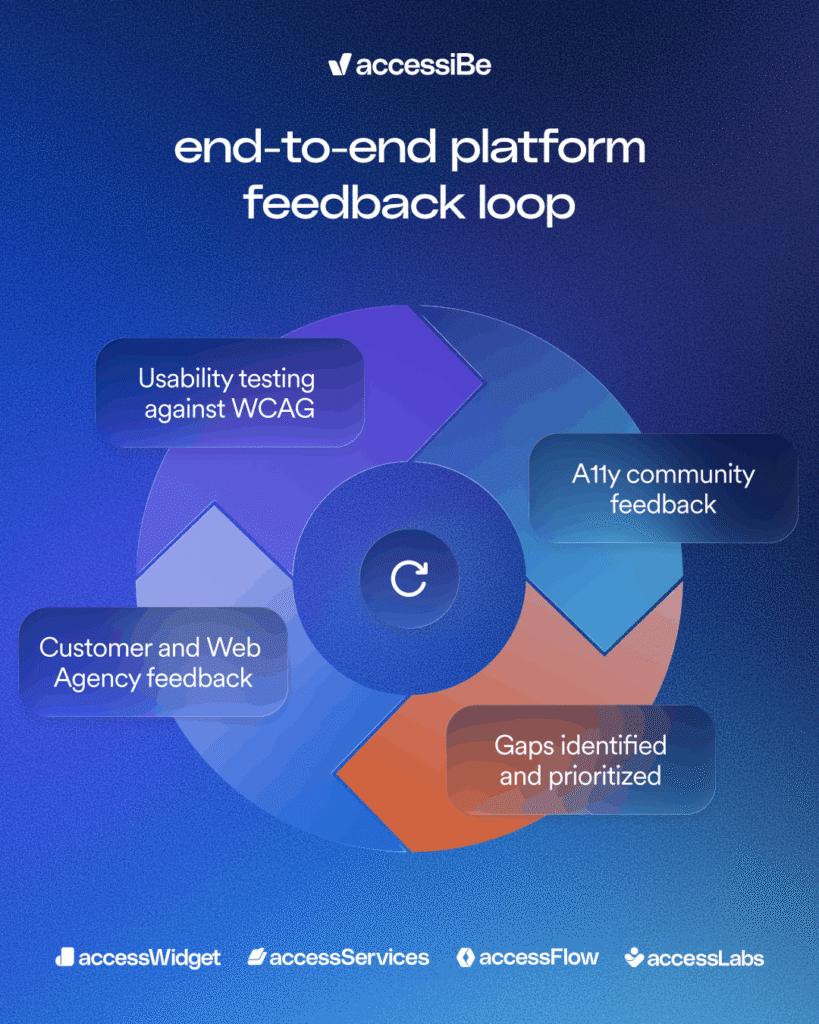
accessLabs operates as an embedded function within our product workflows, with a team of blind usability analysts testing our tools daily using real assistive technologies and real-world scenarios. Their feedback identifies gaps that automation alone cannot surface — and it holds us accountable to the people this work is actually for.
That is the loop we are working to run consistently, across every part of the platform.
What GAAD means to us this year
GAAD has played an important role in building awareness over the past fifteen years. At this point, its role is more revealing.
It creates a moment where companies, developers, and the broader accessibility community are aligned around the same question. Not whether accessibility matters, but what is actually being done about it.
I’ll be candid. GAAD can become performative: You publish something, change a logo, and move on.
This year, we’re using GAAD to show our work and deliver value to help businesses move forward. Because accessibility isn’t a moment. It’s something that gets built over time, across teams, systems, and decisions.
Accessibility is not something that can be completed and set aside. It requires continuous attention, structured processes, and the right combination of automation and human input to remain effective over time.
That is what we have been building toward over the past year. And GAAD is a good moment to show that work.
Frequently asked questions
Q1. What is Global Accessibility Awareness Day?
A1. Global Accessibility Awareness Day (GAAD) is an annual event focused on building awareness around digital access and the more than one billion people worldwide living with disabilities. Over the past fifteen years, it has helped move accessibility into mainstream conversation across technology, business, and design.
Q2. What is accessiBe 2.0?
A2. accessiBe 2.0 reflects how the company operates today. It is an integrated approach to accessibility and compliance that combines automation, human expertise, and developer tooling into a single system.
Q3. What is accessLabs?
A3. accessLabs is a team of blind usability analysts embedded within accessiBe’s product and services workflows.
Q4. How is accessiBe different from other accessibility solutions?
A4. Most accessibility solutions focus on one part of the problem, whether that’s automation, audits, or developer tools. accessiBe brings all three together into a single system, combining automation, expert services, and developer integration. It’s also shaped by ongoing input from the Product Advisory Board and Nonprofit Program, ensuring the platform reflects real-world accessibility needs, not just technical requirements.
Q5. What accessibility regulations should businesses know about in 2025–2026?
A5. Key regulations driving digital accessibility requirements include the Americans with Disabilities Act (ADA), Section 504 of the Rehabilitation Act (particularly relevant for healthcare), Section 508 for federal agencies, and the European Accessibility Act (EAA), which went into effect across the EU in June 2025. Together, these laws are increasing legal exposure for organizations whose websites and digital products are not accessible.
Q6. Why is web accessibility important for SEO / AIO-GEO?
A6. Accessible websites tend to perform better in search. Many WCAG best practices — like proper heading structure, descriptive alt text on images, clear link text, keyboard navigability, and semantic HTML — also align with search engine optimization fundamentals. Making your site accessible can improve crawlability, user experience signals, and overall organic visibility.