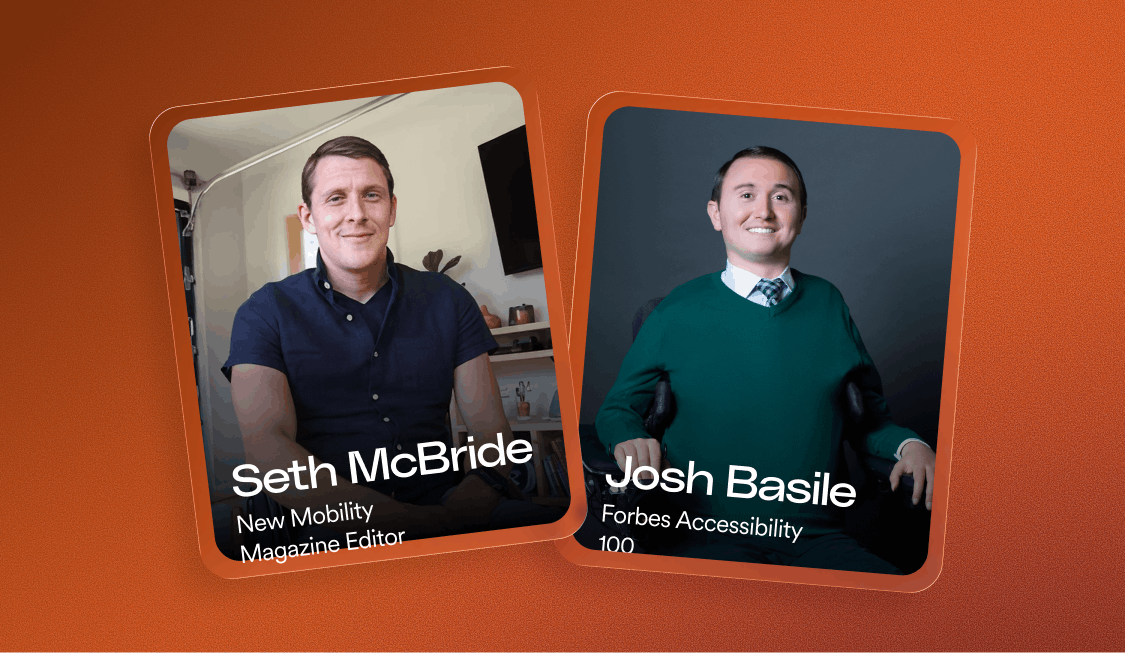
This blog is part of our GAAD (Global Accessibility Awareness Day) series spotlighting members of accessiBe’s Inclusive Product Advisory Board — disability community leaders and advocates helping shape how accessibility is built in practice. Advisory board sessions are moderated by Josh Basile, accessiBe’s Community Relations Manager, C4-5 quadriplegic, and disability rights advocate.
Meet Seth McBride, Director of Digital Content Strategy, New Mobility Magazine
Seth McBride has spent his career at the intersection of disability, journalism, and community. He is the Director of Digital Content Strategy at New Mobility — the leading magazine for the wheelchair user community — where he produces written features, newsletters, product coverage, and YouTube videos. He first wrote for New Mobility in 2011, with a story about touring Ireland by handcycle. He now leads the digital content strategy for the publication, shaping how the wheelchair community sees itself reflected in media.
Seth also serves as Senior Director of Communications at United Spinal Association, one of the country’s leading disability advocacy organizations representing people with spinal cord injuries and disorders.
He is a wheelchair user himself — which means his advisory board contributions come from both the storyteller’s perspective and the lived experience of navigating the web with a disability. He lives in White Salmon, Washington with his wife and two young children.
United Spinal Association serves more than 55,000 members and supporters across the country, providing advocacy, peer support, and resources for people with spinal cord injuries and disorders and their families. Its mission is to improve the quality of life for all people living with spinal cord injuries and disorders.
What accessibility barriers do people with spinal cord injuries face online?
Spinal cord injuries vary enormously in their impact. United Spinal Association’s membership spans a full range of mobility challenges — from people who type with one finger, to those using mouth sticks, to those using voice control, to those using fully automated adaptive technology. Design decisions can make the difference between full participation and exclusion.
Josh Basile, accessiBe’s Community Relations Manager and a C4-5 quadriplegic who uses a power wheelchair and a click stick, experiences this directly every day. He uses the accessWidget’s hide images and read mode settings to navigate websites more intuitively — stripping away visual clutter so he can scroll through content without having to tab through every element on the page.
What makes Josh’s perspective particularly valuable is that his access needs don’t fit a single category. He has a mobility disability — but he has also lived with a reading disability and ADHD since second grade. The web doesn’t know that. Most accessibility tools don’t account for it either.
That observation cuts to the heart of what the advisory board is trying to solve: not just whether a feature exists, but whether the people who need it can find it, recognize it, and use it without needing to already know what to look for.
But Seth’s perspective adds a dimension that goes beyond the technical. As someone who has spent years telling the stories of people with disabilities, he is acutely aware that language creates barriers too. Descriptions that define users by their diagnosis rather than their needs, profiles that assume a standard experience, content that speaks about the disability community rather than to it — these are accessibility failures of a different kind, and often harder to see.
What Seth brought to the table
Seth’s sharpest contribution to the advisory board sessions came during a discussion about how accessibility profiles are described to users. He identified a specific problem with the keyboard navigation profile — and the broader principle behind it was one the whole board recognized.
“Somebody might see that motor label and — say they’re not necessarily using keyboard navigation, say they’re using an eye tracker or some other alternative control that someone with a motor disability might use — and then they’re reading the description to go, ‘oh, is this one actually gonna do anything for me?’ It just opened up more questions for some people in the community than it answers.” — Seth McBride
The insight is precise: a label intended to help a community find the right tool was instead creating doubt about whether the tool was for them at all. The fix isn’t just rewording — it’s rethinking whether describing the technology is more useful than describing what the technology enables.
That instinct — lead with outcomes, not definitions; speak to the user, not about them — runs directly through his work at New Mobility, where the goal has always been to treat the spinal cord injury community as a full audience rather than a subject to be explained to others. It’s the same standard he brought to the accessiBe advisory board, and it’s now shaping how accessibility features are described across the accessWidget.
Seth also shared how United Spinal is integrating AI on its own: a new chatbot designed to handle simpler queries to their resource center, freeing up staff to focus on more complex cases — a practical, community-first application of technology that reflects the same values he brings to his advisory work.
The takeaway
“This is how accessibility is done correctly. It’s done with the community.” — Josh Basile
The best writing, like the best journalism, starts with the person and their experience — not the condition, not the tool, not the regulation. Seth’s work at New Mobility Magazine is a model for what that looks like in practice. His presence on the advisory board ensures that standard applies to how accessiBe communicates too.