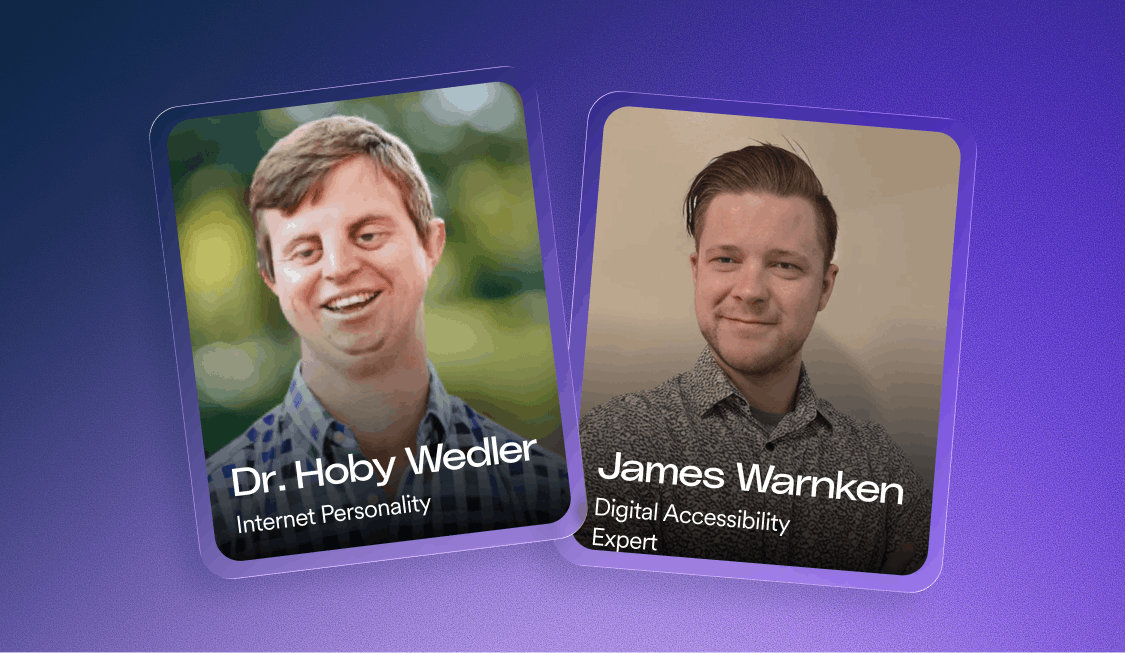
Part of our GAAD series spotlighting members of accessiBe’s Inclusive Product Advisory Board — disability community leaders and advocates helping shape how accessibility is built in practice. Advisory board sessions are moderated by Josh Basile, accessiBe’s Community Relations Manager, C4-5 quadriplegic, and disability rights advocate.
Meet James Warnken
James Warnken’s experience of blindness is different from Hoby’s in a fundamental way: he remembers what it was like to see. James was diagnosed with Stargardt’s disease at age nine — a progressive condition that has been gradually taking his vision for nearly 20 years. He started with 20/20 vision. Today he navigates the world with a cane, reads and writes Braille, and uses screen readers and Braille displays.
That arc, from full sight to the full spectrum of low vision and blindness, is what makes his perspective so precise. He is not describing a theoretical user. He is describing himself at different points in his life.
“I’ve gotten to experience the full spectrum of blindness, from 20/20 at age nine to where I’m at currently — everything in between. That’s really how I got started in this space: a pure curiosity for what other people’s experiences might look, feel, and sound like.” — James Warnken
James is based in Northeast Ohio and works as a digital accessibility trainer and consultant through his company, Clear Vision. He works with organizations across industries on accessibility education, auditing, and remediation — and increasingly focuses on helping professionals with disabilities step into careers in the accessibility field themselves.
“The thing I’m most proud of is continuing to help professionals with disabilities get their certifications and step into careers helping make the online world more accessible.” — James Warnken
What accessibility barriers do blind and low vision users face online?
The blind and low vision community is not a single experience. Someone who has been blind since birth navigates the web differently from someone who lost their vision gradually over decades. Someone with total blindness relies on entirely different tools than someone with low vision who still uses some sight. What they share is a web that was largely not built with them in mind.
Hoby’s experience of the web is built entirely around screen readers, audio interfaces, and the expectation that every piece of content will have a meaningful, accurate text equivalent.
For James, the challenge is often about magnification and reflow. He shared a calculation from his own experience that captures the gap precisely:
“On LinkedIn, when it says something’s a 3-minute read — with how big I have to magnify it, it takes me 3 to 4 times longer. A 3-minute read is actually more like a 15-minute read, because of all the tracking vertically and horizontally, because there’s no way to handle the magnification properly on such a small screen.” — James Warnken
Both perspectives point to the same underlying gap: the blind and low vision community has the technology, but what doesn’t always work is the web itself.
What Hoby and James brought to the table
Both Hoby and James brought sharp, specific feedback to the advisory board sessions — and their contributions consistently pushed toward the same principle: tools and language should serve the user, not ask the user to fit the tool.
Hoby focused on customization and clarity. The most valuable accessibility solutions, in his view, are the ones that let users define what they need rather than assuming it for them. For the blind and low vision community, the spectrum of need is wide — a tool designed for someone with total blindness may not be right for someone with low vision who needs specific contrast adjustments. Customization isn’t a nice-to-have. That’s the whole point.
He also raised a language point that the board took seriously: the term “visually impaired” is one the community has been moving away from in favor of “low vision” — a distinction that matters to the people those features are meant to serve.
“The community has in the past had a gripe with ‘vision impairment,’ and it’s changing — we really want to try to replace that with ‘low vision.'” — Dr. Hoby Wedler
James pushed on consistency. He noted that when accessibility profiles use inconsistent language — mixing “disability,” “disorder,” and “challenges” — it signals to the community that the tool wasn’t built with them in the room. He also made a practical point about how profiles should be described: organize them around how someone interacts with a device, not around their diagnosis.
“The disability community can be particular about which words are used. I would lean towards using the same set of descriptors throughout all of the descriptions — so you’re not creating that sense of exclusion. ‘I have Stargardt’s, I don’t see Stargardt’s in there, it must not be for me.'” — James Warnken
Together, their contributions shaped how accessiBe thinks about language, customization, and the spectrum of need within a community that is often treated as a single category.
accessLabs: testing with the community, not just for it
The blind and low vision community doesn’t just inform accessiBe’s products through the advisory board. It actively tests them. accessLabs is accessiBe’s in-house team of usability testers — people who use assistive technology every day and bring that lived experience directly to the product development process. The team is currently hiring, and is looking for screen reader users with usability testing experience.
That direct feedback loop — from community to product and back — is what separates accessible design from performative compliance. Hoby and James represent the advisory end of that loop. accessLabs represents the testing end. Both are essential.
The takeaway
Blind and low vision users are not a monolithic group. They are scientists, consultants, creators, and advocates — people who have built full lives around technology that was not designed for them, and who have every right to expect that the web gets better. Hoby and James bring that expectation to the advisory board, and their contributions are shaping tools that serve the full spectrum of what it means to be a blind or low vision user of the web.