Part of our GAAD series spotlighting members of accessiBe’s Inclusive Product Advisory Board — disability community leaders and advocates helping shape how accessibility is built in practice. Advisory board sessions are moderated by Josh Basile, accessiBe’s Community Relations Manager, C4-5 quadriplegic, and disability rights advocate.
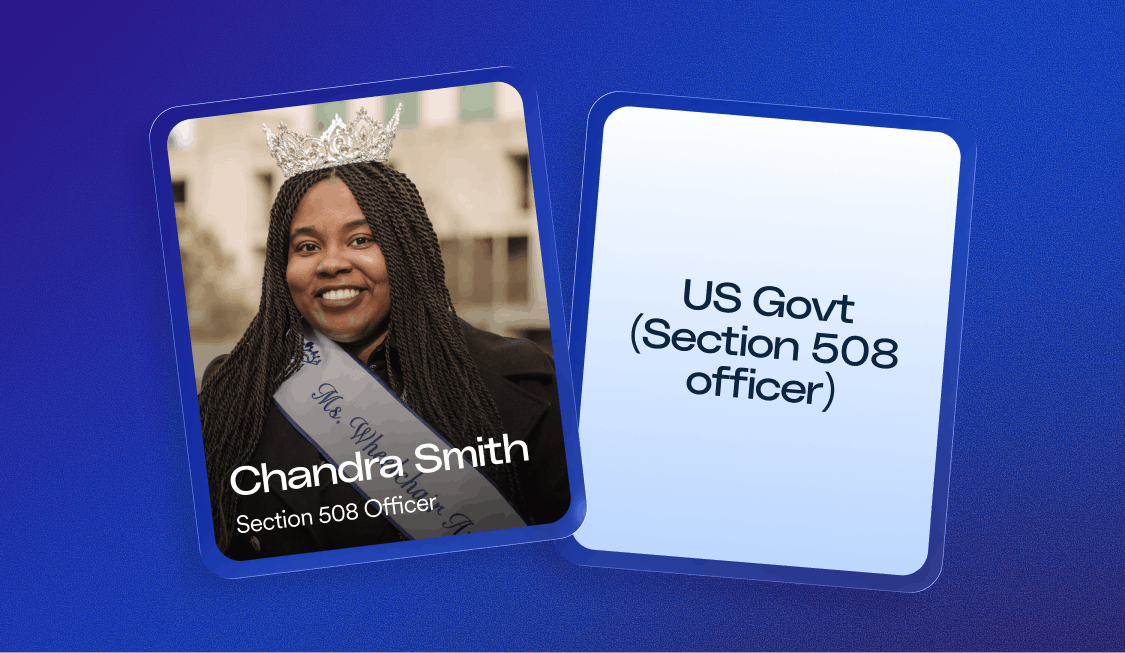
Meet Chandra Smith, Section 508 officer at the Defense Intelligence Agency
Chandra Smith is an IT engineer and Section 508 Compliance Officer responsible for ensuring that digital systems, content, and communications are accessible to people living with disabilities.
Section 508 of the Rehabilitation Act requires federal agencies to make their information and communication technology accessible. This includes websites, internal tools, electronic documents, and video content. In practice, this means ensuring that people can access information using assistive technologies like screen readers, keyboard navigation, and captions.
Chandra was already working in the accessibility field when she acquired her disability after surviving sepsis and a stroke, which resulted in her becoming a triple amputee. That shift changed how she experienced the very systems she helps shape.
“When I was in the hospital, I went to the computer lab and that trip was very different for me. I realized then how significant the barriers in digital accessibility truly are.” — Chandra Smith
Lived experience reframed her mission
Chandra’s expertise is not limited to the technical side of IT. She is also Miss Wheelchair America 2024, using her platform to advocate for accessibility across policy, technology, and community spaces. Whether she is navigating her 4 a.m. routine or a multi-step commute across D.C., Chandra views her daily life as a proof of concept for universal design. Her perspective is a reminder that accessibility isn’t just a digital feature — it is a fundamental part of independence and dignity.
What accessibility barriers do people with disabilities face online?
The digital accessibility landscape is vast.
In the federal sector, while Section 508 has been law since 1998 (and updated in 2018 to align with WCAG), a gap between policy and practice remains, creating a divide between “technical compliance” and “real-world usability.” This gap affects millions of Americans.
The result is that people are technically included, but practically blocked.
- Limb loss and dexterity: For users who don’t use a traditional mouse, a site that isn’t fully keyboard-navigable or lacks large, clickable touch targets becomes unusable.
- Legacy systems: Many public systems require complex document uploads or multi-step forms that don’t support screen readers or voice-to-text software, effectively locking people out of essential services.
- The “checklist” trap: Many organizations treat accessibility as a one-time project rather than a continuous process, leading to “performative” accessibility that doesn’t actually support the user.
These aren’t hypothetical barriers. “How can someone provide a fingerprint if they don’t have a hand?” That’s what happens when systems are designed without considering real users.
The ADA Title II deadline — which extends digital accessibility requirements to state and local governments — has been pushed back, giving organizations more time to comply. But Chandra’s message is clear: more time is not a reason to wait. The gap between policy and practice is already costing people access, and the organizations that treat the extended deadline as a starting gun rather than a finish line are the ones that will build something that actually works.
She recently contributed her perspective as a panelist on accessibility approaches, where she emphasizes that inclusion requires moving beyond a checklist and understanding how users actually interact with a site.
How Chandra is helping build a more accessible web
In advisory board discussions about how the accessWidget’s profiles and features are described to users, Chandra’s instinct was immediate: move away from the abstract and toward concrete functionality.
“Include specific examples of the assistive features—text-to-speech, simplified layouts, color contrast—so that users understand the benefits of the profile better.” — Chandra Smith
That instinct — from the what to the how, from the label to the lived experience of using it — reflects years of work translating accessibility requirements into things developers and agencies can actually act on. Her feedback is now directly shaping how accessWidget profiles are described, ensuring users understand not just what a feature is called, but what it will do for them.
Her perspective brings a discipline to the advisory board that complements the lived-experience voices: the discipline of someone who has spent years making accessibility real inside institutions that resist it.
The takeaway
Chandra’s story highlights a core truth: being disabled is a club anyone can join at any moment. By focusing on specificity, user-centeredness, and continuous improvement, we can move beyond performative compliance and toward a web that actually works for everyone.